The 5th International Symposium on Information Management in a Changing World took place in Antalya, Turkey, from 24 to 26 November 2014. To commemorate the 2014 Turkish-German Science Year, IMCW2014 was organised in cooperation with Hacettepe University and the Goethe-Institutes in Turkey.
IMCW2014 was held jointly with the 10th International Conference on Knowledge Management (ICKM2014) at the same venue so participants could attend both events.

Miracle Hotel, venue of IMCW2014
Research and innovation (R&I) is the lifeblood of development. Digital information and communication technologies (ICTs) offer tremendous opportunities to set up a truly global e-science infrastructure to foster research and innovation and facilitate sharing not only the research outputs but also the research data. The EU countries will spend some 71 billion euro for research under the Horizon 2020 program. An enourmous amount of research data gets created, collected, processed and analyzed during the research process and it has to be managed effectively. As the life of research data is far longer than the research projects themselves, preservation of, access to and reuse of research data is of great importance. Effective management of research data requires infrastructure and data repositories as well as policies and standards for metadata, interoperability, knowledge discovery and reuse. It is estimated that the effective management of research data and opening up “big data” will save Europe about 150-300 billion euro annually.
Main topics of the Symposium included:
• Research Data
• Research Data Infrastructure
• Research Data Management
• Open Access to Research Data
• Knowledge Discovery in Research Data
• Education for Research Data Management
 Research Data Management and Knowledge Discovery being the main theme of the Symposium, IMCW2014 aimed to bring together researchers, data scientists, computer engineers, data repository managers, information scientists and information professionals, data librarians and archivists to discuss the issues pertinent to research data management and open data repositories and to contemplate on how to design and develop innovative and collaborative knowledge discovery and mining services over the research data. This was an opportune time for IMCW2014 to tackle the challenges of research data management and knowledge discovery, ranging from research data infrastructure to metadata standards, from current research information systems to open source data management systems, from research data journals to metrics and from knowledge discovery techniques to semantic enrichment of research data.
The Organising Committee of IMCW2014 invited interested individuals, research teams, societies and project groups to submit proposals for workshops and tutorials to be organised within the conference.
To encourage participation, IMCW2014 did not charge additional fees for participants registered in the conference to attend workshops/tutorials and proposers of accompanying events with at least four registered speakers/participants had their Symposium fee waived.
Download the Call for Workshop and Tutorial Proposals here
Keynote speakers of IMCW2014 will be:
• Kevin Ashley, Director of the UK Digital Curation Centre
Mr. Ashley has been responsible to increase the enabling capacity and capability of DCC amongst the research community in matters of digital curation, as the DCC was set up by JISC in 2004 to give practical advice and guidance to colleges and universities on digital preservation, curation and information management. His specialties are digital curation, digital preservation training, electronic record management and hybrid archives.
Earlier, Mr. Ashley worked as the Head of Digital Archives at the University of London Computer Centre (ULCC) for 13 years, during which time his multi-disciplinary group has provided services related to the preservation and reusability of digital resources on behalf of other organisations, as well as conducting research, development and training. At ULCC, Dr Ashley’s group operated the National Digital Archive of Datasets (NDAD) for The National Archives of the UK for over twelve years, capturing, preserving, describing and releasing government data.
Mr Ashley was chair of the JISC Repositories and Preservation Advisory Group and is currently a member of JISC’s Infrastructure and Resources committee. He is on the steering committee for the Archives Hub at MIMAS and the policy working group of the DL.ORG project. He was part of the task force that developed the RLG/NARA audit checklist for trusted digital repositories, and was a member of the NSF-DELOS Working Group on Digital Archiving and Preservation which produced the report “Invest To Save”.
Mr. Ashley holds a BSc degree in Mathematics from University College London.
• Professor Michael Seadle
Director of the Berlin School for Library and Information Science
Dean of the Faculty of Arts I, Humboldt University
Chair of the ISchools Caucus, Germany
Professor Seadle holds a PhD degree in Sociology from the University of Chicago and an MS degree in Information Science from the University of Michigan. He is currently Dean of the Faculty of Arts I as well as the Director of the Berlin School of Library and Information Science (Institut für Bibliotheks- und Informationswissenschaft) at Humboldt-Universität zu Berlin and serves as the chair of ISchools Caucus comprising more than 50 ISchools around the world. Prior to his current position, Professor Seadle served in various administrative capacities at the University of Chicago and Cornell University, among others, and carried out sponsored projects (LC, NSF, IMLS, DFG). He is the editor of the peer-reviewed journal “Library Hi Tech” published by Emerald. He has written more than 100 papers and authored books on long term digital archiving, computing management and copyright.
Important Dates
Last date to send all types of extended abstracts and proposals: 31 March 2014
Last date to send workshop and tutorial proposals: 10 April 2014
Authors notification: 16 May 2014
Submission of extended abstracts in final form: 16 June 2014
Submission of full papers (if desired): 16 July 2014
Notification of acceptance of full papers: 16 August 2014
Submission of full papers in final form: 16 September 2014
Registration (Early Bird): 16 Feburary 2014 – 31 July 2014
Registration (Regular): 1 August 2014 – 3 November 2014
Registration (Late / Onsite): 4 November 2014 – 26 November 2014
Symposium: 24-26 November 2014
For more information visit: http://imcw2014.bilgiyonetimi.net/scope/
View the article we published on Digitalmeetsculture.net to announce the event
 RICHES on Twitter: #richesEU





 EuroMed brings together researchers, policy makers, professionals and practitioners to explore some of the more pressing issues concerning cultural heritage today. In particular, this year the conference focused on interdisciplinary and multi-disciplinary research on tangible and intangible CH, on the use of cutting-edge technologies for protection, restoration, preservation, massive digitisation, documentation and presentation of the CH content.




 The open source semantic annotation tool Pundit is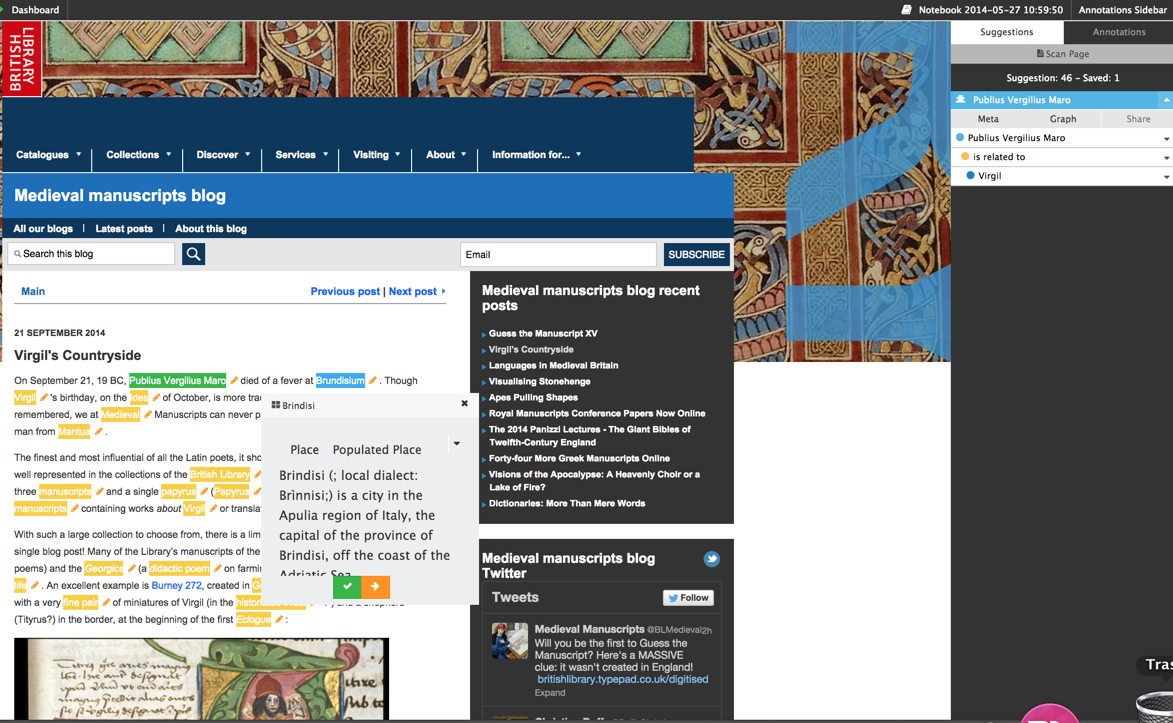
 At present, Net7 is a partner in two European-related projects (DM2E and Europeana Sounds), three ERC-funded projects (EUROCORR and ERC AdG 2011 – LookingAtWords) and in a Dissemination project (StoM – SemLib to Market). Since 2014 Net7 is also associate partner of the
 One report looks at how to digitise, make accessible and preserve culture online, the second report explains how European film heritage can be rescued from rotting cans. Digitised cultural material is a great common and free resource for developing cultural and educational content, documentaries, tourism applications, games, animations and design tools. This can help creative industries to grow beyond their current share of 4% of EU’s GDP.
 The Commission will continue to monitor progress in this area through periodic reports and by chairing the Member States Expert Group on digitisation and digital preservation and the EU Expert Group on Film Heritage. It will also monitor correct transposition of the Orphan Works Directive (transposition deadline 29/10/2014) to bring online books, press articles, films that are still protected by copyright but whose authors or other right holders are not known or cannot be located or contacted.