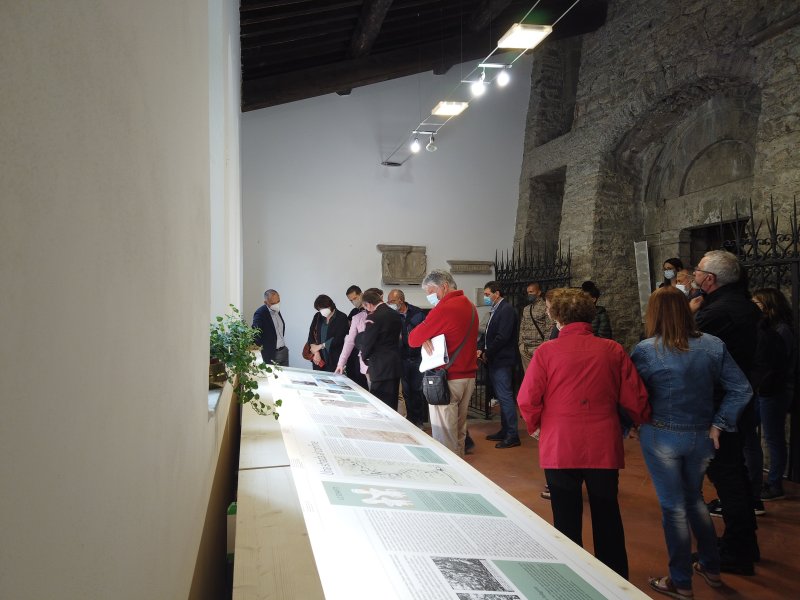
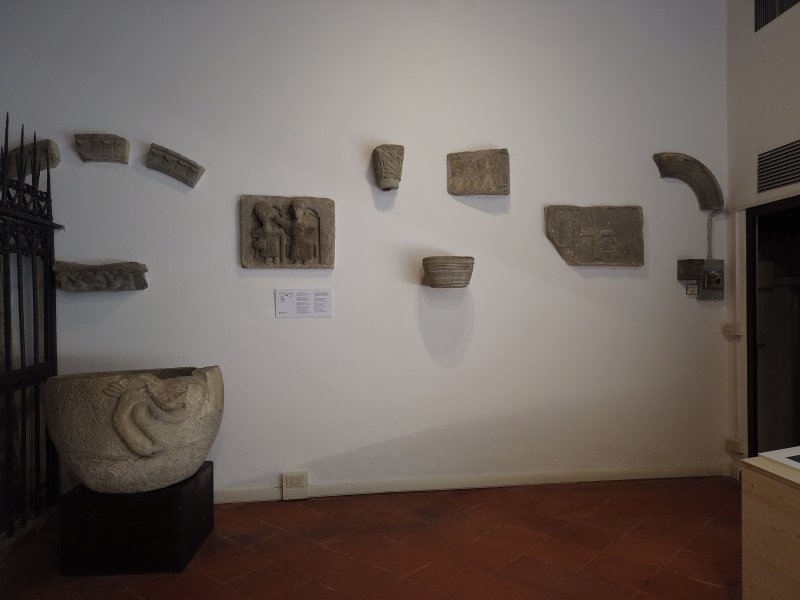
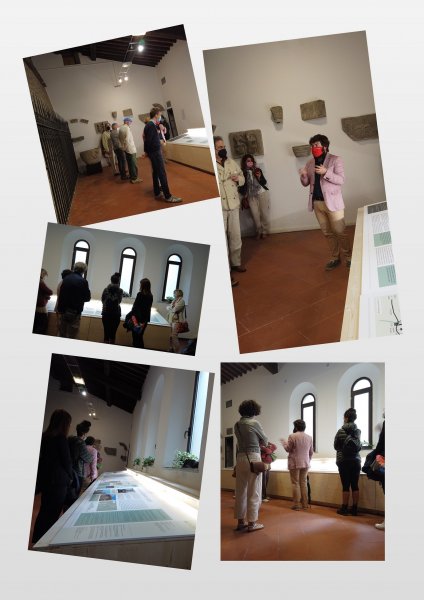
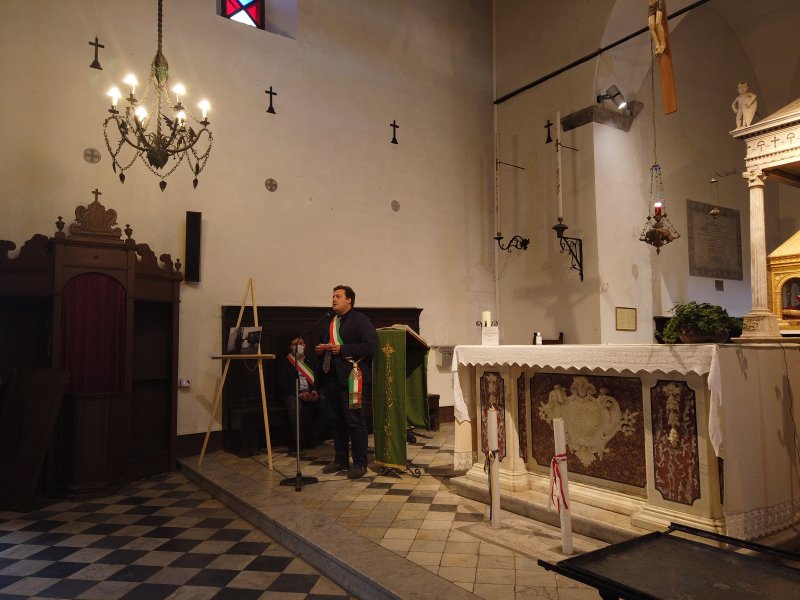
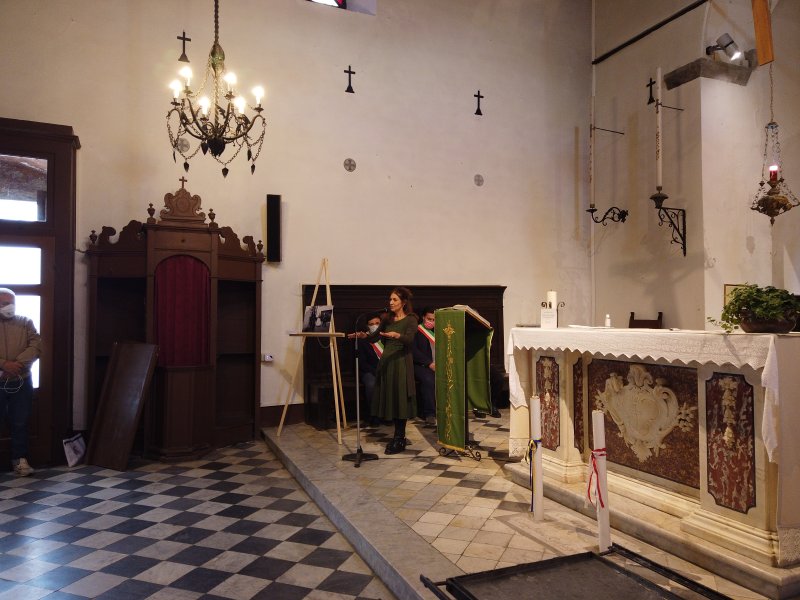
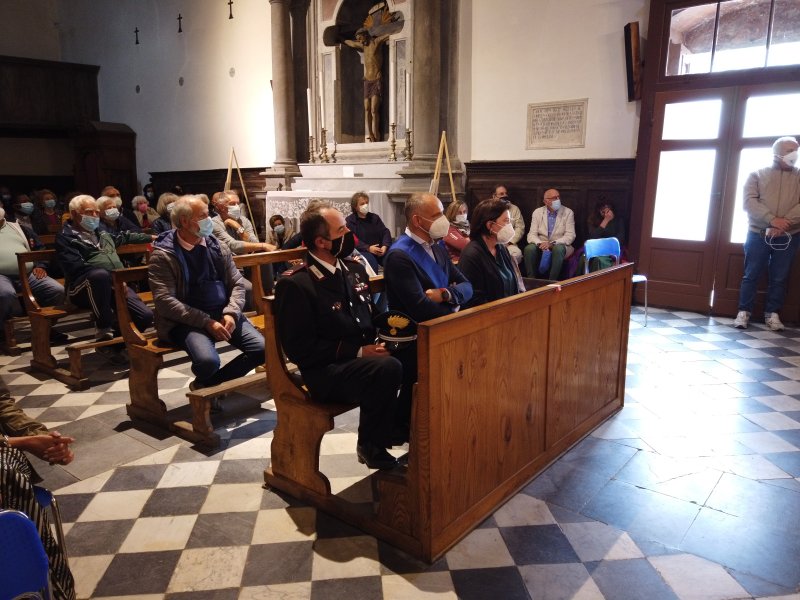
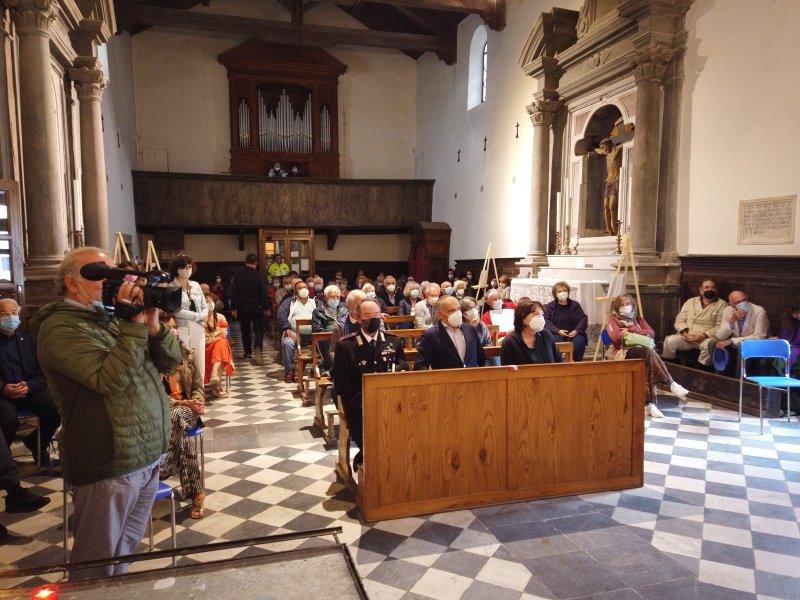
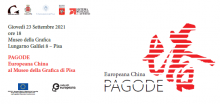
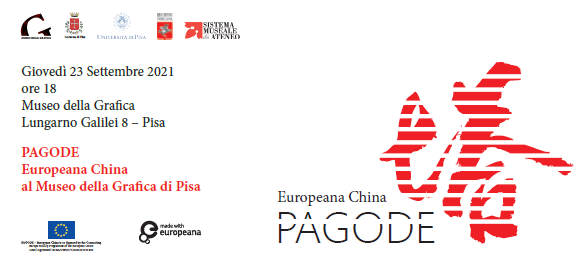
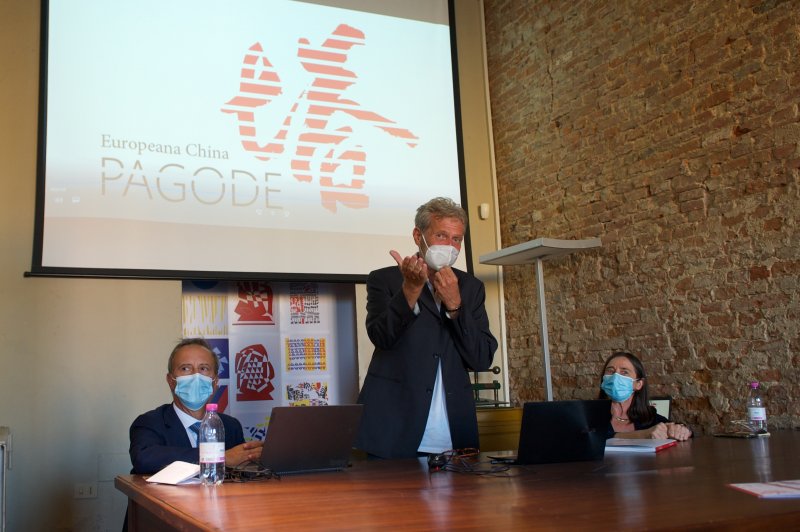
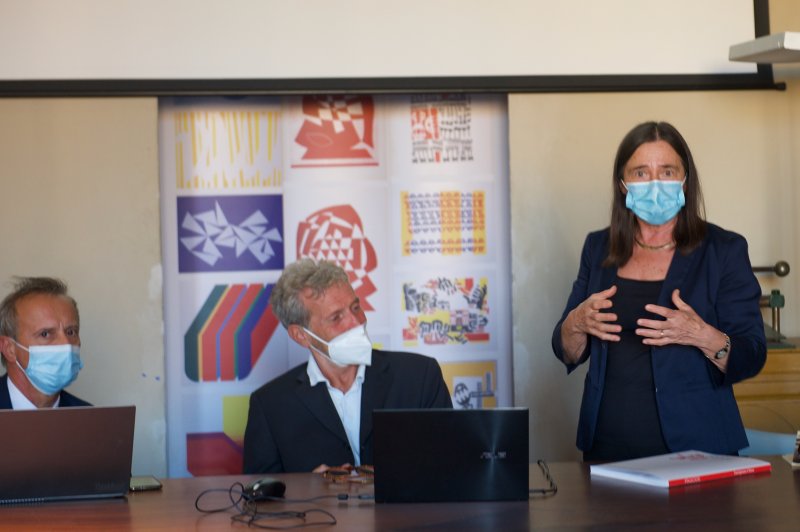
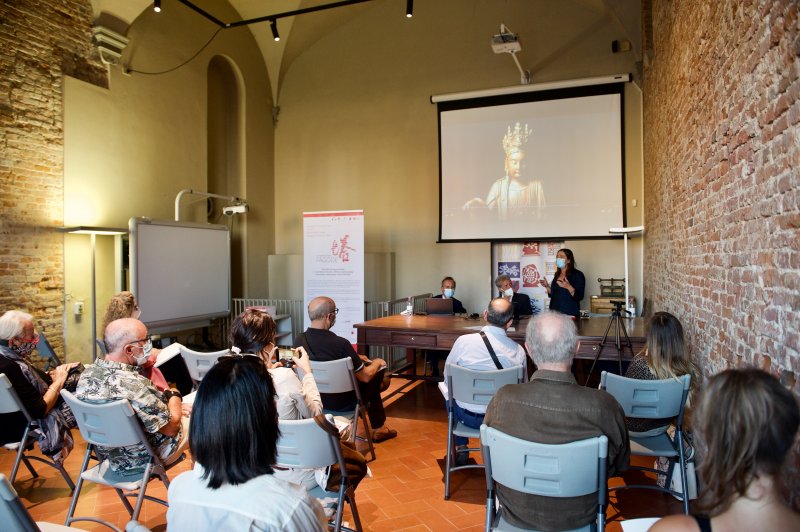
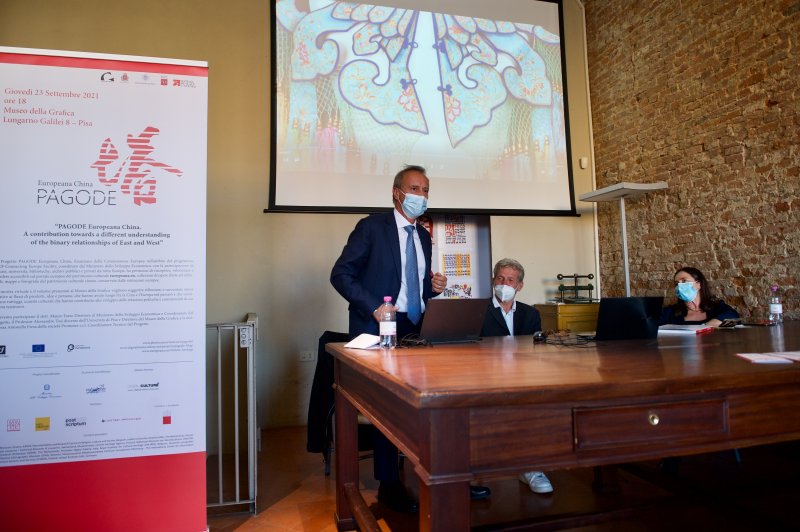
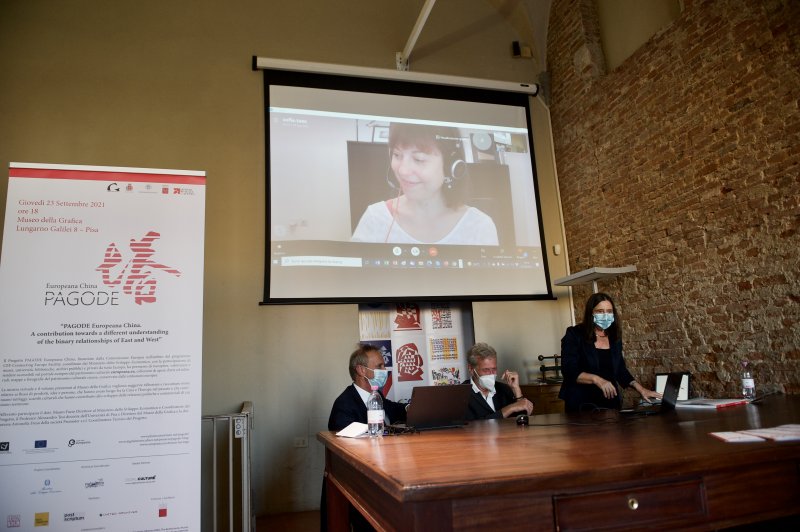
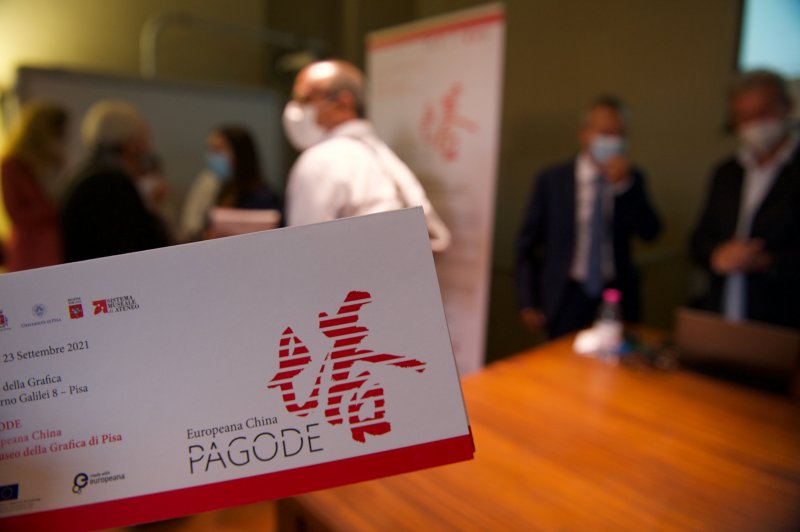
As a complementary event in the framework of PAGODE final conference, an exclusive invite-only meeting at the Museo della Grafica in Pisa was organized on 23rd September 2021, to present the two major outcomes of the project: the virtual exhibition China in Perspective, showcasing gems of chinese heritage preserved by renowned European cultural heritage institutions, and the prestigious book that accompanies the exhibition.
The project coordinator dr. Mauro Fazio of the Italian Ministry of Economic Development, the technical coordinator dr. Antonella Fresa of Promoter s.r.l. and the Museum’s director prof. Alessandro Tosi met with a selected number of stakeholders to share thoughts, experiences and impressions from this exciting project, that highlights Chinese heritage in Europe via Europeana, the digital gateway to European cultural heritage collections. Remote participation of Sofie Taes, curator of the China in perspective exhibition, allowed participants to get a glimps of the concept and rationale which drove the creation of the exhibition and the corresponsing chapter in the book.
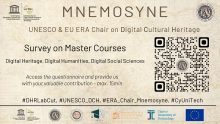
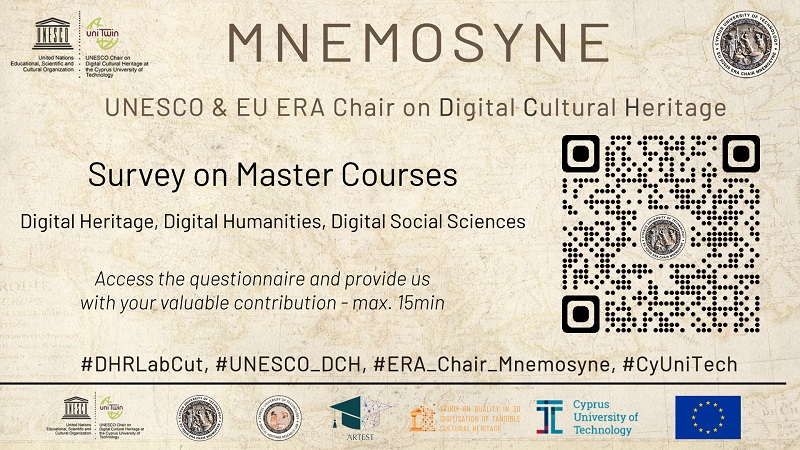
Within the framework of the UNESCO Chair on Digital Cultural Heritage at the Cyprus University of Technology, as well as the current work in different EU funded projects in the area of Digital Cultural Heritage, we are working to investigate the impact and added value on the career of all the graduated students (alumni) from Master Courses in the domain of Digital Heritage, Digital Humanities, Digital Social Sciences.
Therefore, we would like to hear from all alumni about their experiences, their knowledge, opportunities, and values gained from their studies in the different Master Courses. The survey takes max. 15 minutes.
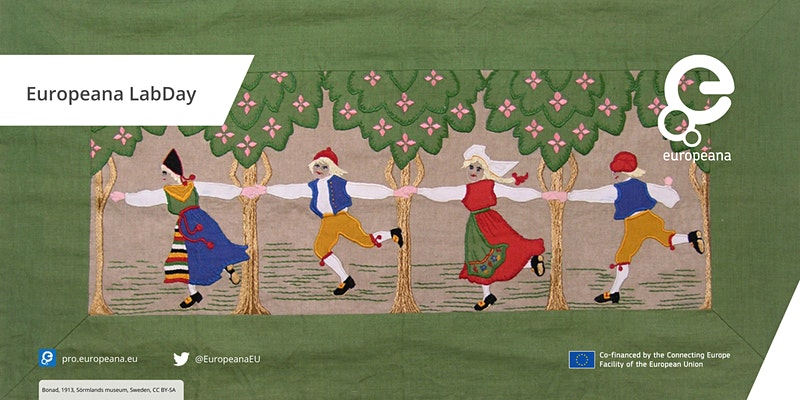
WEAVE project is organizing a series of LabDays to engage communities with their tangible and intangible heritage and present novel ways of cultural heritage representation in the digital realm.
This workshop organized by Europeana engaged minority communities and Cultural Heritage Institutions to enhance their participation in Europeana. It was moderated by the Coventry University team in conjunction with Europeana and with collaboration of Photoconsortium and KU Leuven.
In particular, this event covered 3 main topics:
Introducing what Europeana is and why it is beneficial to share cultural collections in this environment and across the Europeana network of partners, stakeholders and followers
Understanding the copyright framework that is at the basis of Europeana and the labels which are included in the Europeana Publishing Framework, so to enable content partners find the best solution to share and showcase their collections in a lawful way
Explaining Europeana’s editorial strategy and publication formats to include partners’ collections, including engagement with Europeana audiences and stakeholders and the more specific WEAVE Editorials strategy. The LabDay included interactive moments such as small polls and Q&A time.
Speakers: Alex Stan (IN2), Julia Fallon (Community & Partner Engagement at Europeana), Adrian Murphy (Collections Manager at Europeana), Ariadna Matas (Policy Advisor at Europeana), Sofie Taes (KU Leuven).
Additionally, colleagues from Photoconsortium in its role of Europeana accredited Thematic Aggregator and from the Europeana Data Publishing team were available during the LabDay, to handle any possible questions which may arise from the participants about the more technical part of metadata sharing and aggregation-ingestion of content to the Europeana infrastructure.
As Collections Manager at Europeana, Adrian Murphy develops ways of engaging audiences across Europe with the digitised cultural heritage collections found on the Europeana website. He works on participatory campaigns, audience communities and editorial strategies, as well as curating and writing editorial features such as blogs, galleries and exhibitions. Often working in partnership with cultural heritage institutions and consortia across Europe, he has worked on Europeana’s campaigns: Europeana Migration, Women’s History Season, Europe at Work, Discovering Europe and Europeana Sport. Prior to Europeana, he was the Digital Manager at south London’s Horniman Museum and Gardens where he led on digital strategy, website and social media activities.
Sofie Taes is an alumna of KU Leuven (Belgium), where she graduated in musicology and Medieval and Renaissance Studies. Currently she works at the Institute for Cultural Studies (CS Digital) at KU Leuven and at Photoconsortium – Europeana’s thematic aggregator for photography – as a digital curator. She has curated a wide range of editorials and virtual exhibitions for Europeana as well as the physical exhibitions All Our Yesterdays, Thousands are Sailing and Blue Skies, Red Panic. Currently she is active in several European projects involving digital cultural heritage and user engagement strategies, among which Europeana XX: Century of Change, PAGODE – Europeana China, WEAVE and inDICEs.
WEAVE project is organizing a series of LabDays to engage communities with their tangible and intangible heritage.
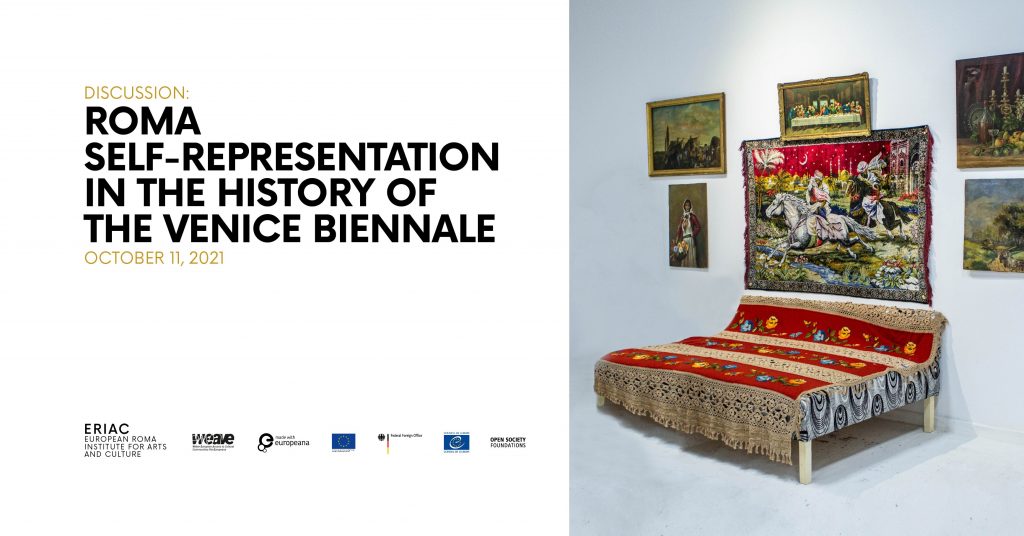
In this LabDay organized by partner ERIAC, a discussion is launched to promote a more permanent exhibition of Roma art and heritage in the context of the prestigous Venice Contemporary Art Biennale.
In the past there have been various exhibitions of Roma culture at Venice Biennale, in 2007, 2011 and 2019, which represent the greatest efforts ever made by Roma to present Roma art in an international stage in the center of contemporary cultural diplomacy.
2007: The First Roma Exhibition was established in 2007 in the frame of the 52nd Venice Contemporary Art Biennale. The exhibition, entitled Paradise Lost, curated by Tímea Junghaus, included the work of 16 Roma artists from eight European countries. It was a stance and claim in the existing frame of European Roma representation, and it proposed a transnational, contemporary and up-to-date vision for thinking about the Roma experience. It had over 200,000 visitors. The location was Palazzo Pisani S. Marina (piano nobile), Venezia, Cannaregio 6103, Calle delle Erbe, Opening period: 10 June to 21 November 2007.
In 2011, at the 54th Venice Contemporary Art Biennale, Maria Hlavajova curated the exhibition Call the Witness(based on Suzana Milevska’s original idea), with a flux of live “testimonies”— works of art, performances, talks, and conversations by and with artists, thinkers, and politicians. It engaged many distinguished non-Roma artists, writers, and curators, including Salman Rushdie and Arnout Mik. The location was Palazzo Zorzi, UNESCO Venice Office, Castello 4930, Venice, Opening period: 1 June to 9 October 2011.
2019:FUTUROMA, curated by Daniel Baker, opened in 2019 within the 58th Venice Contemporary Art Biennale. FUTUROMA featured 14 Romani artists from eight countries: Celia Baker, Ján Berky, Marcus-Gunnar-Pettersson, Ödön Gyügyi, Billy Kerry, Klára Lakatos, Delaine Le Bas, Valérie Leray, Emília Rigová, Markéta Šestáková, Selma Selman, Dan Turner, Alfred Ullrich, László Varga. The exhibition examined the role of art in the enactment of social agency through an eclectic practice interrogating contemporary art discourse and its social implications via the reconfiguration of elements of the Roma aesthetic. The location was Dorsoduro 417 (Zattere), Fondamenta Zattere Allo Spirito Santo 417, Opening period: 11 May to November 24, 2019.
In the lack of collecting, archiving and museum institutions to house artefacts once these Roma exhibitions are dismantled, their histories become vulnerable and their achievements carry on only as interpersonal – and later transgenerational knowledge, which slowly – with the means of digital remembrance – constitute a new form of intangible cultural heritage. The Roma exhibitions are not connected to the prestigious locations, and known spaces of the Venice Biennale, but to the non-spaces of digital-discussions, oral histories, letter and in-person exchange, archival documents and digital exhibitions.
The “Exhibition” of the largest European minority is considered a “collaborative event”, and not a national pavilion. Roma do not have a national pavilion/building/space, while being the largest national minority to many of the exhibiting national representations. As a consequence, the precarious Roma minority’s presence at the Biennale is possible only if Roma pay the entrance fee as a collaborative event (30,500 Euros) to the Biennale Office, in addition to spending to rent the exhibition space in Venice. In these circumstances, the chance for permanent, tangible representation of Roma in the most prestigious European art event is unimaginable.
The Labday discussion mitigates the need for a permanent Roma Pavilion as the place to motivate the development of innovative projects and experimental cross-disciplinary work of Roma. In the context of the Venice Biennale, the Roma Pavilion has the potential to become the safe space won by the Roma struggle, a place of intuition, new ideas, discourses, and trends in European contemporary art.
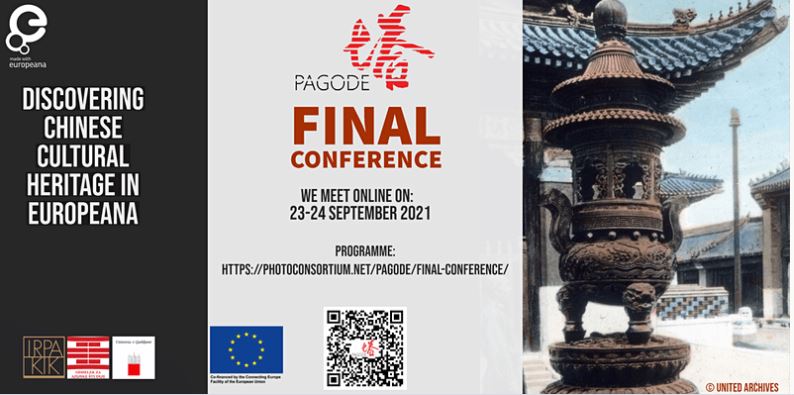
The PAGODE Project, is pleased to announce its Final Conference “Discovering Chinese Cultural Heritage in Europeana”. The event will be held under the coordination of KIK-IRPA and hosted online by the University of Ljubljana.
PAGODE is a Generic Service project granted by the European Commission in the frame of the Connecting Europe Facility Programme, in support to Europeana.
The main scope of the project is to increase the engagement with Europeana according to the EU funding programme, but a broader aim is to enable collaborations among European museums and archives, as well as to foster international connections with Chinese cultural heritage institutions.
The project allowed to:
• bring more Chinese collections into Europeana,
• exhibit Chinese Cultural Heritage from European content holders and memory institutions,
• open cultural connections to China and taking advantage from a wider knowledge of mutual cultures. Several European cultural institutions participated in the project as partners and are associated to contribute with their digital collections about Chinese cultural heritage.
The conference will be the occasion to present the project’s results and the best practices that support the digital transformation of cultural heritage with a focus on Chinese Cultural Heritage hosted in European Cultural Institutions; the speakers will share their experiences of making collections accessible via Europeana.
More information at https://photoconsortium.net/pagode/final-conference/
WEAVE project is organizing a series of LabDays to engage communities with their tangible and intangible heritage and present novel ways of cultural heritage representation in the digital realm.
In this LabDay organized by partner ARCTUR (Slovenia) in collaboration with Universidade NOVA de Lisboa (Portugal) and Coventry University (UK), solutions for interactive experiences with 3D and cultural heritage are presented.
The advantages of investing in cultural heritage tourism
A short presentation of the development of interactive experiences (3D movie, hologram, 3D printing, virtual tours with the 3D objects, interactive table with 3D objects, enriched reality, VR360movie with the 3D objects, VR games, etc.)
How to prepare a good concept with defined target groups and user experience
Cooperation of key stakeholders in the process of digitisation and the digitalisation of cultural heritage
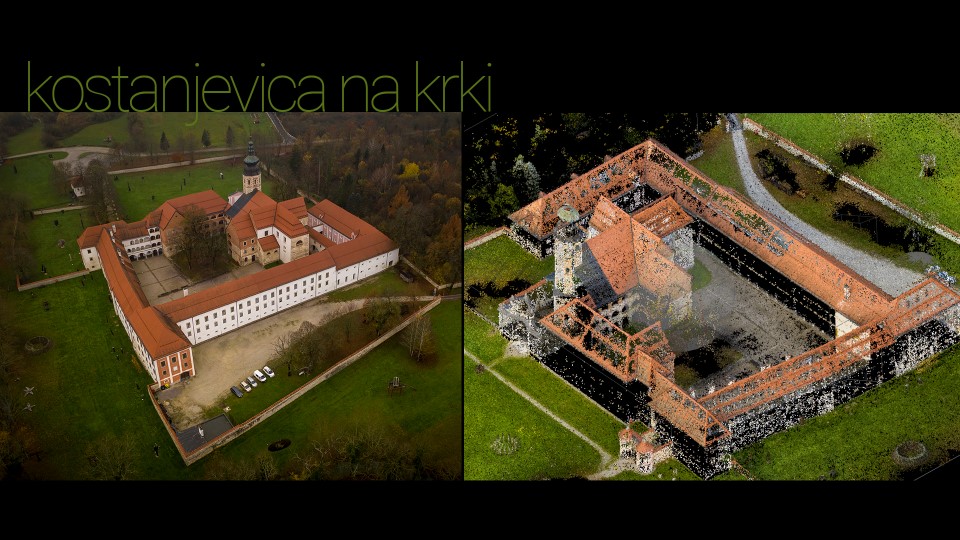
The digitising process: digital capture, point clouds, photogrammetry and laser scanning, data processing, simulated reconstructions on practical case studies of cultural heritage objects.
img. courtesy ARCTUR
The LabDay will be moderated by COVUNI. ARCTUR will be joined by Universidade NOVA de Lisboa (Portugal) to discuss the MotionNotes tool, an open web-based video annotator for both video streams and recorded videos which focuses on the annotation of movements, targeting dance and performance professionals. MotionNotes has been developed within the CultureMoves Generic Services project. The current version of MotionNotes allows only for manual annotations. In WEAVE they will integrate innovative ML/AI algorithms to perform semi-automatic recognition of specific gestures and movements (dance steps, for instance), outputs which can be used to identify Europeana videos containing dance or be re-used outside the toolbox as a software library and dataset. Moreover, MotionNotes will be extended to allow annotations in 3D space, representing information about what the performers are doing, and also about where they are in the physical space, along with their moving patterns. For the visualization of the performance space, images and 3D models will also be used, thus opening up new possibilities of re-using 3D content of Europeana. MotionNotes will be a 3rd party hosted tool that will connect with Europeana CSP via Europeana APIs.
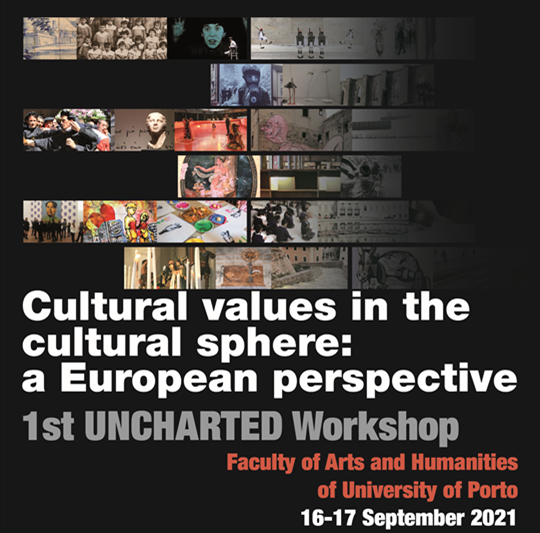
The UNCHARTED project is delighted to announce the first of a series of three co-creation workshops planned by the Consortium in the framework of the investigation action. The aim of the initiatives is to combine the generation of knowledge with the creation of a common understanding and a shared approach to the themes addressed by the research of UNCHARTED.
This upcoming event will be hosted and coordinated by the Faculty of Arts and Humanities of the University of Porto.
Through an extended dialogue between the whole UNCHARTED Consortium, some members of the project Advisory Board and other invited stakeholders, it will develop an examination of the factors shaping the value of culture in Europe and will carry out a systematic comparison between perspectives on different areas of cultural practice where these values emerge.
The programme includes sessions devoted to present and discuss the results of WP1. The case studies carried out in WP2 are presented in parallel sessions focused on the three main areas of the project: cultural participation, cultural production and cultural administration. Advisory Board members will act as discussants in these sessions.
Another kind of sessions will confront the synthetic representations of the configuration of values in the different areas of cultural practice that will be elaborated along WP2 with practical reflections by selected stakeholders.
Additionally, in a final session partners and stakeholders will debate about the Covid-19 impact on the values of culture in cultural participation in view of generating policy recommendations for cultural institutions at a time of recovery of normality. Visit the Porto co-creation workshop’ s webpage to stay up to date with the latest news.
A pioneering approach to technologies for Cultural Heritage, by merging research, science, art and business
On a regular schedule, the WEAVE team publishes a blog post which features a partner of the WEAVE consortium. This blog item presents partner ARCTUR.
Established in 1992, Arctur has been pioneering by merging research, science, art and business. The headquarters of the company are in Nova Gorica and with additional locations in the Slovenian capital, Ljubljana. We are one of the main commercial suppliers of high-performance computing services and solutions for SMEs in Central and Eastern Europe. Arctur has its own HPC and Cloud Computing infrastructure to be used as the technological foundation for advanced HPC and Cloud computing solutions and innovative IT services in a distributed, high-redundancy environment.
The company has extensive experience and a long track record of EU projects in the deployment of complex IT systems specialized for SMEs in different sectors. At the moment we employ around 50 skilled co-workers and experts (analysis, technicians, researchers, web developers, project managers, etc.) that are fully involved in the daily tasks and credited with the achievements and work that the company is doing today. So because of that, Arctur has been a home for Tourism 4.0 for the last 3 years. The initiative that is unlocking the innovation potential through collaboration between all stakeholders in the smart tourism ecosystem to co-create enriched experiences with the help of the key enabling technologies from Industry 4.0 which has grown into a partnership of 180+ international members from academia, business and other institutions.
The Tourism 4.0 ecosystem connects the T4.0 Core APIs with the technology pillars T4.0 DOTI, CIT, FLOWS and TIM. T4.0 Core is built on state of the art HPC infrastructure supported by AI, blockchain and HPDA, which ensures efficient, safe and transparent access to data and its exchange. DOTI is a personal digital passport that allows the individual (tourist) to maintain ownership and full control of their own data. Collaboration Impact Token (CIT) is a crypto voucher based on blockchain technology that changes the value in time and places intending to award positive behaviour and support the redirection of tourist FLOWS. Tourist destination managers, service providers, researchers want to better understand tourist flows: what impact traffic flows have, when traffic peaks are occurring, what are the seasonal effects, which areas are more / less congested with tourists, how the weather, holidays and other events affect tourist flows. Tourism Impact Model (TIM) is a tool using real data to create an objective picture of the impact of tourism in a certain micro-location. In 2020 TIM was rewarded as The Best Innovation on AI and Data Analytics at the Tourism Innovation Summit in Seville, Spain and in the same year it also received The Golden recognition for Best innovation, awarded by The Chamber of Commerce and Industry of Slovenia.
One of the larger programs within Tourism 4.0 is Heritage +, where their main goal is to prevent that our roots and cultural heritage aren’t left out of the new mixed-reality world, where the new generations already live in. After all our heritage makes us who we are. Heritage+ is an innovative approach to creating new enriched tourist experiences based on cultural heritage. It uses advanced technologies (360° photo and video, Augmented Reality, 3D scanning, modelling and printing, Simulated Reconstruction, …), hybrid skills of digital business model development, and strategic planning of digital transformation. It is an awarded social innovation, answering the needs of society and local communities for sustainable development, communication of heritage values and reinforcement of the sense of belonging.
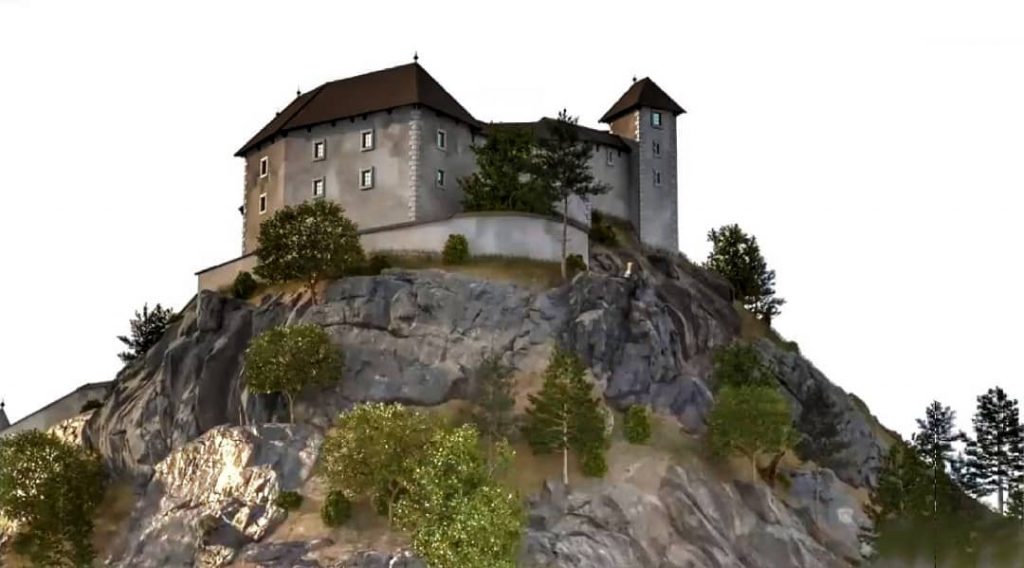
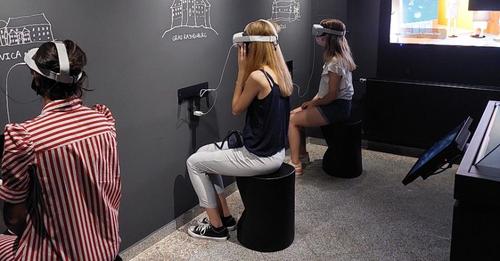
As an example of good practice, we are presenting the e-Castles of Posavje, where they just recently opened the door to a new, unique virtual experience and designed a digital room where 3D models of castles are exhibited. The room also includes VR glasses where 360-degree videos from all 7 castles take the visitors around the region in just a few minutes. VR glasses or Virtual reality is a form of computer simulation where the key challenge is to trick the brain into being in a virtual rather than a real environment, as our brains are much more advanced than the most advanced video screens. We can achieve that with the most important piece of a virtual reality kit that is the headset, a device like a thick pair of goggles that goes over your eyes.
Immaterial Future Association spotlights CultTech entrepreneurs through its new IF Innovation Award initiative
Immaterial Future Association announced 6 startup finalists of the IF Innovation Award
The finalists represent 6 countries from the Americas and Europe. The winner will be announced on September 4 at the Award ceremony in Vienna and will receive a €50,000 investment for their business.
The discussions at the Award ceremony will shine a light on the state of impact investing in culture and creative industries, as well as the barriers and enablers for sustainable solutions in this space
The Award celebrates the most inspiring entrepreneurs offering new bold solutions in the field of CultTech*. This year 165 startups from 52 countries participated in the competition by submitting projects that leverage technology and create new business models for culture and creative industries. Six finalists – startup teams from the Netherlands, US, UK, Brazil, Luxembourg, and Germany – will pitch their ventures to an international jury panel and compete for €50,000 in non-equity funding.
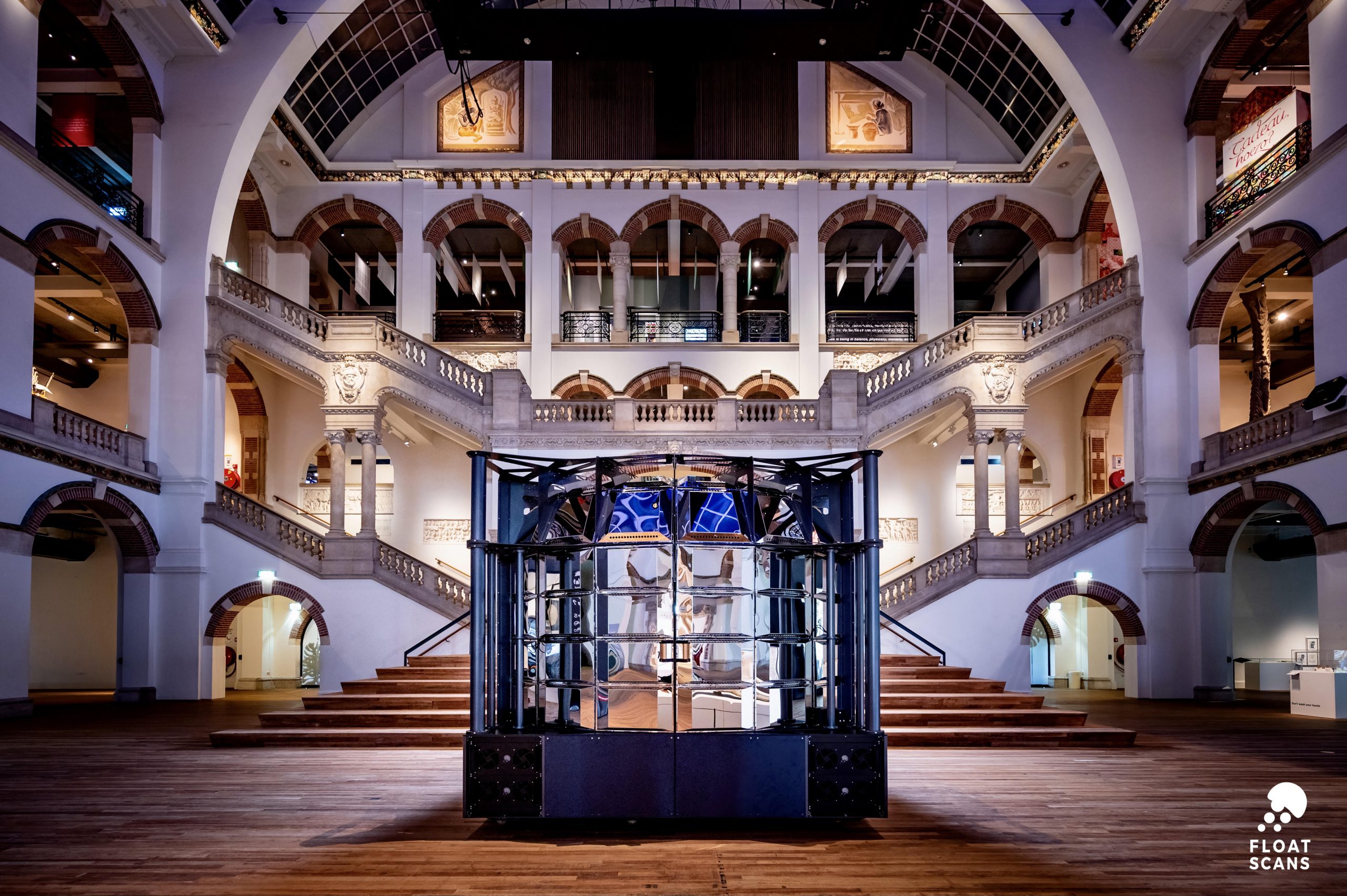
img. Floatscans
The finalists offer solutions that develop new business models that give culture financial independence or create distribution models that allow wide access to cultural experiences while upholding their authenticity. With a loss of 31% of its turnover[1], the cultural and creative economy is one of the most affected in Europe by the COVID-19 pandemic. Now it is vital to fund and support technological solutions and impact ideas that will help the industry build back in the most sustainable way.
img. Scan the World
This year’s IF Innovation Award finalists are:
FloatScans (Netherlands). Proprietary 3D scan technology that makes it possible to bring real-world objects to life digitally. The core focus is on art and cultural heritage, in which 95% of the objects are stored away or not publicly visible. With this technology, museums and galleries may unlock their full collections independent of available space + monetize collections by developing new business models.
ArtMe (Brazil). A platform (mobile app) where ArtCasets (stories, art descriptions and exhibition tours) can be submitted and translated into 19 languages. Content can be provided by the community with no museum censorship. ArtMe can be used to discover artworks within a city, making visits to museums and galleries even more pleasant.
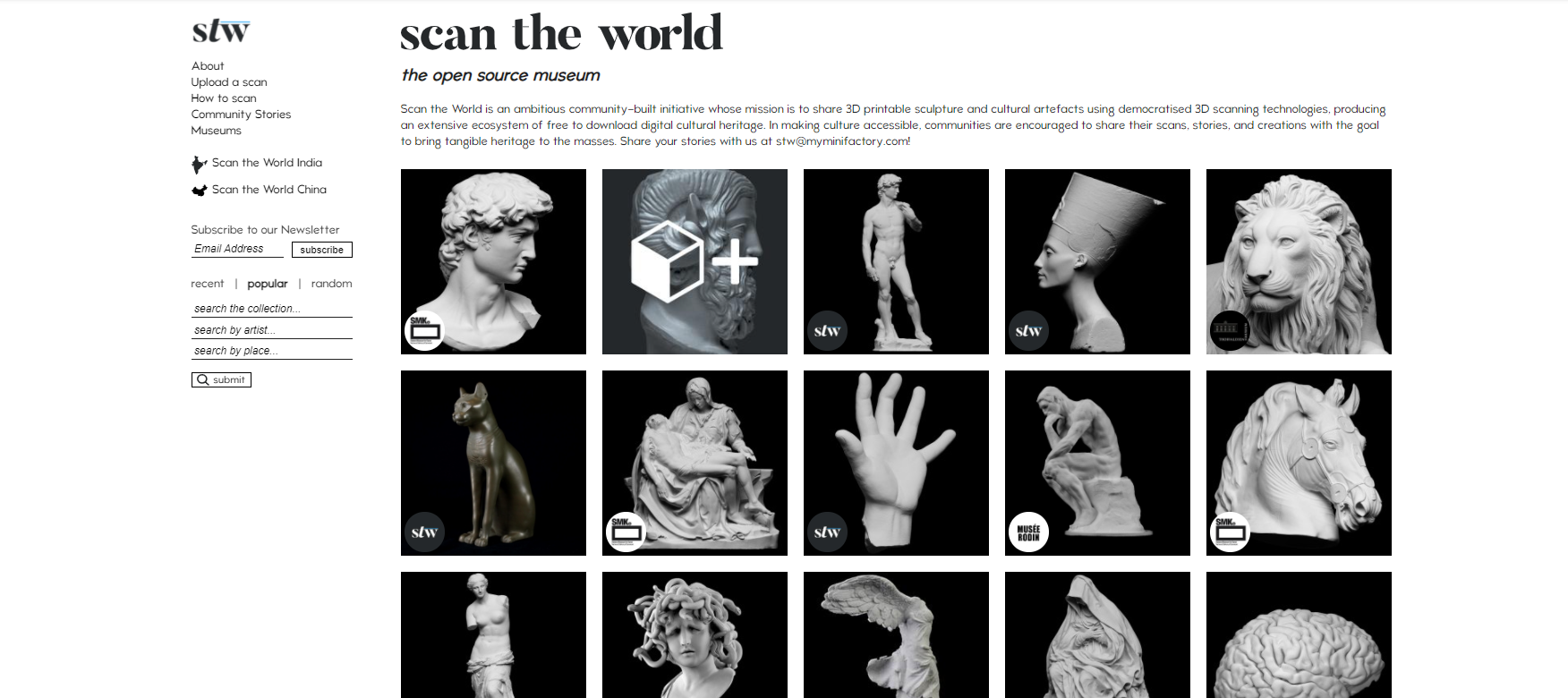
Scan the World (UK). With over 18,000 objects online, it’s the largest digital museum of 3D printable cultural artefacts. It’s a community-built, open-source project archiving objects of cultural significance using 3D scanning and 3D printing technologies. Cultural institutions, heritage boards, and private collectors may use the 3D solution to generate new revenue streams: gift shops (selling high-quality facsimiles and merchandise), 3D scanning, and printing on demand.
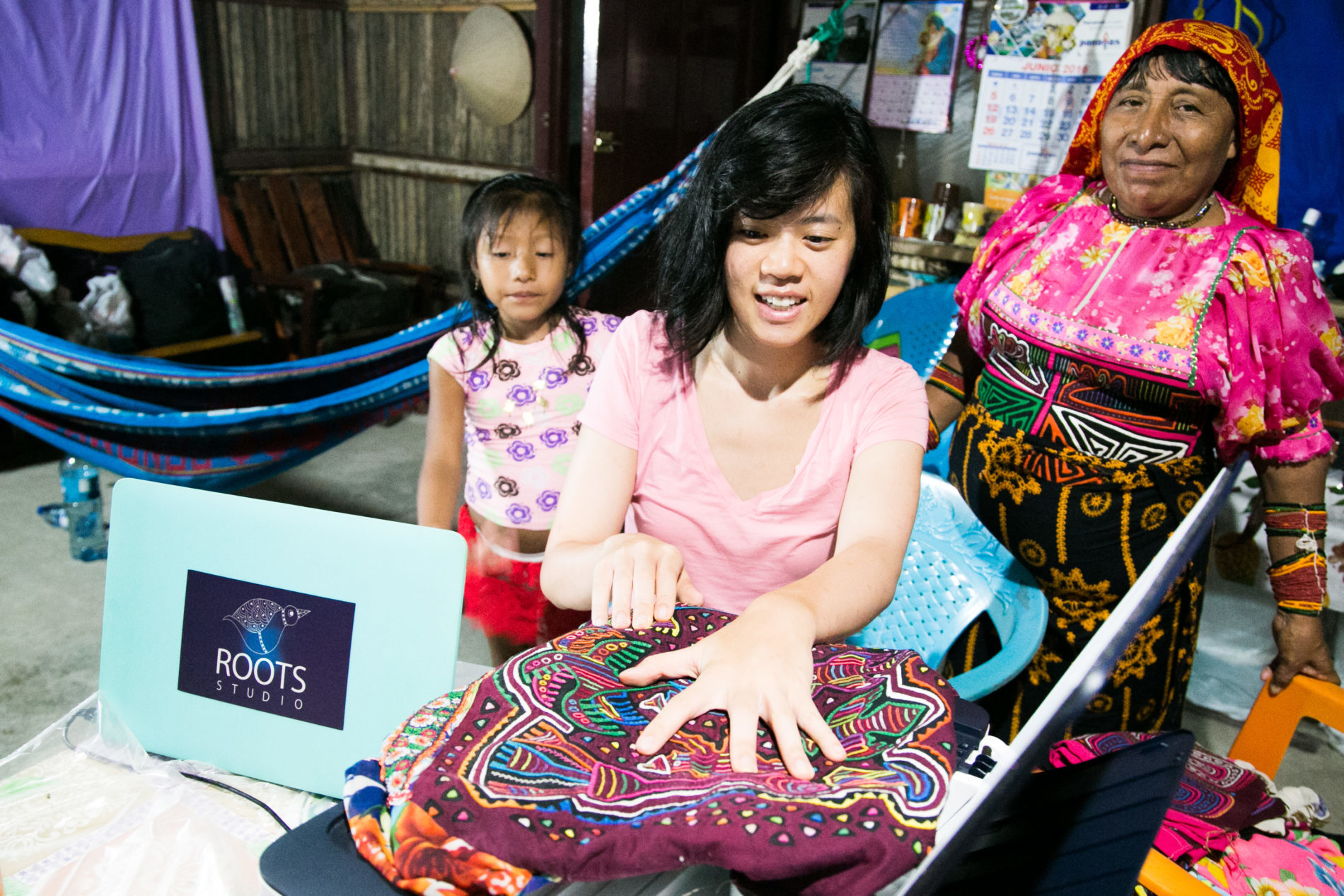
Roots Studio (US). Works with indigenous and minority artists globally to digitize their unique and endangered heritage arts into new fashion and home products, through a model that can financially support their livelihoods, communities, and traditions. The model of the startup may be interesting for ethnic artists and collectors of ethnic fine arts.
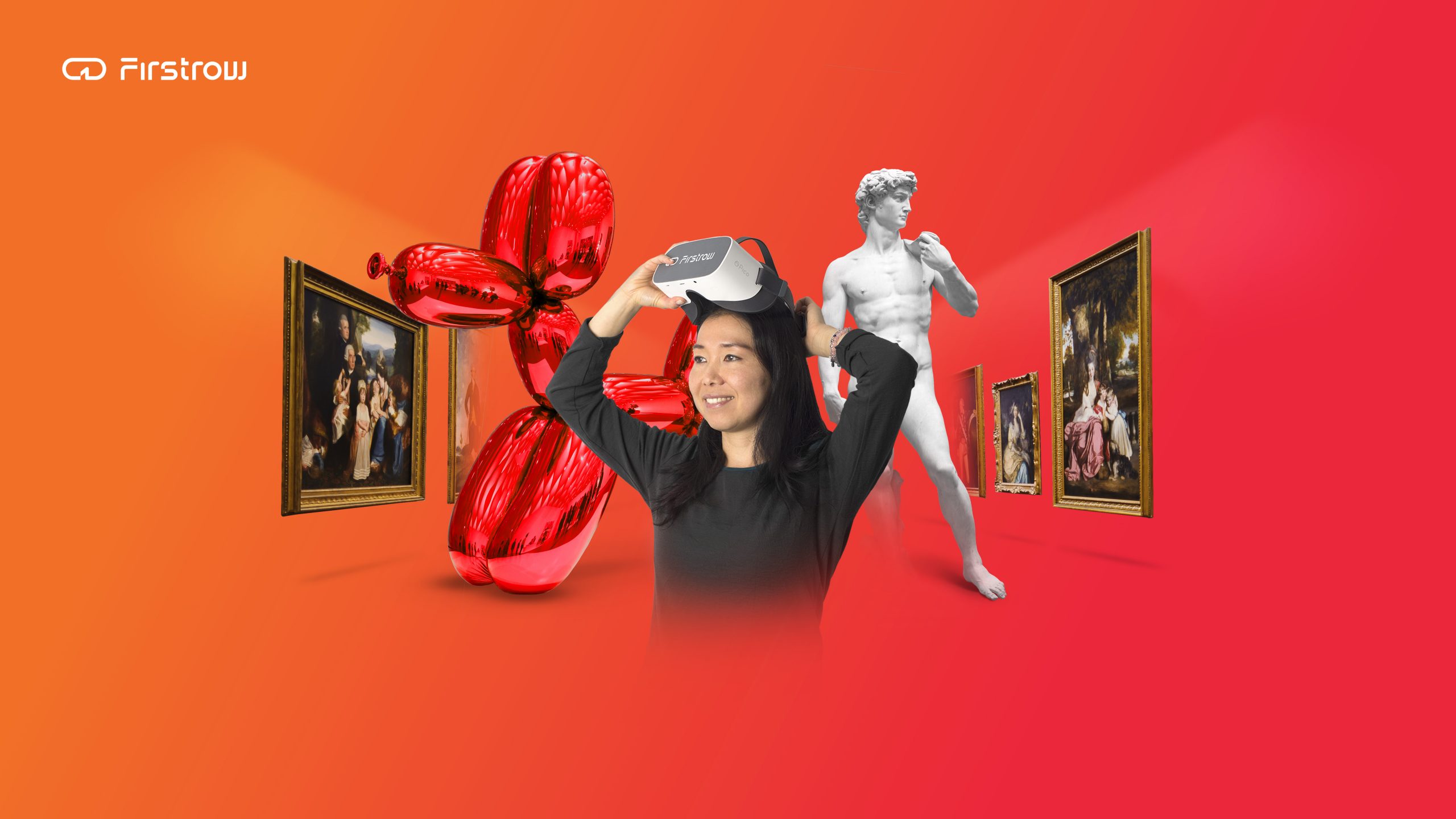
Firstrow (Germany). A VR distribution platform that enables performing arts companies and venues in the culture sector to monetize their production through digital (VR) showcasing. The distribution platform is augmented by a home delivery service offered for consumers who don’t possess their own VR device.
ANote Music (Luxemburg). A marketplace for investing in music royalties. It enables publishers, record labels, and artists to list a portion of their royalty stream rights up for auction, introducing a new system of financing, as well as offering music enthusiasts and investors a new opportunity and the chance to own shares in their favorite music, thus turning music into an alternative asset class.
img. Firstrow
Composed of six members, the IF Innovation Award jury represents a group of visionaries in the fields of arts, technology and venture capital:
Oliver Holle, Сhairman of the IF Innovation Award jury panel, Founder and Managing Partner of Speedinvest, a leading European early stage venture fund.
Philip Ginthör, Digital entrepreneur and investor, former CEO of Sony Music for the DACH region, board member of Bonnier Media (Germany).
Thierry Baujard, Founder and CEO of Media Deals, a pan-European investment network focusing on the creative industries, active member of the EU’s ‘Creative Shift’ initiative;
David Yang, Founder of ABBYY, Co-Founder of Yva.ai, a pioneer of Artificial Intelligence;
Dmitry Aksenov, Founder and President of the Immaterial Future Association;
Following the pitch session the program will feature a panel discussion on impact investing in culture and creative industries with representatives of the leading social innovation organizations in Europe including Impact Hub Vienna, and the European Venture Philanthropy Association (EVPA).
Immaterial Future (IF), a Vienna-based non-profit association, is established in 2021 to shift our world’s growth model towards intangible production and consumption, with culture as main vector of change. It aims to leverage culture’s huge untapped potential to positively impact every single human, breaking away from its elitist confines and becoming more accessible to all.
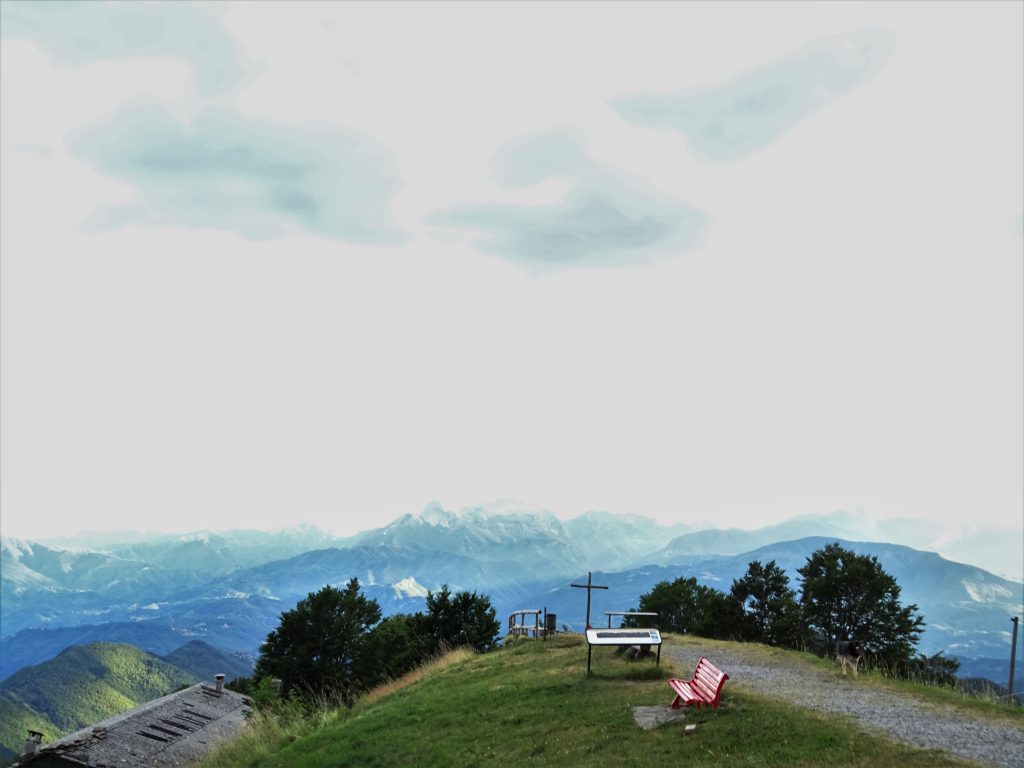
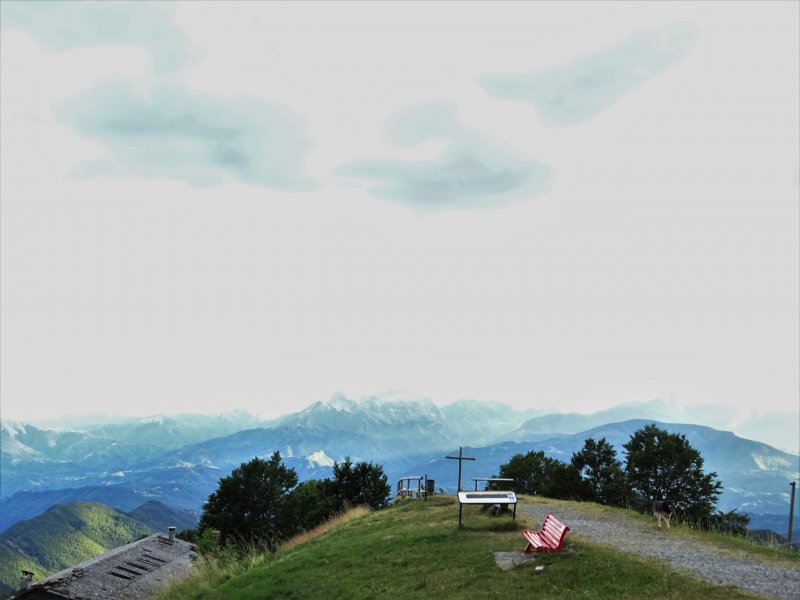
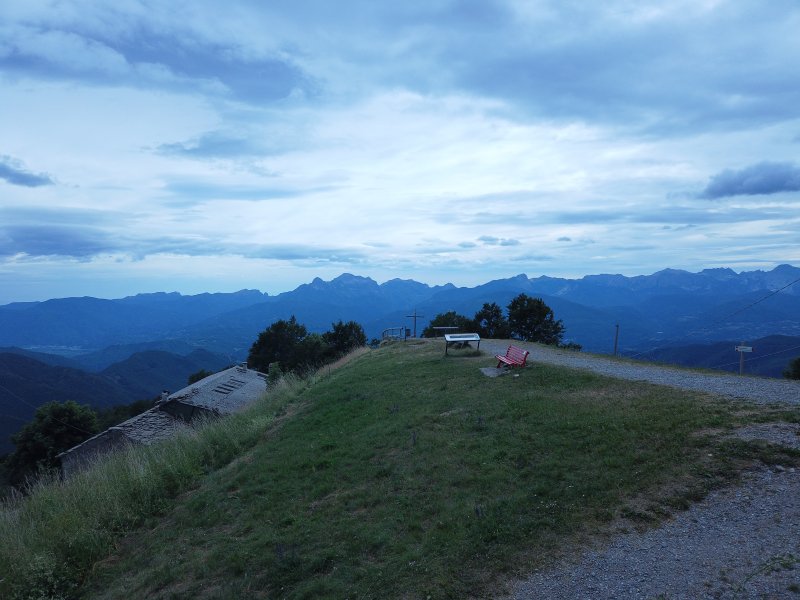
One of the Pilots of the INCULTUM project, aiming and empowering sustainable cultural tourism in peripheral areas with communities engagement, is coordinated by the University of Pisa and is set in the beautiful landscape of the Garfagnana in Tuscany.
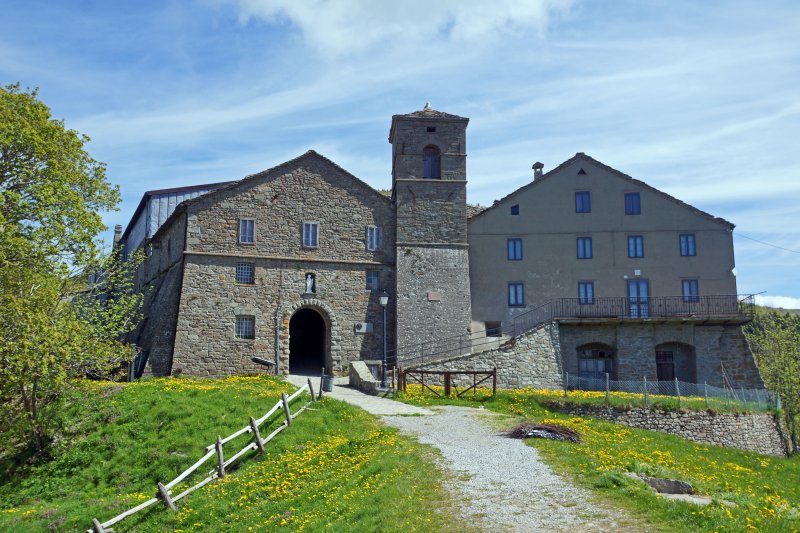
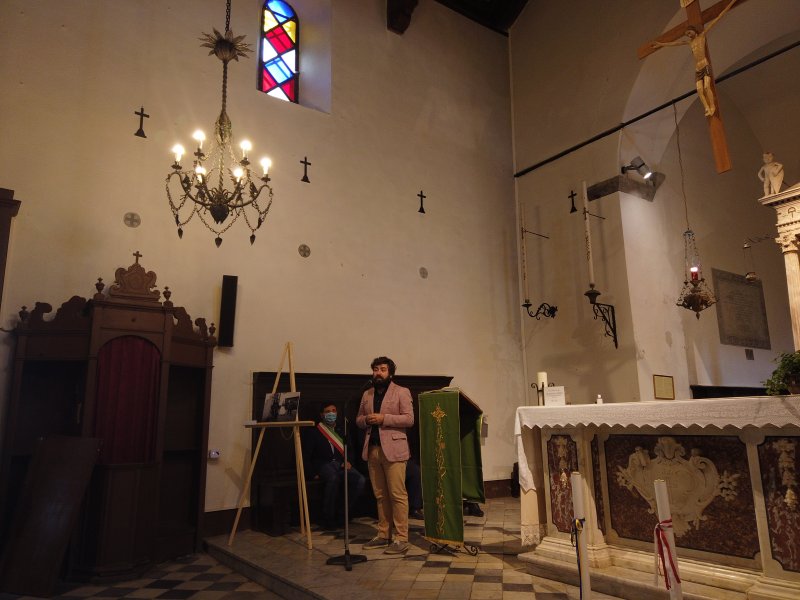
San Pellegrino in Alpe village, with its mountain breathtaking view and its spirituality athmosphere, has recently been the stage for the launch of the Pilot managed by the Department of Political Science of Pisa University and coordinated by Professor Enrica Lemmi (full Professor of Geography) in the framework of INCULTUM – INnovative CULtural ToUrisM in European peripheries, the European project financed under HORIZON 2020 programme.
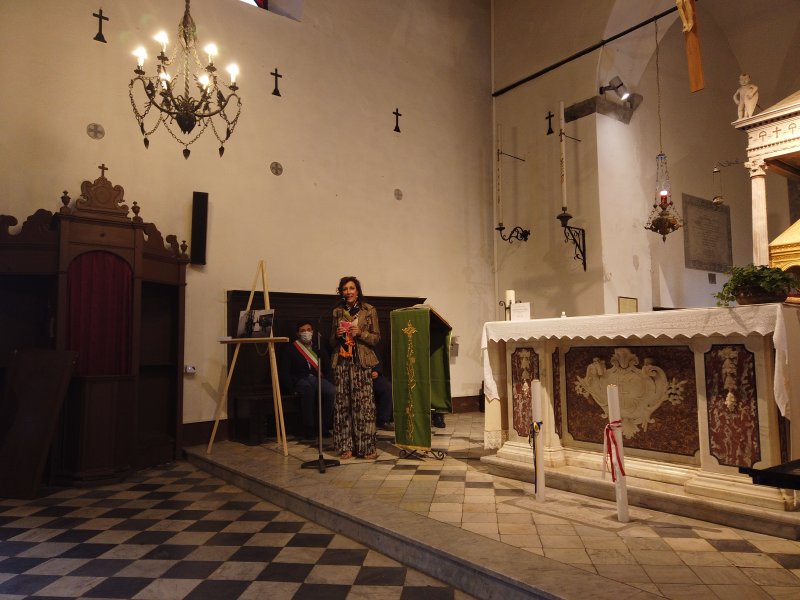
On 17th July 2021, INCULTUM inaugural event was held in Saint Pellegrino and Saint Bianco Sanctuary, where a religious art exhibition called “San Pellegrino in Alpe. History of a boundary town” was set up. The event has been organized by the Departments of Political Science of Pisa University, in collaboration with private and public local stakeholders: the Priest of San Pellegrino in Alpe, Fondazione Area, Fondazione Campus of Lucca, the Municipalities of Castiglione di Garfagnana and Frassinoro, the Provinces of Lucca and Modena; the event has attracted numerous residents and visitors mainly interested to experience the high cultural identitary value of the place.
The aim of the first INCULTUM event for this Pilot is to valorize San Pellegrino in Alpe village for its rural cultural heritage, its unspoilt landscape, as well as for its pilgrimage’s place history, especially through Saint Pellegrino lifetime and legend konwledge and promotion. Besides, during this inaugural event, particular attention has been given to local traditions, handicrafts, migration history and past rural lifestyle, told by the actress Elisabetta Salvadori, in her theatrical performance called “La Barbiera”, which have representing the central event of the day.
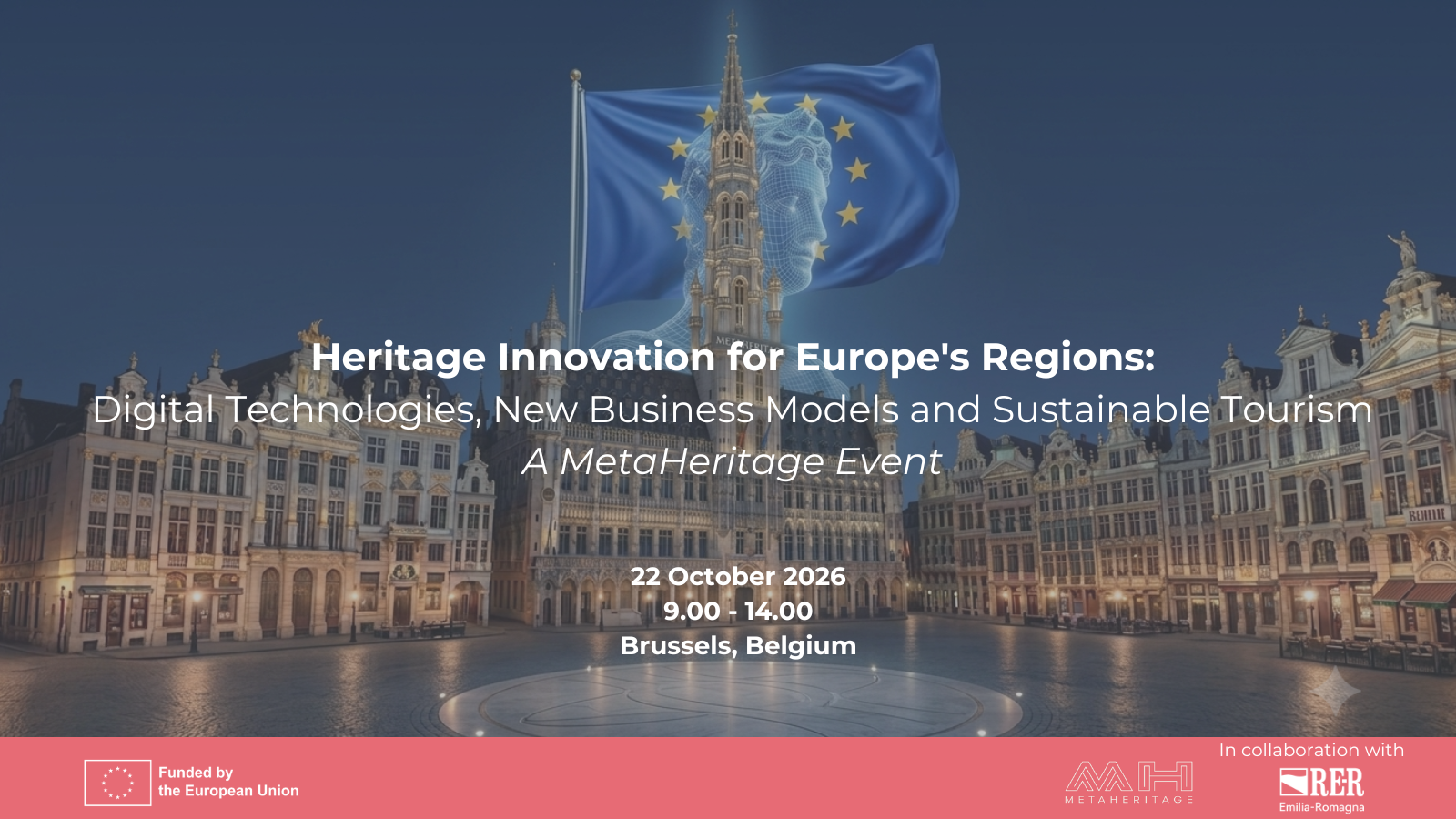
Developed by project partner Bibracte in the context of EUreka3D-XR, two Open Educational Resources (OER) on XR technologies and cultural heritage: “On the Shoulders of the Celts – How yesterday’s inventions have made today’s digital world possible“, a step-by-step guidance … Continue reading →
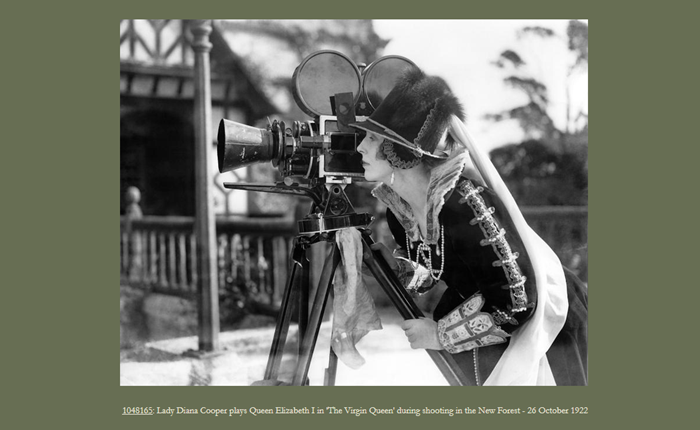
To mark the 2026 World Day for Audiovisual Heritage, prestigious British Archive TopFoto has organised an online event, “Topfoto: Past, Present and Future of Press Photography” online on Octber 27th. The event will explore how press photographs move from newsroom … Continue reading →
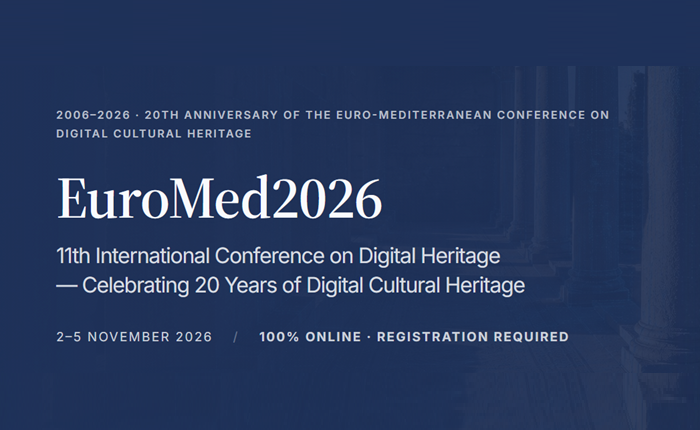
For two decades, EuroMed has provided an international forum where researchers, cultural heritage professionals, museums and memory institutions, technology experts, industry, educators and policymakers come together to exchange knowledge and shape the future of Digital Cultural Heritage. EuroMed2026 continues the … Continue reading →
As cultural heritage increasingly moves into digital environments, professionals and organisations working with images and photographic collections face a range of challenges — from digitisation and data management to interoperability, access, reuse and the adoption of new technologies. In the context … Continue reading →
Join the European Heritage Hub to its upcoming Policy Talk, ‘INNOVATE. PROTECT. EMPOWER. How cultural heritage can make Public AI a reality’, taking place online on 29 September, from 16:00 to 18:00 CET. The Policy Talk will explore the vision … Continue reading →
This website uses cookies to improve your experience. We'll assume you're ok with this, but you can opt-out if you wish. Cookie settingsAccept All
Privacy & Cookies Policy
Privacy Overview
This website uses cookies to improve your experience while you navigate through the website. Out of these, the cookies that are categorized as necessary are stored on your browser as they are essential for the working of basic functionalities of the website. We also use third-party cookies that help us analyze and understand how you use this website. These cookies will be stored in your browser only with your consent. You also have the option to opt-out of these cookies. But opting out of some of these cookies may affect your browsing experience.
Necessary cookies are absolutely essential for the website to function properly. This category only includes cookies that ensures basic functionalities and security features of the website. These cookies do not store any personal information.
Any cookies that may not be particularly necessary for the website to function and is used specifically to collect user personal data via analytics, ads, other embedded contents are termed as non-necessary cookies. It is mandatory to procure user consent prior to running these cookies on your website.




 The
The 
 Established in 1992, Arctur has been pioneering by merging research, science, art and business. The headquarters of the company are in Nova Gorica and with additional locations in the Slovenian capital, Ljubljana. We are one of the main commercial suppliers of high-performance computing services and solutions for SMEs in Central and Eastern Europe. Arctur has its own HPC and Cloud Computing infrastructure to be used as the technological foundation for advanced HPC and Cloud computing solutions and innovative IT services in a distributed, high-redundancy environment.
 The Tourism 4.0 ecosystem connects the T4.0 Core APIs with the technology pillars T4.0 DOTI, CIT, FLOWS and TIM. T4.0 Core is built on state of the art HPC infrastructure supported by AI, blockchain and HPDA, which ensures efficient, safe and transparent access to data and its exchange. DOTI is a personal digital passport that allows the individual (tourist) to maintain ownership and full control of their own data. Collaboration Impact Token (CIT) is a crypto voucher based on blockchain technology that changes the value in time and places intending to award positive behaviour and support the redirection of tourist FLOWS. Tourist destination managers, service providers, researchers want to better understand tourist flows: what impact traffic flows have, when traffic peaks are occurring, what are the seasonal effects, which areas are more / less congested with tourists, how the weather, holidays and other events affect tourist flows. Tourism Impact Model (TIM) is a tool using real data to create an objective picture of the impact of tourism in a certain micro-location. In 2020 TIM was rewarded as The Best Innovation on AI and Data Analytics at the Tourism Innovation Summit in Seville, Spain and in the same year it also received The Golden recognition for Best innovation, awarded by The Chamber of Commerce and Industry of Slovenia.