


EUreka3D-XR participates at CEPIC2026

EUreka3D-XR is set to take part to CEPIC Congress 2026, that will take place in Valencia from May 6 to 8.

The project will join leading professionals from across the visual media ecosystem  by contributing to the discussion on media authenticity and trust in the cultural heritage domain.
Programme of EUreka3D-XR participation:

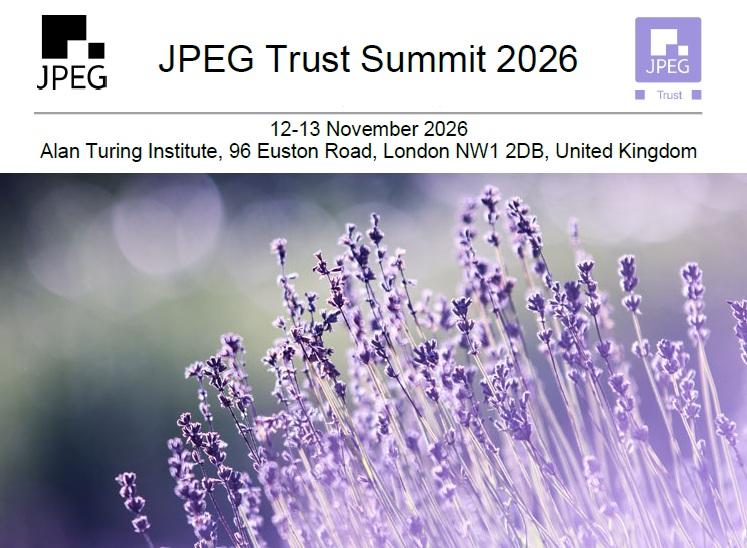
  • 10:00-10:30 – Keynote presentation: Addressing Media Authenticity Challenges in Cultural Heritage with JPEG Trust (Frederik Temmermans)
  • 10:30-11:00 – Panel session. Participants: Antonella Fresa, Philippe Rixhon, Frederik Temmermans (additional panellists and moderator to be confirmed).
    Followed by moderated discussion and audience questions.

The session will discuss good practices illustrated through the lens of JPEG Trust, an ISO/IEC standards framework designed to support media authenticity and trust assessment. Particular attention will be given to how this framework can safeguard trust and long-term reusability across cultural heritage workflows, including in scenarios where emerging technologies such as AI are adopted.


EUreka3D-XR at the Immersive Heritage Conference 2026

EUreka3D-XR project will be presented in Timișoara in March, during the very first edition of Immersive Heritage Conference, taking place at Politehnica University of Timișoara (Romania), from 18-20 March 2026.

The Conference is organized by Lip3D project, an initiative with the mission of experimenting with innovative tools, methods, and practices to create immersive virtual worlds, with a special focus on archaeological sites – aim that bonds strongly with the beliefs and purpose of the EUreka3D initiative, creating synergies between the two projects.

EUreka3D-XR will be present at the event, with project coordinator Antonella Fresa delivering a presentation to disseminate the project’s achievement and objectives and present the EUreka3D Data Hub.

Learn more on the Conference at this link.


Immersive Heritage Conference


The 1st Immersive Heritage Conference will bring together leading experts, researchers, creatives and institutions in exploring the future of digital cultural heritage through immersive technologies – XR, AR, VR and gamification, and how new technologies are transforming the way heritage can be preserved, interpreted, and experienced.

The event will be divided into three different days, that aim to tackle three different specific areas: Immersive Tech, Metaverse and Research & Policy. By participating, you will be able to  join leaders in the cultural heritage and technology sector for a pioneering event in the field of heritage preservation and valorization by registering to the conference.

More details will follow: get updates at this link.


Italian Chinese Cultural-Tourist Week: Pisa & Hohhot 2026

From February 6th to 10th, Italy and China met through the Italian Chinese Cultural-Tourist Week 2026 in Pisa: during this week, fifteen studentns from Mongolia were guests of the City and Province of Pisa as part of an agreement between Italy and China.

The programme of the series of events included different cultural and artistic events, visits of the city, shows and activities. Download the programme<<<<

The main event of the initiative took place on Saturday, February 7th, from 3 to 5 pm, hosted at the Bastione del Parlascio (Pisa). The protagonists were 11 young dancers from Inner Mongolia, performing traditional Mongolian dance. The performace was accompanied by a generative digital visual composition by the artist Cibarius, presenting the work “Distant Land” in direct dialogue with the dances of the young Mongolian dancers invited to perform for the occasion (curated by Claudio Francesconi).

Cibarius’s work, grounded in algorithmic and generative processes and the latest research in contemporary digital art, intertwines with the choreographic tradition from which the dances originate, giving rise to a close interaction between languages ​​and imagery. The result is an intense visual synthesis, in which cultures with distant histories and worldviews meet and intertwine, opening a space for reflection on the relationship between technology, memory, and identity.


Re-shaping Tourism: Practical Circular and Regenerative Solutions for Sustainable Touristic Destinations

The SECreTOUR project participates in the webinar co-organised with the VERNE project, in collaboration with Cross Re TourGreen2Grow and Regenera4MED. The webinar, Re-shaping Tourism: Practical Circular and Regenerative Solutions for Sustainable Touristic Destinations, will take place on February 24, 2026 at 14:30 CET.

The event aims to foster practical exchange and peer learning, encourage already existing good practices around sustainable tourism and stimulate discussions, reflections and insights.

The webinar aims at finding synergies and strenghtening connections on the theme of innovation in sustainable tourism, in line with SECreTOUR’s mission as part of the project’s networking activity, to which EUreka3D initiative is an associated partner.


Acces the webinar’s agenda<<<<.

Registrations are open.


Re-shaping Tourism: Practical Circular and Regenerative Solutions for Sustainable Touristic Destinations

As part of its networking activity, the SECreTOUR project participates in the webinar organised by the VERNE project, in collaboration with Cross Re Tour, Green2Grow and Regenera4MED.

The webinar will take place online on 24/2/2026.

The joint event brings together EU-funded projects at different levels of maturity working on sustainable, circular, and regenerative tourism.

Speakers will share both early insights and more advanced solutions and participants will have the possibility to ask questions and participate in interactive sessions.

The event aims to foster practical exchange and peer learning, inspiring tourism destinations and practitioners to adopt and adapt existing good practices.

The agenda of the webinar is available here.

The link is open for registration.

We look forward to meet you online!


Follow SECreTour online also on the SECreTour project’s website.


Florence Heri-Tech 2026: CALL FOR PAPERS open NOW

Florence Heri-Tech International Conference was launched in 2018 by the Department of Industrial Engineering of University of Florence (DIEF) and Florence Biennial Art and Restoration Fair. The idea was to create a synergy between Cultural Heritage and New Technologies. Today the Conference involves a large number of research projects and scholars from around the world and puts the industry’s current issues under the spotlight, specifically on issues related to innovative techniques and technologies for Cultural Heritage. This year’s Florence Heri-Tech will take place in from 27-30 April 2026.

The conference will be held both in person and online: register for Florence Heri-Tech 2026 at this link.

The Call for Papers deadline has been extended until February 18th: some of the most requested topics include:

  • Materials science and engineering
  • ICT and Artificial Intelligence
  • Museology.
  • Architecture.
  • Environment.

Each author will have the opportunity to be published in the proceeding volume by Springer.

Submit your proposal and read the full Call here!


Development of cultural & creative tourism in rural and remote areas, empowered by multidimensional models of tourism growth


In the occasion of the international conference organised by TOURAL project, SECreTOUR, CROCUS and CULTURALITY, the projects that participate in the cluster of cultural tourism actions supported bhttps://toural-project.eu/y the EU under the Horizon Europe Programme, presented their initiatives in a dedicated corner of the conference’s poster session.


Furthermore, SECreTOUR and CULTURALITY had the opportunity to participate, together with TOURAL, in the special session held on 31/1/2026, to present their actions addressing various aspects of promoting cultural tourism in remote and rural destinations.


Posters and presentations delivered by Cluster projects are available for here below for free download:

SECreTOUR poster

SECreTOUR presentation

CULTURALITY poster

CULTURALITY presentation

CROCUS poster

TOURAL-posters

Further information about the conference and the Cluster’s special session is available in the TOURAL newspost.


Follow SECreTour online also on the SECreTour project’s website.


From Roman Castulo to the Alhambra

© Factum Foundation

Factum Foundation for Digital Technology in Preservation, a not-for-profit organisation based in Madrid, collaborated on the PhD thesis carried out by Ana Carrasco Huertas at the University of Granada, co-supervised by Víctor Medina (University of Granada) and Carlos Bayod Lucini (Factum Foundation). The research was defended on 30 January 2026 and focuses on the study, digitisation, and virtual reconstruction of three groups of decorative architectural surfaces from different contexts and periods: fragments of Roman cornices made in lime mortar from the archaeological site of Castulo (1st–2nd centuries AD); decorative reliefs carved in bone discovered in the ancient city of Isturgi (1st–3rd centuries AD); and a 14th-century façade of plasterwork and wood in the Islamic tradition, located within the Alhambra Monumental Complex. In all three cases, these decorative surfaces have been heavily affected by the passage of time, which makes them difficult to read, understand, and interpret.

As part of the project, Ana completed a training and research placement at Factum Foundation in Madrid (May–July 2022), followed by work with the ARCHiOx project at the Bodleian Library, University of Oxford (June–September 2023). The aim of both stays was to learn and apply high-resolution 3D recording methods and the associated workflows used to support the virtual reconstruction of cultural heritage.

For the study and digitisation of the material, Factum’s Lucida 3D Scanner and Selene PSS were used. This made it possible to capture the micro-topography of the Roman reliefs (both lime-mortar elements and carved bone) and the plasterwork with great precision, enabling detailed analysis of the manufacturing marks and tools involved (such as moulds, profiling tools, lathes, and carving gouges). The work also produced highly accurate digital twins suitable for material and technical study, which will serve as the foundation for the subsequent virtual restitution.

© Factum Foundation; Read the original post.


Report of Dijon event hosted by Bibracte

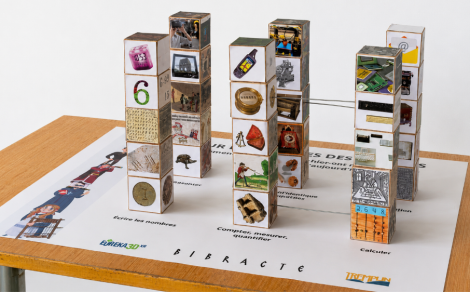
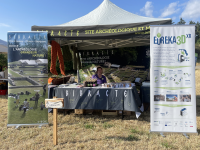
On 11 and 12 October 2025, Bibracte hosted a stand in Dijon during the Fête de la Science. On this occasion, a construction game entitled “The Ancestors of Digital Technology and Extended Reality” was presented, along with the EUreka3D-XR project, to an audience of around one hundred people, mostly families.

The aim of this game is to explain the principles of digital technology and extended reality to the public, and to young people, by placing them within the long history of knowledge and techniques, in line with the idea that we are “standing on the shoulders of giants”. This approach takes the form of a construction game made up of cubes to be stacked chronologically, from Antiquity to the digital age.

The goal of the game is to identify the theme and period of each of the 36 wooden cubes to stack them on the bases corresponding to six main themes: Writing numbers, Counting and measuring, Calculating, Producing identical copies and automating, Processing information and Visualising. The 216 illustrations (one on each face of the cubes) are drawn from the collections of Bibracte, Europeana and Wikimedia Commons. Some illustrations appear identically on several cubes to highlight transversal links between themes, using a system of magnets and small steel rods. These links emphasise major inventions that have benefited a wide range of fields, such as the printing press, both for the reproduction of identical copies and for the dissemination of information.

This game will lead to the production of an Open Educational Resource, included among the project deliverables, enabling cultural institutions to reproduce it and adapt it to their own context.