ENGINE SHED announces festival showcasing digital innovation in the heritage sector: Scotland’s dedicated building conservation centre will host programme highlighting the use of ground-breaking technology to preserve and explore the past. DigiFest will also incorporate two-day international conference featuring high-profile industry experts from across the globe.
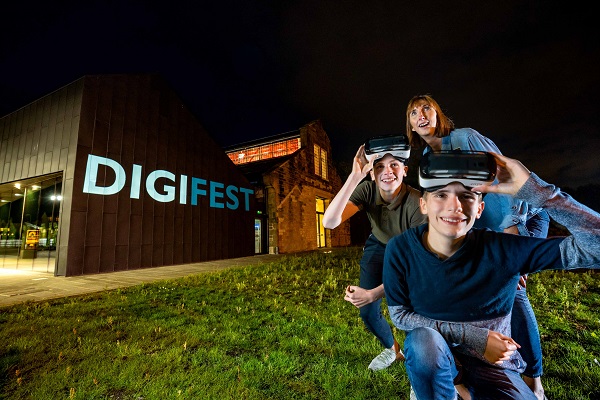
Robbie Coombes (14) and James Hoskins (15) with Dorothy Hoskins (Technical Outreach and Education Manager at the Engine Shed) for the announcement of Historic Environment Scotland’s DigiFest, a festival to showcase digital innovation in the heritage sector taking place at The Engine Shed, Stirling 8 to 20 October 2018. More info from Fergus.Reid@smartscommunicate.com, 0141 222 2040
STIRLING – 29 August 2018: Historic Environment Scotland (HES) today unveiled the programme for a digital heritage festival, a first for Scotland.
Taking place from Monday 8 to Saturday 20 October 2018 at The Engine Shed, Scotland’s dedicated building conservation centre in Stirling, DigiFest will highlight Scotland as a global leader in digital innovation in the heritage sector. Aimed at schools, professionals, families and young people, it will feature a range of free events and activities allowing visitors to explore the latest technologies in areas including 3D modelling and printing, augmented reality, virtual reality, gaming, animation, robotics and coding.
The festival will also incorporate DigiDoc, a two-day international conference running from 11-12 October, and the DigiDoc Research and Innovation Day which takes place on Wednesday 10 October.
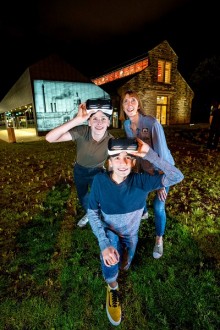
Robbie Coombes (14) and James Hoskins (15) with Dorothy Hoskins (Technical Outreach and Education Manager at the Engine Shed) for the announcement of Historic Environment Scotland’s DigiFest, a festival to showcase digital innovation in the heritage sector taking place at The Engine Shed, Stirling 8 to 20 October 2018. More info from Fergus.Reid@smartscommunicate.com, 0141 222 2040
Showcasing ground-breaking technology, DigiDoc features an impressive speaker line-up of academics and high-profile industry experts from organisations such as Google, the Smithsonian Institution and gaming giant Ubisoft, and is expected to attract professionals in the technology and heritage sectors from across the globe. A selection of speakers will also participate in the DigiFest programme, along with the Engine Shed’s own team of experts.
Dorothy Hoskins, Technical Outreach and Education Manager at the Engine Shed, said: “While advances in technology are allowing us to conserve, monitor and care for our historic sites and buildings with ever-increasing efficiency and effectiveness, these same innovations are also making Scotland’s heritage more accessible than ever. New online platforms and developments in digital technologies are enabling people to inspect historic sites and artefacts from anywhere in the world, while a combination of digital documentation and animation allows for accurate recreation of historic environments which can be explored through gaming. Virtual reality can further bring such environments to life, creating immersive and illuminating experiences that transport the user into the past. We are very excited to be launching our first ever DigiFest, which aims to encourage the people of Scotland and beyond to embrace this opportunity to explore the historic environment in new and innovative ways, and look forward to welcoming some of the top pioneers in the fields of technology and heritage to share their knowledge and insight.”

Robbie Coombes (14) testing Assasins Creed video game for the announcement of Historic Environment Scotland’s DigiFest, a festival to showcase digital innovation in the heritage sector taking place at The Engine Shed, Stirling 8 to 20 October 2018. More info from Fergus.Reid@smartscommunicate.com, 0141 222 2040
DigiFest will offer a range of activities for visitors to get involved in, including demos of action-adventure video game Assassin’s Creed and the chance to hear more about the technologies behind it from the game’s historical researcher, and robot races with Sphero SPRK, a robot toy which teaches children how to code.
There will also be a masterclass on the history of animation, from Stop Motion to the latest Computer-Generated Imagery (CGI), with leading animation and visual effects company Tippett Studio, whose credentials include sequences in the Star Wars, Harry Potter and Twilight franchises. Visitors inspired by the talk can make their own Stop Motion animation films.
In addition to the diverse programme of talks and workshops, DigiFest will see the creation of a “Digital Village” outside the Engine Shed. This will include an immersive reality walk-in dome pioneered by digital content producer Soluis, which facilitates highly immersive VR experiences by enveloping the users’ full field of vision and utilising surround sound.

Ben Mitchell (10) and Ellie Mitchell (6) inspecting a 3D printed model of the Duppland Cross for the announcement of Historic Environment Scotland’s DigiFest, a festival to showcase digital innovation in the heritage sector taking place at The Engine Shed, Stirling 8 to 20 October 2018. More info from Fergus.Reid@smartscommunicate.com, 0141 222 2040
Launched by Historic Environment Scotland in July 2017 as a central hub for building and conservation professionals and the general public, The Engine Shed has seen a highly successful opening year, welcoming over 15,000 visitors and winning a number of awards. The establishment of a public-facing facility, which includes a large scale interactive map allowing visitors to explore over 2000 years of Scotland’s history through the power of augmented reality, aims to engage the next generation with our historic environment and the value of protecting and preserving it.
Delivered by Historic Environment Scotland and supported by Stirling Council, DigiDoc is sponsored by Leica Geosystems, a leading provider of premium 3D laser scanning equipment and services, and DigiFest is sponsored by Creative Scotland.
The full programme for DigiFest and DigiDoc, along with pricing information for the conference and research and innovation day can be viewed at the website: https://www.engineshed.scot/digifest-2018/
DigiFest programme available here.
DigiDoc programme available here.






 From August 29th to September 1st, took place in Rome the 14th International Conference on Urban History organized by the European Association for Urban History.








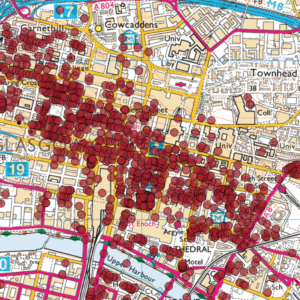

 The conference Europe and Fashion: Questioning Identities and Cultures focused on European sartorial heritage, its collecting and its archiving practices; it explored and contextualised spaces of cultural interactions, displacement and construction of national and transnational identities in the European landscape.
 The conference was organised by the European Fashion Heritage Association in collaboration with The New School – Parsons Paris, IUAV University of Venice and London College of Fashion – University of the Arts London, under the auspices of the French Ministry of Culture. The event was also listed among the initiatives part of “2018 – European Year for Cultural Heritage”.
 South Florida-based artist Luis Valle, who has spraypainted murals across Miami, is a part of a project called “Augmented Reality.” Using an app, Mussa, viewers can have an augmented reality experience and view a 3D model of his artworks. Luis says this particular intersection of technology and art is thrilling and he believes AR will help creatives better connect their work with onlookers, because of its ability to make art more evocative.


 The International Council on Archives (ICA), through the Section on Sport Archives (SPO), aims to make governments and the public aware of the need to preserve and conserve archives belonging to all the individuals, public and private institutions, associations and other organisations linked to the world of sport.