

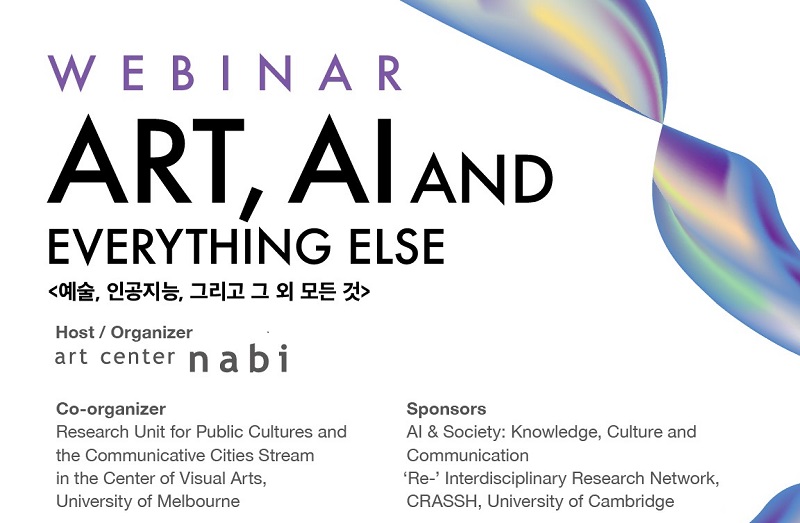
For over two decades, Art Center Nabi in Seoul has been committed to exploring the role of the arts and new technologies to gain new insight in human possibilities and addressing social problems. Nabi has invited artists to develop projects that use technology to overcome social divisions, counter to racial violence, debunk stereotypes, as well as nurture emotional connectedness, cultural engagement, political participation. In general, it has promoted the role of the arts in enhancing social solidarity and operated on the assumption that it can improve the quality of life.
In celebration of two decades of practice Nabi will host a series of web-based seminars.
3 web-based symposia spread over 3 days 3 – 5 December 2020
More info and registration link: http://www.nabi.or.kr/en/page/board_view.php?brd_idx=1084&brd_id=project
Session 1.
Art, Technology and the Cosmos
3 Dec 2020 (Thu) 18:00 ~ 19:30 (KST) / 10:00 ~ 11:30 (CET)
A pan-demic is a good time to evoke the pan-demos. Mobility has become a central feature of contemporary society. Art has been used as an advocate for flow, interaction and exchange, as well as a way of opposing disruption, exploitation and inequality. In this first seminar we throw open the scale of enquiry and experimentation. Art is a technology, and Cosmos is the space-time of everything. However, an ancient definition of cosmos refers to the activity of making a space-time attractive for the Other. The recent developments in contemporary art have been directed towards removing political boundaries and enhancing sociality. When schedules, plans, and models for organizing our ‘liquid life’ are on pause, space-time becomes an object of anxiety. This first session will be surveying the history of technology and how it brings us to the point that we find ourselves. We will zoom out to the widest questions and zoom in to specific examples from recent contemporary practices in art and technology. We will explore the possibilities for critique, and the possibility for art to stimulate sociality and solidarity in an era of masks and the fear of contagion that too easily becomes fear of community. How will artists conduct face-to-face encounters and operate skin-to-skin exchanges? Is a virtual public sphere and life on Zoom enough?
Session 2.
The poverty of philosophy after AI
4 Dec 2020 (Fri) 18:00 ~ 19:30 (KST) / 10:00 ~ 11:30 (CET)
In 2008 Chris Anderson declared that the data deluge had brought about the end of theory. The speed of computation had not only marginalised but eliminated a model of thinking that involved qualitative evaluation. How do we reimagine the role of thinking in action? Is there action without thinking? Has thinking been superseded by technologies of capture, storage and processing? AI and algorithms have been internalised as a normal feature of everyday life. Their banality eludes our attention while summoning deep anxieties. Do we have a vocabulary and conceptual understanding that can keep pace with this change? In this seminar we explore the disjunction between technological advances, modes of thought and models of governance. We question the belatedness of philosophy’s grasp on technology and the consequences of the differential speeds, places and temporalities where technology, thought and politics operate.
Session 3.
Humanizing the Machine/ Mechanizing the Human
5 Dec 2020 (Sat) 14:00 ~ 15:30 (KST) / 06:00 ~ 07:30 (CET)
Tools have always been part of how we define human ‘nature’. Our everyday use can make them feel like parts of our bodies. In habitual use there is constant feedback between us and them. With time and use the border between body and tool dissolves. Now tools also appear as models, but all models, for good or ill, fail us. The dominant understanding of AI flips between two models: either we maintain mastery over the tool, or the technology acquires sufficient agency to consume its master. This seminar goes beyond this dominant paradigm to consider a more fundamental question: what is the intelligence in technology? How do we align our social values and human desires with the dynamism of tools that also remake ‘us’ in the process of using them? If we go beyond the dichotomy between AI as engine of utopia and AI as corporate and exploitative logic, can we also imagine a form of AI that has no utility, one that is not designed according to a service function? Would this perspective allow us to consider ecological modes of intelligence not confined to the human mind, but distributed across and constituted by urban, natural and technological environments?


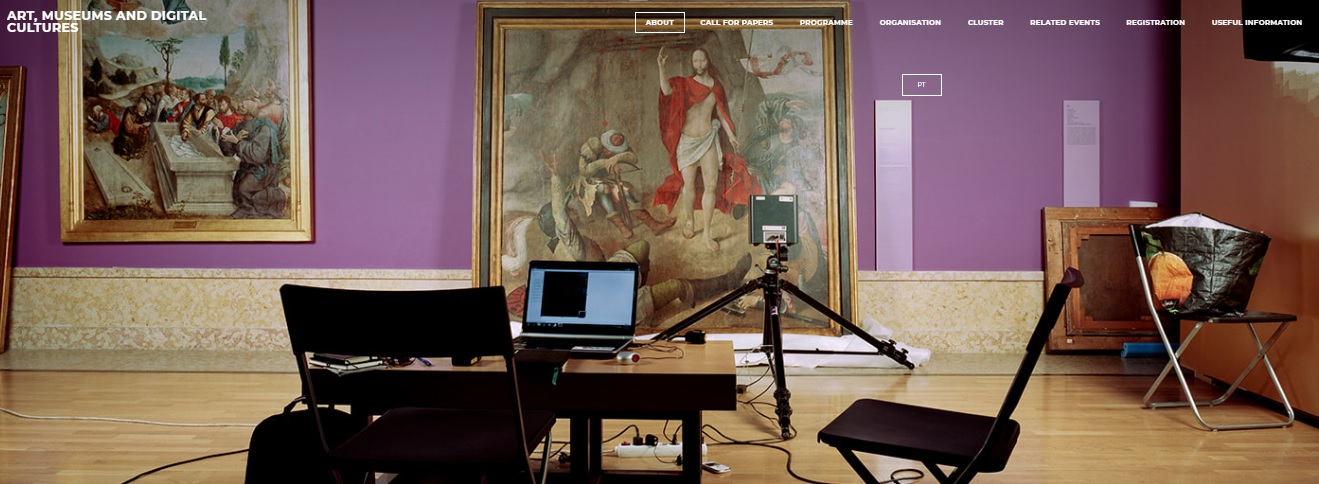 The International Conference on Art, Museums and Digital Cultures will bring together different scientific and creative perspectives on the crossovers between information technologies and the arts. How are museums, curators and the artists themselves responding to the opportunities, but also the risks, of the so-called “digital transformation”?
 Work package 1 of the UNCHARTED project, leaded by the University of Barcelona, is devoted to the analysis of the configuration of the values of culture.
 SOPHIA “Social Platform for Holistic Impact Heritage Assessment” aims to promote collective reflection within the cultural and political sector in Europe on the impact assessment and quality of interventions in European historical environment and cultural heritage at urban level.
 This first edition of the SOPHIA project Newsletter “Cultural Heritage and Impact Assessment” provides a general overview of the mission and challenges of the social platform. It invites to reflect on the importance to assess and evaluate projects dealing with cultural heritage by adopting an holistic point of view.