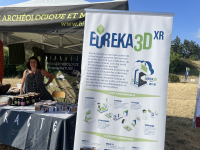


A follow-up course to “Introduction to XR for cultural heritage” is now live on Europeana “Planning XR projects for cultural heritage” is an introductory course that provides a foundation for understanding XR and its applications in cultural heritage, developed as … Continue reading
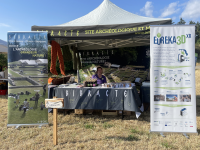
EUreka3D-XR was back in Burgundy for the Roman Days in Autun, where the construction game once again attracted several hundred visitors to the Bibracte stand. This time, there was no demonstration of the application, differently from the event in Arverniales: … Continue reading
Topic: history & archaeology

“Excellent progress: the project has fully achieved its objectives and goals for the period and has even exceeded expectations”. So the European Commission concluded on 19 May, in Bruxelles, its review of the EAGLE project’s activities. The project’s conclusion looks really promising! Stay tuned! Continue reading
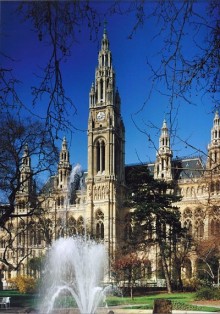
The XX Conference on Cultural Heritage and New Technologies, organised by the Department of Urban Archaeology of Vienna’s Museum, is being held in the Vienna City Hall on 2-4 November 2015. The conference’s call for paper/poster/video expires on 15 June 2015 (deadline extended). This year, the event is dedicated to the theme “Urban Archaeology and Public Relations. New Technologies Enabling Archaeological Outreach” Continue reading
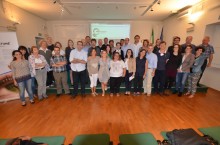
In Bari, from Thursday 24 September to Friday 25 September 2015 the sixth EAGLE international event is being held, under the title “Off the Beaten Track. Epigraphy at the Borders”. Aim of the meeting is to discuss issues and raise questions about encoding inscriptions different from those labelled as standard, even in languages other than Greek and Latin. Organisers intend to address peculiarities that are due to material supports, executing techniques, graphic shapes, non-alphabetical signs and generally visual components relating to the epigraphic texts. Continue reading

The first EAGLE promo video has just been released and is now available on the EAGLE website. The script focuses on the dramatic and compelling story behind the main inscription on the Arch of Septimius Severus in Rome, evoking the whole arc of the subsequent history of Ancient Rome. Continue reading
Did ancient statues living in the traditional museums lose their radiance and divine feature? New technologies, combining 3D imagery and multisensory visitor experience, enable to recreate within an innovative space the ancient splendour of the Greek plastic. Sophie Montel recognises … Continue reading
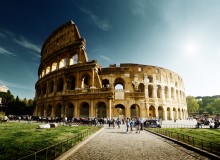
EAGLE 2016 International Conference on Digital and Traditional Epigraphy in Context is the second in a series of international conferences planned by EAGLE BPN. The event will feature presentations and hands-on workshops regarding themes of the EAGLE project, led by the project’s Working Groups. Continue reading
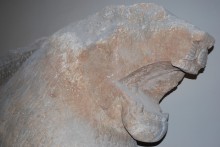
The historically important city of Mosul holds artefacts of huge cultural and historical importance and the Mosul Museum is the second largest museum in Iraq after the National Museum of Iraq in Baghdad. Photo of Ishtar temple lion from Project Mosul website. Photo in public domain. Special thanks go to the volunteers who have submitted the images: Suzanne E. Bott, Col. Mary Prophit, and Diane Siebrandt
Continue reading
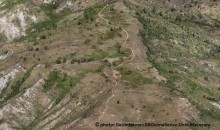
The workshop “Aerial photogrammetry surveys with drones” was held in Tirana, Albania, at the National Museum, on 13 March 2015. It presented examples of aerial photogrammetry surveys conducted by means of drones in the Albanian Drino Valley, Valona Region, in the Hellenistic sites of Hadrianopolis, Jergucat, Frashtan and Antigonea. Continue reading
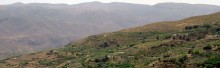
After twenty years of abandonment, and even forty in the case of the branch of La Hijuela, the traditional irrigation system of Barjas (Granada, Spain) was rehabilitated in collaboration with the National and Natural Park of Sierra Nevada and CEAMA. This campaign was undertaken between the months of February and March of 2014, using traditional techniques and knowledge provided by the local irrigators’ community. This activity involved 180 national and international volunteers and concluded with 5 kilometres of the channels restored, including the branch of La Hijuela. Continue reading
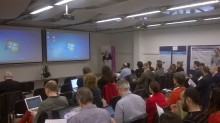
Use and Re-Use of Digital Cultural Heritage Assets – Interoperability, Repositories and Shared infrastructures was the fifth in a series of international events planned by EAGLE BPN. The event, organised by The Cyprus Institute, in collaboration with Heidelberg University and Sapienza, University of Rome, featured presentations and hands-on workshops regarding themes of the EAGLE project. Continue reading