Immersive digital art experiences are becoming more and more popular and art galleries, museums to innovate and differentiate their cultural services
Research project of MA students in the Museums in Context course at the Erasmus University Rotterdam, MA Cultural Economics led by professor Trilce Navarrete.
Authors: Anna Bontempi, Ludovica Giberti, Florent Mortier
All images courtesy of the authors.
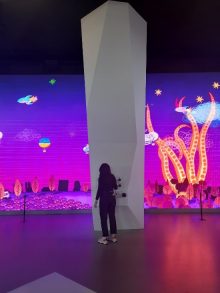
Rotterdam just opened Remastered, the first immersive cultural space in The Netherlands, the cultural space offers an immersive digital experience focused on ‘The old Dutch Masters reimagined by the new Dutch Masters’. The venue covers more than 1.500 m2, 60 state-of-the-art projectors, 50 loudspeakers and high-quality pixels resolution right in the heart of the city, under the Erasmus Bridge.
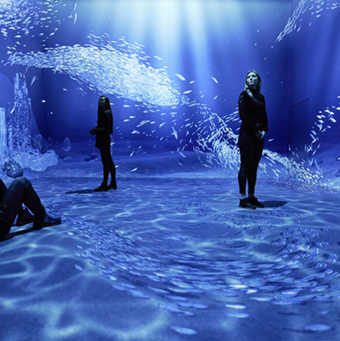
Room 2 Remastered – Underworld – screengrab from Remastered website
Immersive digital art experiences are becoming more and more popular and art galleries, museums, and cultural spaces have started making use of Information and Communication Technologies (ICTs), Virtual Reality (VR), and Augmented Reality (AR) to innovate and differentiate their cultural services in the market. In this regard, one of the most successful examples is the digital art centre Atelier des Lumières in Paris.
‘The role of an art centre is to decompartmentalise, and that is why digital technology is so important in twenty-first-century exhibitions. Used for creative purposes, this technology has become a formidable vector for dissemination, and is capable of creating links between eras, adding dynamism to artistic practices, amplifying emotions, and reaching the largest possible audience’ says Bruno Monnier, President of Culturespaces, the organization aimed to create digital art centers and immersive digital exhibitions around the world among which Atelier des Lumières.
While the Remastered displays the artworks of the old Dutch painters like Van Gogh, Mondrian, and Rembrandt, the Atelier des Lumières designs immersive exhibitions about international artists, artistic movements as well as contemporary creations: in 2018 they dedicated a long successful program to Gustav Klimt, but they reached their peak in 2020 when a scene of the famous Netflix tv series Emily in Paris was shot within their spaces, which brought a remarkable attention on the venue
[https://www.museumnext.com/article/blockbuster-immersive-digital-exhibitions-bloom/].
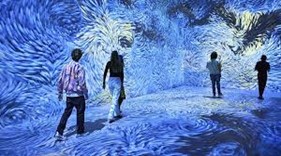
Room 6 Remastered – Van Gogh – screengrab from Remastered website
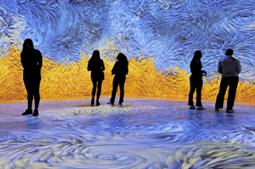
Room 6 Remastered – Van Gogh – screengrab from Remastered website
In order to further understand the role of immersive and digital art experiences and what are the public’s expectations and post-visit perceptions, we conducted a survey on the visitors of the Remastered.
We managed to involve a total of 106 respondents and their contribution helped us understand how digital art experiences are perceived by visitors. Overall, it was found that almost half of the people that filled out the survey were in the 25-34 age group, with a clear female prevalence (66%). It has been in fact difficult to engage with older targets because of language or technological barriers since the survey was only available in English and could be carried out by scanning a QR code. Finally, for what regards the country of origin, the vast majority (91,5%) were from the Netherlands, revealing that the venue is scarcely attended by foreign tourists.
The expectations of the Remastered experience, can be characterized by respondent looking forward to having fun and being entertained (74,5%), while the second most clicked answer was about seeking a new experience (69,8%). These digital art venues are perceived above all as places of entertainment where to spend leisure time, especially for the younger audience, in an environment of beautiful imagery. While it has often been pointed out that many people in visiting museums also have educational purposes, only a number of our respondents (18,9%) were be-looking for an opportunity to learn something.
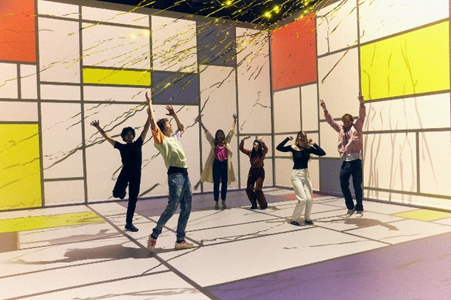
Room 6 Remastered – Mondrian – screengrab from Remastered website
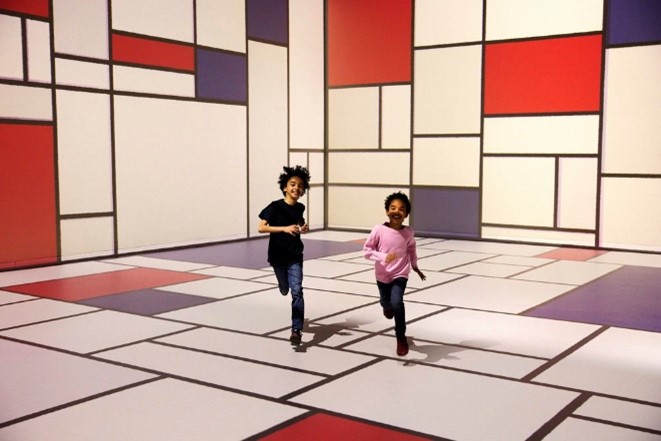
Room 6 Remastered – Mondrian – screengrab from Remastered website
It is also very interesting to note that more than 60 respondents believe that this kind of immersive digital experience may enhance physical museums exhibitions, making them more attractive and worth the visit. Moreover, the majority of respondents (58,5%) would return in the future to Remastered and would recommend it to a friend, even though 41% of them have found the ticket price (24 euros) to be expensive. The majority of respondents (92,5%) already seen at least one of the paintings in person in a museum, which means that visitors are already familiar with the art. The remaining percentage is an important target group not yet captured by museums. When asked to write down the name of one Dutch painter whose artworks were reproduced during the visit, the most frequently mentioned artist was Van Gogh. This is not surprising as Van Gogh has a very recognizable painting style and he is considered a superstar as can be read here and here.
For what concerns post-visit impressions, despite that almost 30% of the visitors have defined the visit as weird and strange, most respondents (71,7%) stated they had fun, and they have described the experience as both exciting (66%) as well as interactive (57,5%). The perception of the experience appears to be aligned with the aim of the venues: to involve and excite their audience by creating a new reality where people can interact with all the senses.
It is conceivable that such digital immersive experiences might be a new and strategic service for museums to enrich, differentiate, and innovate and to wider their audiences. Introducing this type of technology could also renew the public perception of museums, sometimes considered elitist places.
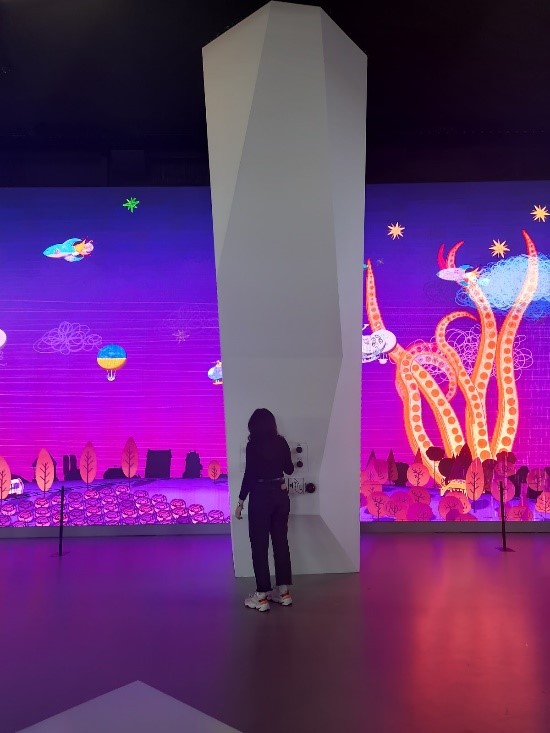
Playground Remastered (source: personal picture)
Museums are recognized as trustworthy institutions, that collect authentic pieces, and this can lead to reflection on another issue, that of authenticity. While it has been argued (Domínguez-Quintero, González-Rodríguez, & Luis Roldán, 2019) that this is a fundamental element people take into account in choosing what to consume in the cultural sector, others (Duerden, 2018) believe people look primarily for entertainment and enjoyment. If consumers seek memorable and engaging experiences, can digital reproductions provide a remarkable and authentic experience comparable to that of the original artworks?
Our respondents agree that digital technologies have helped them to connect emotionally with the artworks during the visit, therefore an interesting line of future research could be developed to better understand the relationship between visitors and digital reproductions or projections. By understanding how the visitors perceive the artworks in a digital format, museums can really start recognising the opportunity that these tools could bring to the physical experience to potentially making it more attractive and visitor-oriented.
Will it be possible to further combine these two contrasting realities even better in the near future?
For further insights about the Remastered in Rotterdam, please visit their You Tube channel Remastered Experience.
Additionally, if you are interested in Atelier des Lumières, please check out Culturespaces Digital on You Tube.
Reference:
Domínguez-Quintero, A. M., González-Rodríguez, M. R., & Roldán, J. L. (2019). The role of authenticity, experience quality, emotions, and satisfaction in a cultural heritage destination. Journal of Heritage Tourism, 14(5-6), 491-505.
Duerden, M. D., Lundberg, N. R., Ward, P., Taniguchi, S. T., Hill, B., Widmer, M. A., & Zabriskie, R. (2018). From ordinary to extraordinary: A framework of experience types. Journal of Leisure Research, 49(3-5), 196-216.












 Every year, starting from the European Year of Cultural Heritage 2018, the
 RomaGenius is an annotation tool designed by four students from the Cultural Studies Master’s program at KU Leuven University. As part of their Cultural Policy course, they collaborated with the Weave/Europeana project and made their contribution by creating a platform where Roma & Non-Roma people can share their knowledge of Roma music by engaging in respectful dialogue and mutual interaction.