Text by Caterina Sbrana.
It might seem difficult to talk about art, ecology and nature, during the pandemic from Covid-19.
Giving the public the opportunity to live the art even when the museums are closed is a challenge that not all museums have picked.
That’s not what happened at the M WOODS museum, in Beijing’s 798 Art District.
Thanks to its Artistic Director and Chief Curator Victor Wang, the health emergency that has affected many communities in China and in the world leaves a space in which the arts can reflect.
We can read the question put by the Director and his staff on the home page of the museum website: “How we then experience art during times of institutional closure: what are the forms that art and art museums must take when galleries become inaccessible to the public?”
The answer is in the online exhibitions inaugurated on February 13 2020, whose title is “Art Is Still Here: A Hypothetical Show for a Closed Museum”.
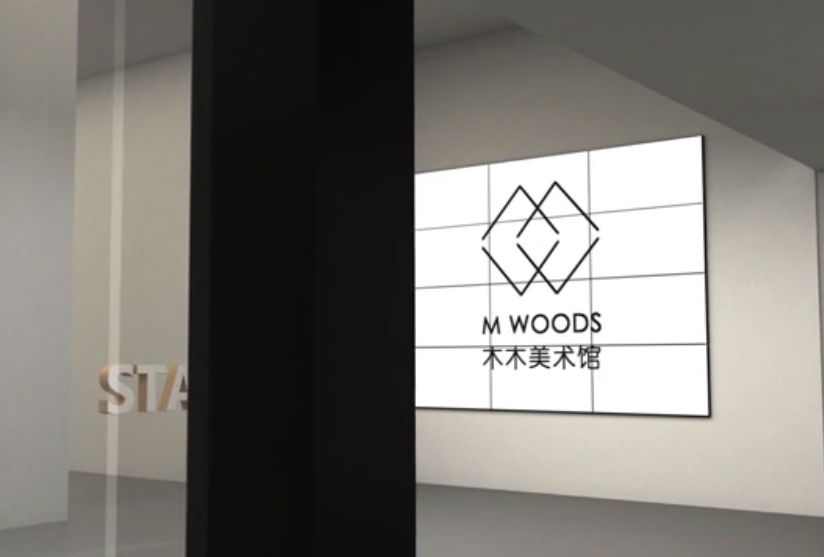
Screenshot image of the home page of M WOODS museum; https://www.mwoods.org/Art-Is-Still-Here-A-Hypothetical-Show-for-a-Closed-Museum
These experimental exhibitions continued for 9 weeks; the museum presented artworks, videos, photographs, and invited many artists to talk about issues such as “ecology, nature, extinction, isolation and kinship”.
Different galleries of the museum have been opened virtually, “with accompanying artworks presented online through the museum’s online platforms – Weibo, WeChat, Instagram and Facebook”.
In the art world, virtual art exhibitions are a groundbreaking concept in the experience of art itself. Social media could connect many communities both locally and internationally, without space or time limits, and share information also during the quarantine period.
I visited some online exhibitions screened in the “Art is still here” series, of which I suggest the vision to the public of DIGITALMEETSCULTURE.NET
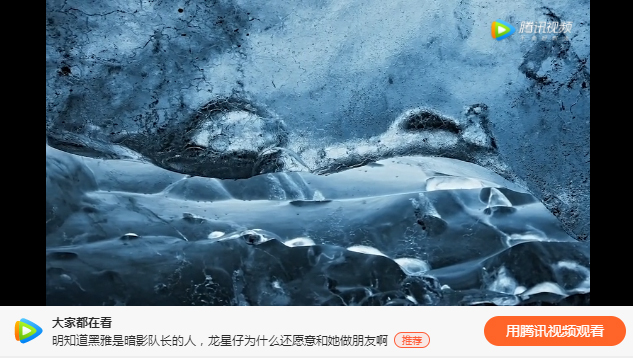
Screenshot image by the M WOODS website, regarding Michael Najjar’s work “Terraforming” (Week 5, Room 5; the image chosen is at 22.22 minute of the video); https://www.mwoods.org/ROOM-0319HZ
The museum dedicated a room to each week. Within the virtual museum rooms we find several artists. Biography, exhibitions and synopsis of the work presented by each artist are written in English. A video, with a comment spoken and written in Chinese, shows the work of the artists.
The German photographer Michael Najjar presented a work titled “Terraforming” in which the artist focuses on the transformation of a natural environment though energy input.
Rodrigo Braga, whose work was presented by the museum along with that of other artists in the Week 9, Room 9, “addresses the conflict between man and nature, human and animal. In Tônus (2012), he ties himself to a goat and attempts to run in a different direction, an action that results in them both spinning endlessly in circles. He also fights the claws of a crab with his bare hand, a duel that ends in stalemate – a metaphor for the human condition in a landscape impossible to tame” (https://www.mwoods.org/ROOM-0416LY)
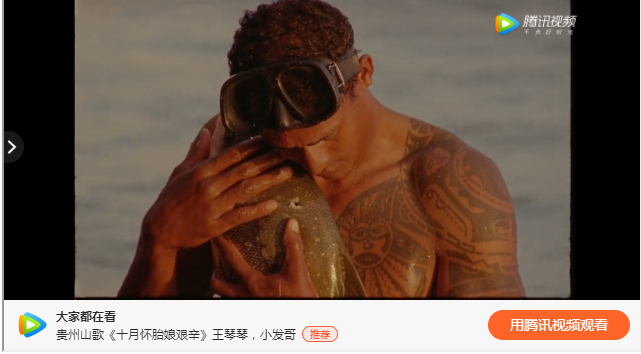
Screenshot by the M WOODS website, regarding Jonathas de Andrade’s work: O Peixe; Week 9, Room 9; the image chosen is at 44.31 minute of the video; https://www.mwoods.org/ROOM-0416LY;
As mentioned on the presentation of the museum, “M WOODS is an independent, not-for-profit art museum founded in 2014 by collectors Lin Han and Wanwan Lei. Across two museum sites, M WOODS 798, housed in a former munitions factory in Beijing’s 798 Art District, and the newly inaugurated M WOODS Hutong, inside the M WOODS Art Community, located in the city’s historic Dongcheng district, present a year-round programme of exhibitions, performances, music, education, live events and talks that situate contemporary art at the heart of the city and beyond”.
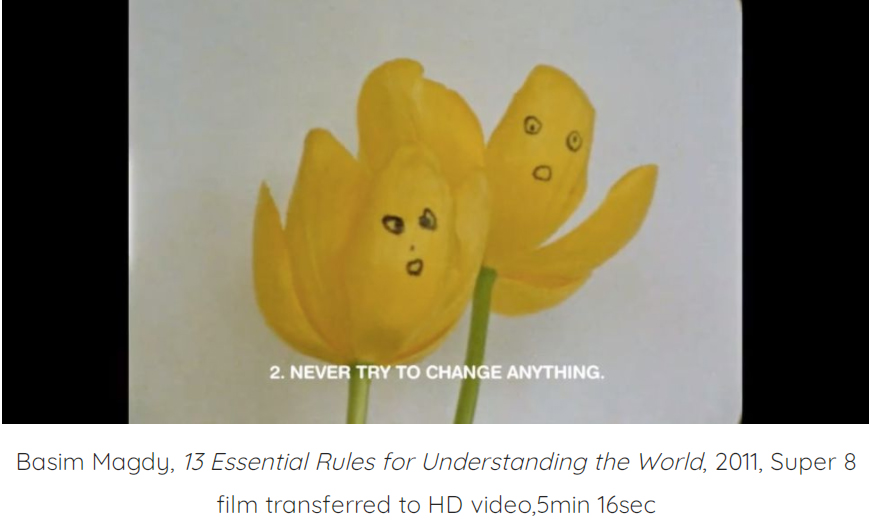
Screenshot by the M WOODS website, regarding Basim Magdy’s work: 13 Essential Rules for Understanding the world 2011; Week 3, Room 3; https://www.mwoods.org/ROOM-0227BS
In 2020, M WOODS was formally granted official heritage museum qualifications by The National Bureau of Cultural Heritage in China.
I really appreciated the exhibitions that the museum presented, the artists chosen and the themes that these artists use in their artworks that I consider very topical.
I think it is important to reflect on the response that humans can give to serious events such as that of a pandemic, their reaction that demonstrates the will to continue to live and to surround themselves with the beauty of art, their choice to use digital technologies to reach not only the usual audience of the museums, but a much wider audience making art accessible at all times and in all circumstances.
In the museum presentation page we read “Remaining dynamic and experimental, at the core of M WOODS is the idea that art should be ‘Free, Alchemical, and Timeless’ (FAT)”, an extremely concise but effective definition of art with which I fully agree.
https://www.mwoods.org
https://www.mwoods.org/About-M-WOODS
https://www.mwoods.org/ROOM-0319HZ
https://www.mwoods.org/ROOM-0416LY
https://www.mwoods.org/ROOM-0227BS




 Google Arts and Culture (GA&C) is now a major portal through which users can experience artworks and cultural artifacts from over 2000 galleries, libraries, archives and museums (GLAM), from over 80 countries, worldwide. While the portal attracts large audiences, there has been next-to-no published research on the GLAM sector experience of GA&C. What is attractive about the platform to institutions? What benefits does it provide to the partner organisation? What was the experience of preparing and submitting material to GA&C? What issues are there regarding labour, permissions, copyright, and sustainability? What lasting effects will it have on the sector?
 Digital Past is an annual two-day conference organised by the Royal Commission on the Ancient and Historical Monuments of Wales. It showcases innovative digital technologies and techniques for data capture, interpretation and dissemination of the heritage of Wales, the UK and beyond.
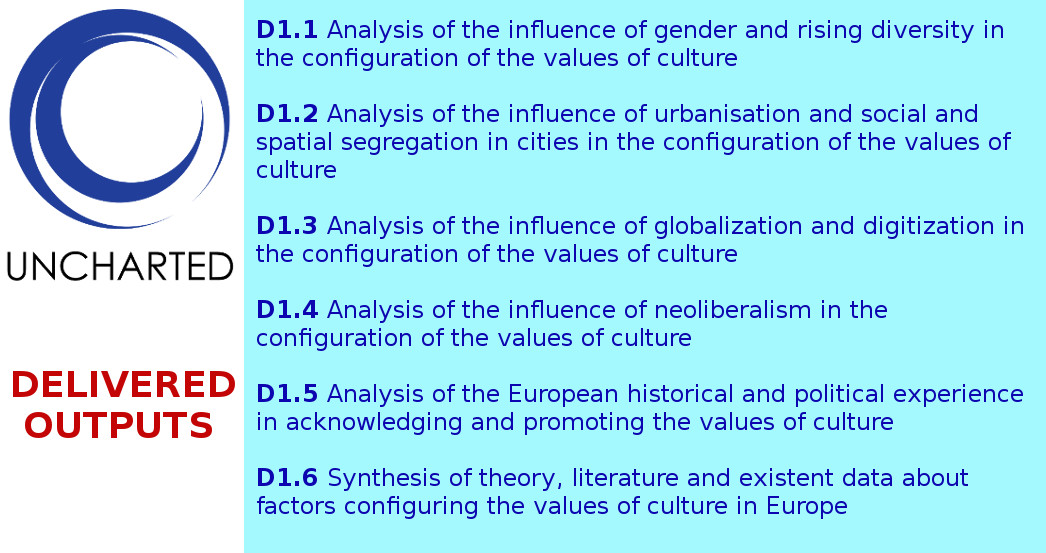 After the publication of the first outputs of its investigation, UNCHARTED presents the sixth and final deliverable of the


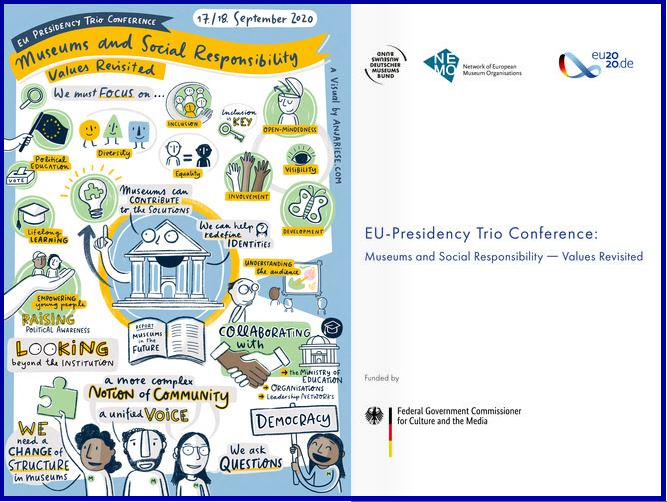 As the result of the online conference “Museums and social responsibility—values revisited” organised in the framework of