
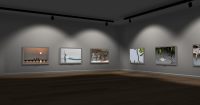
OpenVGal is an open-source 3D virtual gallery for people and institutions that already have digitized photographs or artwork images. It lets them show the work in a walkable room instead of a page of thumbnails. The exhibition is a folder … Continue reading

Join the European Heritage Hub to its upcoming Policy Talk, ‘INNOVATE. PROTECT. EMPOWER. How cultural heritage can make Public AI a reality’, taking place online on 29 September, from 16:00 to 18:00 CET. The Policy Talk will explore the vision … Continue reading
Topic: EU projects
The 3-day EUDAT conference, 28-30 October 2013 – Rome, Italy, addresses new data challenges – the case for cross-disciplinary science and services – in view of the EC’s forthcoming Horizon 2020 programme. International e-infrastructure cooperation and collaboration benefits are high on the agenda, with a particular focus on the recently launched RDA. The community-driven initiatives collaborating with EUDAT will also take an active role in the interactive discussions through associated workshops taking EUDAT synergies to new levels. Continue reading
The event is very wide. For this reason, to provide an effective way for participants to explore such a rich and diverse program, Digital Heritage 2013 built an interactive schedule featuring social networking, a personal agenda builder, dynamic attendee directories, and more. Users can view the schedule in list, grid, and other forms as well as on mobile devices. Continue reading
The session was intended to foster knowledge exchange and networking actions to address a very common and shared issue from different points of view and backgrounds, also in the light of enabling a true and exploitable creative re-use of the digital content available in Europeana and in other online collections. Continue reading
Towards an e-infrastructure for the Digital Cultural Heritage sector and the humanities research: which are the needs and the requirements of the DCH?
How can this sector benefit from the new and innovative solutions offered by the e-Infrastructures?
Experts tries to answer these question. Continue reading
The need for novel more efficient and affordable solutions for digital preservation is increasing in the Social Science and Humanities. The workshop presented the advancements in the state of the art, to understand which could be the benefits offered, in particular to the Digital Cultural Heritage sector, by the new technologies and e-infrastructures. Continue reading
Intermediate objective is to deliver to Europeana a huge number of metadata, in order to publish a first batch of images to witness the history of Europe and the art of photography in the period 1839-1939. The images are supposed to be on line and accessible to everyone by early 2014, and for this reason EuropeanaPhotography content providers are working closely to the technical deadlines to allow this result. Continue reading
The Linked Heritage project draws to a close at the end of September 2013. Linked Heritage – with the strapline, ‘Share culture, link content’ – was a content-focused project, which aimed to bring large quantities of content into Europeana, to enhance metadata quality and to improve the search, retrieval and re-use of Europeana content. Continue reading
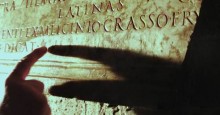
Europeana Professional recently published an interesting article related to Eagle project, a best practice network that brings together the most prominent European institutions and archives in the field of Classical Latin and Greek epigraphy to provide Europeana with a comprehensive collection of unique historical sources which constitute a veritable pillar of European culture. Continue reading
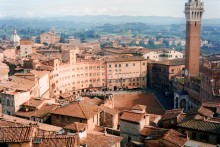
The annual event organized by Polis (Polo di Innovazione delle Tecnologie per la Città Sostenibile – Innovation Pole of the Technologies for a Sustainable City) was held in the Engineering College of Siena’s University on the 26th – 27th September 2013. It has hosted two days of debate about the “Smart Specialization Strategy” general topic, structured on the three Polis themes MOBILITY, CULTURAL HERITAGE and SUSTAINABLE BUILDING. Continue reading
The shared vision of the INDICATE network is that in ten years’ time, access and use of digital cultural heritage will be available to all and that collaboration with the e-Infrastructures community will facilitate realisation of this vision. Continue reading