

OpenVGal is an open-source 3D virtual gallery for people and institutions that already have digitized photographs or artwork images. It lets them show the work in a walkable room instead of a page of thumbnails. The exhibition is a folder … Continue reading
Join the European Heritage Hub to its upcoming Policy Talk, ‘INNOVATE. PROTECT. EMPOWER. How cultural heritage can make Public AI a reality’, taking place online on 29 September, from 16:00 to 18:00 CET. The Policy Talk will explore the vision … Continue reading
Topic: EU projects
Digital Humanities Awards are a new set of annual awards given in recognition of talent and expertise in the digital humanities community and are nominated and voted for entirely by the public. There is no financial prize associated with these community awards, just the honour of having won and an icon for your website. By its work at making available, with the most advanced digital technologies’ support, the vast majority of the surviving inscriptions from the Greco-Roman world, we think EAGLE can be a valid and qualified competitor for 2013’s edition of DH Awards. Continue reading

The Digital Scholarly Editions Initial Training Network (DiXiT) offers 12 fellowships to Early Stage Researchers (ESRs) for a period of 3 years and 5 fellowships to Experienced Researchers (ERs) for a period of 12 to 20 months. Fellowships are now open for applications (except 4 ER fellowships which will start at a later date). Continue reading
«EVA 2013 Moscow, Information society, culture, education»: the theme of this edition was «Libraries and museums in digital environment: dialogue and cooperation». EuropeanaPhotography was presented at the conference with a good speech, and distribution of flyers. Moreover, possible cooperation with local Institutions was deeply discussed. Several people asked questions, mainly about how their Institution can join the project and how Russian organizations can be involved. Continue reading
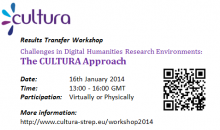
Supporting researchers in exploring and examining digitised artefacts presents many challenges in terms of understanding each researcher’s needs, performing appropriate manipulation of and uplift from content, and in presenting a suite of useful research tools to facilitate exploration. This virtual/physical workshop will use CULTURA as a case study to drive discussion by presenting demonstrations and results from the project. The outputs of this workshop will be captured and placed online. Continue reading
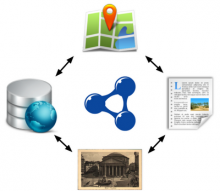
EAGLE (the Europeana network of Ancient Greek and Latin Epigraphy) joins Pelagios, a collective projects which aims to help introduce Linked Open Data goodness into online resources that refer to places in the historic past. By joining Pelagios, EAGLE will be able to connect with other major online projects about the Ancient World and make its data accessible to other aggregator and LOD projects. Continue reading
The EUDAT 2nd conference held on 28-30 Oct 2013 in Rome, was the ideal setting to showcase these services and outline the roll out phase as well as to offer hands-on training. Discussions on the new set of EUDAT services were also a feature of the conference with semantic annotation, dynamic data & workflows addressed, a natural follow on to the Working Group discussions that were held in Barcelona in Sept. 2013. Continue reading
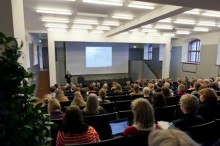
The project coordinator prof. Fred Truyen and his assistant Sofie Taes were invited for a lecture at the National Museum of Finland in Helsinki, during the Photo Archive Days. Finland is not represented (yet!) in the EuropeanaPhotography consortium but the event was useful to start a dialogue and relationships with representatives from the Finnish archives and museums. Continue reading
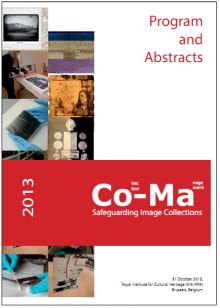
The 31st of October 2013, Brussels’ IRPA (Royal Institute for Cultural Heritage) hosted a 1-day conference on issues in the management of photographic collections: CO-MA. A small exhibition of IRPA’s photographic collection accompanied the conference. Continue reading

The AIUCD (Associazione Italiana per l’Informatica Umanistica e la Cultura Digitale) annual conference, devoted to any aspect of the digital humanities, was held in Padua on 11-12 December 2013. Continue reading

IRCDL is a yearly conference for Italian researchers on Digital Libraries related topics. The aim of IRCDL 2014 is once more to provide the opportunity to explore new ideas, techniques and tools and to exchange experiences also from on-going projects. Continue reading