
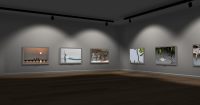
OpenVGal is an open-source 3D virtual gallery for people and institutions that already have digitized photographs or artwork images. It lets them show the work in a walkable room instead of a page of thumbnails. The exhibition is a folder … Continue reading
Join the European Heritage Hub to its upcoming Policy Talk, ‘INNOVATE. PROTECT. EMPOWER. How cultural heritage can make Public AI a reality’, taking place online on 29 September, from 16:00 to 18:00 CET. The Policy Talk will explore the vision … Continue reading
Topic: art & new media technologies
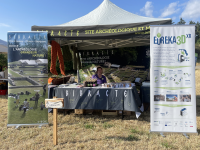
Last month EBN welcomed ADDICT – Creative Industries Portugal, the Creative Industries Agency in Portugal. ADDICT is a non-profit association created in 2008. It currently gathers around 100 members and is recognised by the Ministry for Economy as the coordinator of the Creative Industries Cluster in Portugal. ADDICT’s mission is to foster a favourable environment for culture and creative economy to thrive, advocating the sector interests and acting as platform for knowledge and innovation. Continue reading
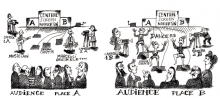
Ultraorbism was an interactive distributed action between two networked connected spaces in two cities: Barcelona and Falmouth. The story was a linear interpretation of the first of the two books of True Story by Lucian of Samosata (a Syrian writer who lived in the second century AD), who tells an impossible journey on which everything is invented, with references to the mythology and literature of the era. Ultraorbism, a project directed by Marcel•lí Antúnez Roca, is part of the European project SPECIFI and case study of the RICHES European project’s research area. Continue reading
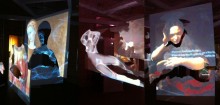
Ballade of Women is an interactive installation that explores perspectives on women’s rights. Through the lens of the personal experience of three women, the exhibition offers an interactive narration on three fundamental themes: emancipation, self-determination and violence. In the installation, representations of three paintings are fragmented and float in the space; set on rotating spindles, these fragments resist attempts by the viewer to capture them as a whole. Thus, the screens only provide a complete view of the paintings at selected times and from specific view-points in the room… Continue reading
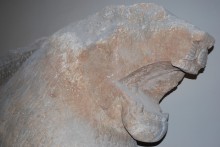
The historically important city of Mosul holds artefacts of huge cultural and historical importance and the Mosul Museum is the second largest museum in Iraq after the National Museum of Iraq in Baghdad. Photo of Ishtar temple lion from Project Mosul website. Photo in public domain. Special thanks go to the volunteers who have submitted the images: Suzanne E. Bott, Col. Mary Prophit, and Diane Siebrandt
Continue reading
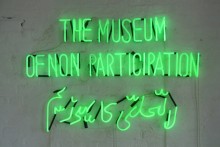
The Museum of Non Participation embeds its institutional critique in its very title, yet it releases itself from being an actual museum. Instead it travels as a place, a slogan, a banner, a performance, a newspaper, a film, an intervention, an occupation: situations that enable this museum to “act.” Continue reading

The CSA (Audiovisual Experimental Center) is a workshop for cine-audiovisual shooting, which was established during the academic year 2013-14, as part of the “Prosmart” master’s degree (in Prato), promoted by University of Florence in partnership with PIN (the University Center … Continue reading
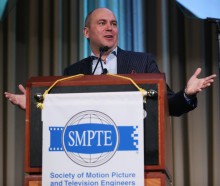
Society of Motion Picture and Television Engineers organises the SMPTE Forum 2015 “Entertainment Technology in the Internet Age: A European Perspective”, being held on 7-8 May 2015, at the Fraunhofer-Forum in Berlin. Factors as wide as EU policy, net neutrality, copyright and mining “big data” are shaping the possibilities in the complex European market and redefining how the industry engages its audience. The SMPTE Forum 2015 will examine these topics Continue reading

FutureEverything celebrated its 20th anniversary. For the last two decades the festival has brought people together to imagine, shape and question the vision of a truly participatory society. A belief in the emancipatory and creative potential of new technologies runs throughout digital culture. It is found both in the open source community and in the rhetoric of Silicon Valley start-ups. In recent years, the contradictions in this vision have come to the surface. The digital age has brought a collision of positives and negatives. This year was an ideal opportunity for FutureEverything to hit pause on its headlong rush into the future, to reflect on the consequences of the past decades and the prospects for the decades to come. Continue reading
On 10 February 2015, at the Salle Triangle of Centre Pompidou, in Paris, is being held the seminar “Social Hermeneutic Networks”, centred on the topic “museology, museography and new forms of address to the public”; Alain Garnier, Yuk Hui and Henry Story are intervening in the event. The seminar will show how the social network can become matter of study and subject of a dissertation or a course, as well as tool for the student, the researcher or the non-professional user. Continue reading

Coventry University Centre for Dance Research (C-DaRE, http://c-dare.co.uk/) held the 5th edition of the Digital Echoes Symposium. Digital Echoes Symposium 2015: Intangible and Performance-based Cultural Heritage 13 February 2015, Institute for Creative Enterprise, Coventry University Convenors: Sarah Whatley, Rosamaria Cisneros, Amalia Sabiescu Digital … Continue reading