
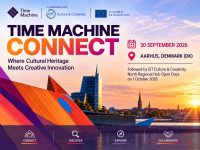
Time Machine Connect 2026 (September 30, Aarhus) brings together the Time Machine Organisation (TMO) and EIT Culture & Creativity communities in Aarhus to explore how cultural heritage data, digital technologies and creative expertise can come together to create new opportunities … Continue reading
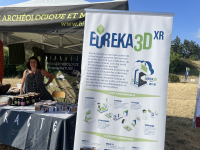
This Gallic archaeology festival takes place every year at the Gergovie oppidum, the very place where the Gauls famously resisted the Roman invaders. Around 300 people visited the Bibracte stand, where they could discover the EUreka3D-XR project. Nearly 150 visitors … Continue reading
EUreka3D-XR project’s partner Bibracte has organized an onsite workshop focused on the AR Tour Experience tool developed within the project: Bibracte is inviting heritage, tourism or education professionals that want to enrich the experience of their audiences with immersive technologies. … Continue reading
Area: digital heritage
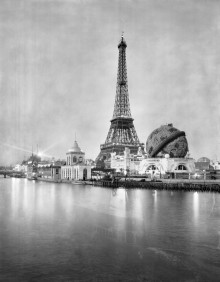
A valuable workshop organized in the framework of EuropeanaPhotography took place in Paris on 14th-15th November 2013. The workshop was one day and half including presentations and round table discussion, focusing on IPR issues related to digital content and to the … Continue reading
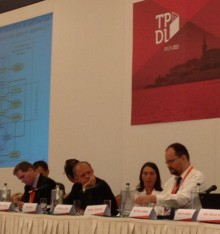
The International Conference on Theory and Practice of Digital Libraries (TPDL) constitutes a leading scientific forum on digital libraries that brings together researchers, developers, content providers and users in the field of digital libraries. TPDL 2013, the 17th edition of the conference, has organized by University of Malta and it was held in Valletta, Malta on September 22-26, 2013. Continue reading
Alongside the great new logo, EAGLE have also launched their website and project tagline – ‘A digital bridge to the ancient world’. The rich, detailed and intuitive website (www.eagle-network.eu) contains all the information relevant to the project, including contact information, upcoming events and schedules, and a detailed description of partner institutions and their contributions. Continue reading
The goal of this study, prepared for the European Commission, is to evaluate the feasibility of delivering an integrated Authentication and Authorisation Infrastructure to help the emergence of a robust platform for access to and preservation of scientific information within a Scientific Data Infrastructure. Continue reading
The 3-day EUDAT conference, 28-30 October 2013 – Rome, Italy, addresses new data challenges – the case for cross-disciplinary science and services – in view of the EC’s forthcoming Horizon 2020 programme. International e-infrastructure cooperation and collaboration benefits are high on the agenda, with a particular focus on the recently launched RDA. The community-driven initiatives collaborating with EUDAT will also take an active role in the interactive discussions through associated workshops taking EUDAT synergies to new levels. Continue reading
The goal of this workshop was to provide researchers and practitioners in the fields of Digital Libraries, e-Science, and e-Research, with a forum where they can constructively explore foundational, organizational and systemic challenges in contexts having publishing, interlinking, preservation, discovery, access, and reuse of publications and datasets as focal points. Continue reading
The event is very wide. For this reason, to provide an effective way for participants to explore such a rich and diverse program, Digital Heritage 2013 built an interactive schedule featuring social networking, a personal agenda builder, dynamic attendee directories, and more. Users can view the schedule in list, grid, and other forms as well as on mobile devices. Continue reading
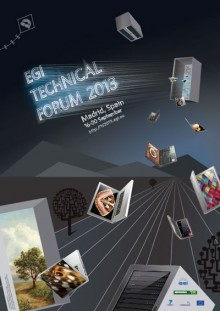
The EGI Technical Forum 2013 was held in Madrid at the Meliá-Castilla Hotel & Convention Centre. The event was being organised with the support of the Ministry of Economy and Competitiveness of Spain, the Spanish National Research Council and Red IRIS. On 18th september was scheduled a workshop on VRC Project cases with a presentation related to DCH-RP project that it was taken by R.Vanderbroucke and A. Fresa… Continue reading
The session was intended to foster knowledge exchange and networking actions to address a very common and shared issue from different points of view and backgrounds, also in the light of enabling a true and exploitable creative re-use of the digital content available in Europeana and in other online collections. Continue reading
The need for novel more efficient and affordable solutions for digital preservation is increasing in the Social Science and Humanities. The workshop presented the advancements in the state of the art, to understand which could be the benefits offered, in particular to the Digital Cultural Heritage sector, by the new technologies and e-infrastructures. Continue reading