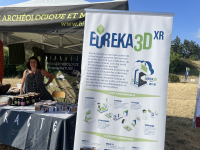

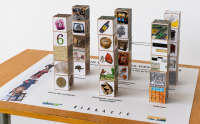
Developed by project partner Bibracte in the context of EUreka3D-XR, two Open Educational Resources (OER) on XR technologies and cultural heritage: “On the Shoulders of the Celts – How yesterday’s inventions have made today’s digital world possible“, a step-by-step guidance … Continue reading
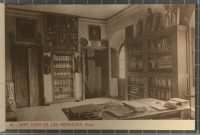
Paper for the 19th Image and Research Conference in Girona, 19-20 November 2026. Abstract Historical photographic archives contain considerably more information than the comparatively small number of images traditionally selected for digitisation and publication. United Archives is therefore developing a … Continue reading
Starting today, it is possible to explore every single object that has been ingested on Europeana through EUreka3D-XR project. Produced by project coordinator Photoconsortium, two new galleries are now available on Europeana: one where all the 3D digitised, reconstructed and … Continue reading
Area: digital heritage
The Linked Heritage project draws to a close at the end of September 2013. Linked Heritage – with the strapline, ‘Share culture, link content’ – was a content-focused project, which aimed to bring large quantities of content into Europeana, to enhance metadata quality and to improve the search, retrieval and re-use of Europeana content. Continue reading
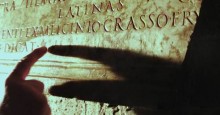
Europeana Professional recently published an interesting article related to Eagle project, a best practice network that brings together the most prominent European institutions and archives in the field of Classical Latin and Greek epigraphy to provide Europeana with a comprehensive collection of unique historical sources which constitute a veritable pillar of European culture. Continue reading
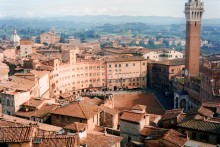
The annual event organized by Polis (Polo di Innovazione delle Tecnologie per la Città Sostenibile – Innovation Pole of the Technologies for a Sustainable City) was held in the Engineering College of Siena’s University on the 26th – 27th September 2013. It has hosted two days of debate about the “Smart Specialization Strategy” general topic, structured on the three Polis themes MOBILITY, CULTURAL HERITAGE and SUSTAINABLE BUILDING. Continue reading
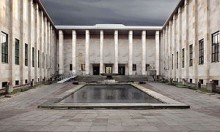
On 14-15 October 2013 the National Museum in Warsaw has hosted the international seminar Photography – Museum Narratives. The seminar was organized by the Archaeology of Photography Foundation, in collaboration with the National Museum in Warsaw and National Institute of Museology and Collections Protection. Continue reading
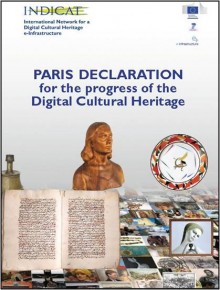
The shared vision of the INDICATE network is that in ten years’ time, access and use of digital cultural heritage will be available to all and that collaboration with the e-Infrastructures community will facilitate realisation of this vision. Continue reading

On the 12-13 November 2013, at the Jerusalem’s Van Leer Institute, is being held the Xth Annual International Event for Professionals in Cultural Heritage and Advanced Technologies. Scholars from all-over-the-world are invited to share their latest projects with the colleagues with a seven-minutes spot-light. Continue reading
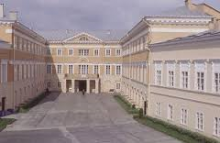
LAM is a national museum based in Vilnius, originally founded in 1933, it takes an active role in regularly organizing exhibitions and cultural events and in connection of the opening of a travelling exhibition and an internationa conference about ancient photography and digitization, it was chosen to host the third plenary meeting of EuropeanaPhotography project. Continue reading
Sciencegateway.org organises a Science Gateway Institute workshop co-located with IEEE Cluster 2013 Conference. Papers will be co-publishing in a special issue of Concurrency and Computation, Practice and Experience (http://www.cc-pe.net/journalinfo/) together with selected papers presented at the International Workshop on Science Gateways 2013 (http://www.iwsg2013.org). Continue reading
A flexible and dynamic ecosystem, providing integrated services through interoperable infrastructures. It should be open and accessible, and continuously adapting to the changing requirements of research and to new technological opportunities. Continue reading
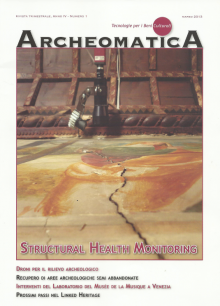
The n. 21 issue of the Italian magazine Archeomatica includes as “guest paper” a wide overview about Linked Heritage. The article, in English language, was written by dr. Antonella Fresa and dr. Claudio Prandoni, the Technical Coordination of the project. Continue reading