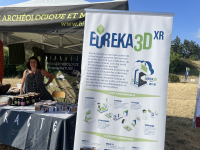

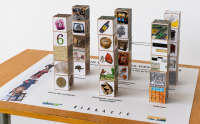
Developed by project partner Bibracte in the context of EUreka3D-XR, two Open Educational Resources (OER) on XR technologies and cultural heritage: “On the Shoulders of the Celts – How yesterday’s inventions have made today’s digital world possible“, a step-by-step guidance … Continue reading
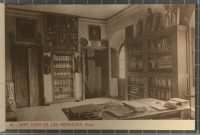
Paper for the 19th Image and Research Conference in Girona, 19-20 November 2026. Abstract Historical photographic archives contain considerably more information than the comparatively small number of images traditionally selected for digitisation and publication. United Archives is therefore developing a … Continue reading
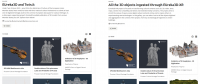
Starting today, it is possible to explore every single object that has been ingested on Europeana through EUreka3D-XR project. Produced by project coordinator Photoconsortium, two new galleries are now available on Europeana: one where all the 3D digitised, reconstructed and … Continue reading
Area: digital heritage
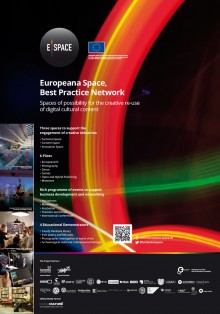
Europeana Space brand new poster has been presented at the International Conference on Information Technologies for Epigraphy and Digital Cultural Heritage in the Ancient World organised by the EAGLE project. The poster is also showcased in the Conference Digital Exhibition web page. Continue reading

The open source semantic annotation tool Pundit is RICHES Associate Net7’s main product for the Digital Humanities. The main idea behind semantic annotation is to enable users not only to comment, bookmark or tag web pages, but also to semantically create structured data while annotating. The ability to express semantically typed relations among resources, relying on ontologies and specific vocabularies, not only enables users to express unambiguous and precise semantics, but also, more interestingly, fosters the reuse of such knowledge within other web applications. Continue reading
On 2 October 2014, the European Commission published two reports, coinciding with the international conference held in Rome, at the National Central Library, on occasion of the Italian Presidency of the EU. The conference aimed at urging cultural institutions in Europe to put more cultural heritage online, with the government support. The Commission will continue to monitor progress in this area through periodic reports and by chairing expert groups on digitisation and digital preservation and monitoring the correct transposition of the Orphan Works Directive. Continue reading
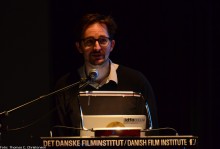
A presentation of PREFORMA has been delivered by Erwin Verbruggen at the workshop “Digital AV Archiving Workflows; Digitisation, Ingest, Preservation, Conversion, and Delivery” organised on 22 and 23 September 2014 in Copenhagen by the PRESTO4U project. Continue reading

The International Image Interoperability Framework community is hosting a one day information sharing event at the British Library on Monday 20th October 2014 about the use of images in and across Cultural Heritage institutions. The day will focus on how museums, … Continue reading
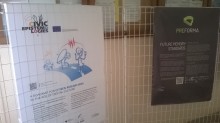
A poster of PREFORMA has been presented at the International Conference on Information Technologies for Epigraphy and Digital Cultural Heritage in the Ancient World organised by the EAGLE project. The poster is also showcased in the Conference Digital Exhibition web page. Continue reading
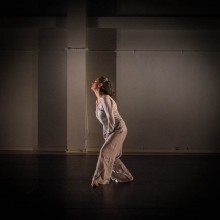
Decoda has supported the Dance E-Space Pilot since Summer 2014 by including us in the Summer Dancing Festival 2014. They have been instrumental in connecting the Pilot partners with various freelance artists, practitioners, teachers, learners and researchers. Decoda has played a crucial role in finding a range of content which the Pilot is now using to test its applications. Photo: Christian Kipp and Summer Dancing/Decoda. Continue reading
Antonella Fresa, Technical Coordinator of Europeana Space project, says: “This is a golden opportunity for the creative industries, for the cultural institutions, for students and researchers, for anybody interested in the new scenario of digital cultural heritage. This is the occasion to learn what is happening in this sector: join us, follow us on our blog, website and social networks!” Continue reading
The Jornades APP, organized by The Generalitat de Catalunya – Departament de Cultura (GENCAT), i2Cat and Kònic thtr, will be held during the 1st, 2nd and 3rd of October at the headquarters of the CaixaForum in Girona city (Catalonia). For … Continue reading
The Cooperation Agreement that has been signed between SCIDIP-ES and DCH-RP mainly concernes the collaboration and exchange of tools and services for digital preservation of – in this case – cultural assets. Continue reading