



“My works consists of photomanipulated images. I take individual pictures of objects or whatever I want, and then shape them and assemble them to create a composition, which can be a landscape, a scene of everyday life, and much more. My style is a bit fantasy, leaving all of the work to my imagination. As regards to the technique, I apply an artistic style, transforming the photomanipulation into something pictorial. Often it is used to make things inherently photorealistic.” Continue reading
Collide@CERN is part of CERN’s policy for engagement with the arts, Great Arts for Great Science, initiated and launched by the laboratory in 2011. It is an annual international competition that will run for a period of three years. Continue reading
After beginning his career as an oil painter, the digital artist known as Shichigoro has found his way into further explorations of his themes through Photoshop. Mixing biology with organic machines, his work is influenced by anime and manga. Continue reading
As digital art continues to impact contemporary art, teachers in the United States are finding innovative approaches to design. We recently caught up with Bill Blidy, a high school teacher who began his career with technology and someone who has been “tweaking” the way digital technology can enhance his students’ visions. An interisting interview by our US correspondent James and Maria Huntley. Continue reading
Currently a full professor in the School of Art and Design at the University of Illinois, Gerald Guthrie began his career as a printmaker but began to teach himself 3D modeling and animation in 1996. Since then, he has added digital art to his repertoire and has exhibited in many animation festivals around the world. Interview by US correspondents James and Maria Huntley. Continue reading
“Building virtual environments as an art activity promotes a complex opportunity to investigate the dynamics of perception and communication.” Margaret Dolinsky has been working with virtual environments since 1995, creating interactive art experiences that have been exhibited internationally including China, Japan and Austria. Interview by US correspondents James and Maria Huntley. Continue reading
A very interesting piece just appeared on Fast Company digital edition, by Adam Bluestein. He had an interview with dr. Stefan Sinclair, associate professor of digital humanities at McGill University’s Department of Languages, Literatures and Cultures, in Montreal Canada. Continue reading
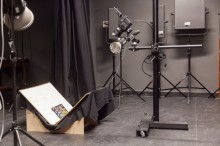
Founded in 1425, KU Leuven combines a rich tradition with top research and technology. Bruno Vandermuelen from the Faculty of Letters talks about the digitization facilities available at the University digital lab, helping digitization for EuropeanaPhotography EC project and other art-technical research in cultural heritage. Continue reading
Founded in 1425, KU Leuven bears the double honor of being the oldest existing Catholic university in the world and the oldest university in the Low Countries. KU Leuven combines a rich tradition with top research & technology. There are more than 38.000 students, about 2000 academic staff and more than 4000 junior researchers. Continue reading
Artist Jared Bendis likes to make light of his self-described title as the “man of many hats,” but this innovator has many insights and opinions about the new technologies that are affecting the contemporary art world. As the Creative New Media Officer at Case Western Reserve University, he works with the latest trends concerning technologies in our “digital” existence on a daily basis. Continue reading