


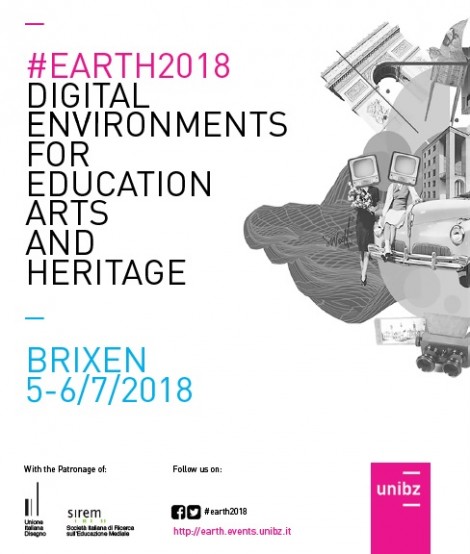
 The meanings that are defined in relation to the concept of heritage as well as the methods and tools for exploring cultural heritage have changed and expanded. In this context, information technologies offer new semantic spaces and action boundaries to experiment with different approaches to heritage education. This determines an increasingly complex intertwining of media and environments with the consequence that any artifact can be configured as a digital ecosystem. In this sense, virtual museums, multimedia installations, interactive technological platforms, as well as apps, serious games and immersive realities, are some of the possible variations of the digital environment in which to place innovative modes of education to tangible and intangible heritage. Collective and connective intelligences enter into a relationship to build new experiences with art and heritage towards an awareness of the protection of the creative expressions of civilizations.
CALL FOR PAPERS – submission deadline 12 May
In relation to what is described, we expect contributions that present case studies in the field of heritage education in digital environments, innovative experiments in the field of digital representation and methodological reflections on the use of IT tools in various educational contexts.
- Digital representation technologies
- Virtual Museums and Virtual Exhibitions
- Virtual, Augmented or Mixed Reality
- Digital Heritage and Digital Arts
- 3d scan / print for museums and exhibitions
- Art and Heritage Education
- Teaching and technologies for museum
- VR and AR technologies in schools
- Education through digital media
- Interactive digital publishing
- Psychology of perception and attention
- Psychology of arts and communication
- Economy of culture
- Serious game and gamification
More information: https://earth.events.unibz.it/