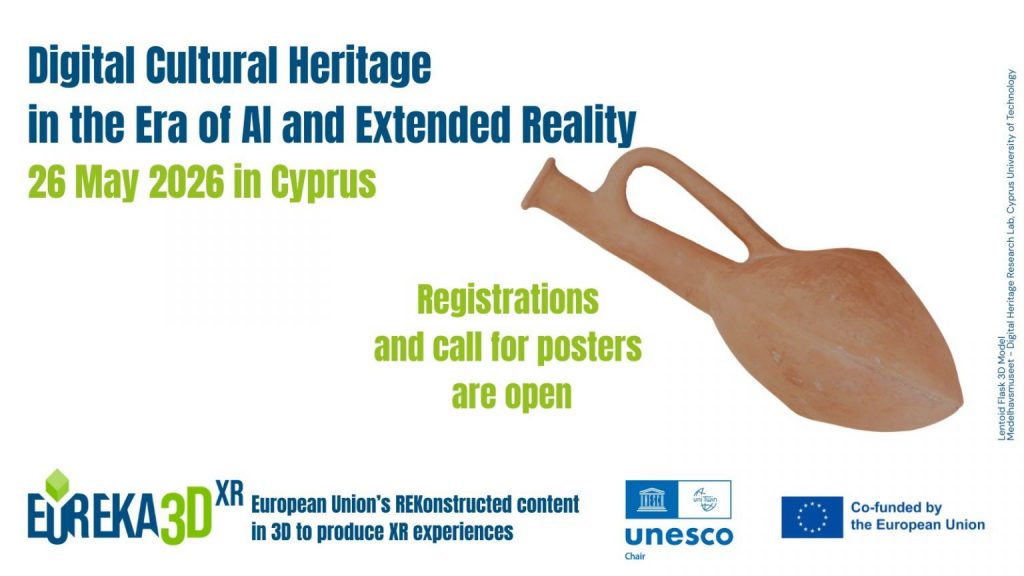
Digital Cultural Heritage in the Era of AI and Extended Reality
26 May 2026 – All-day event.
Further details and registration: https://eureka3d.eu/eureka3dxr-final-event/
Onsite at the auspices of our Partner UNESCO Chair on Digital Cultural Heritage at the Cyprus University of Technology in Limassol, Cyprus
During the Cypriot Presidency of the EU Council of the European Union and in the framework of the EuroMed2026 Digital Heritage Summit (25th to 30th of May 2026), the EUreka3D-XR project will organize its final conference. The event will showcase the project’s key outcomes and achievements through public presentations delivered by project partners and invited experts in the field.
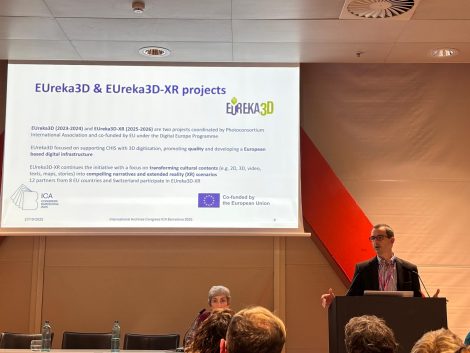
The conference will focus on how 3D digitisation in AI and Extended Reality (XR) technologies enable innovative re-use of cultural heritage, supporting the transformation of digital assets into compelling narratives and immersive experiences for diverse audiences. In this context, the innovative and breakthrough results of the project will be presented for the first time, illustrating the combined outcomes of the EUreka3D and EUreka3D-XR projects by bringing monuments and heritage sites to life and allowing them to “speak” through digital storytelling and immersive technologies.
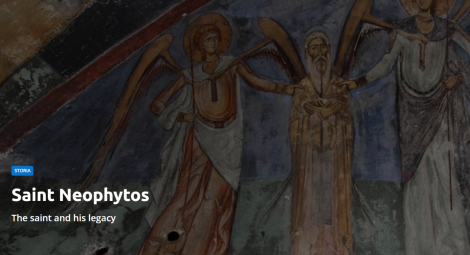
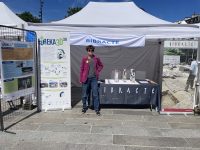
The event will also showcase the project’s use-case scenarios developed in Girona (Spain), Bibracte (France), and Saint Neophytos Monastery, Paphos (Cyprus), as well as the five project tools, demonstrated in real operational contexts and made available to Cultural Heritage Institutions. In addition, project partners will present the long-term vision of the EUreka3D Initiative, building on the project’s results and evolving towards the establishment of a European Competence Centre for 3D digitisation and XR in digital cultural heritage.
A roundtable discussion will actively engage key professionals and leading experts in the domain through live, in-person presentations and dialogue, fostering critical reflection, strategic alignment, and knowledge exchange.
This full-day event will culminate in the delivery of a position paper addressed to the Cyprus EU Council Presidency, as well as the preparation of a unique Springer Nature book publication, capturing the strategic insights, research challenges, -contributions, and future directions emerging from the multidisciplinary experts and conference.
The EUreka3D-XR Final Event will take place within a high-level European context, coinciding with the final events of the Cypriot Presidency of the Council of the European Union, EuroMed 2026 – the 11th International Summit on Digital Heritage, held in Limassol from 24 to 30 May 2026 under the theme “Monuments, Memory and Identity”, and the Europeana Hackathon, taking place in Limassol on 27–28 May 2026
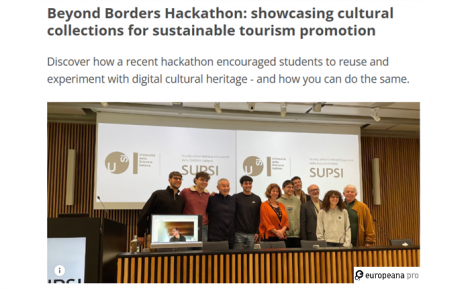
In parallel, a Pan-European Hackathon will be organised in cooperation with Europeana and the European Commission (DG CONNECT), taking place at the same venue and during the same period in Limassol on 27–28 May 2026, further strengthening cross-European collaboration and innovation around the use and re-use of high-quality 3D content in cultural heritage.
 EUreka3D-XR project is co-financed by the Digital Europe Programme of the European Union.