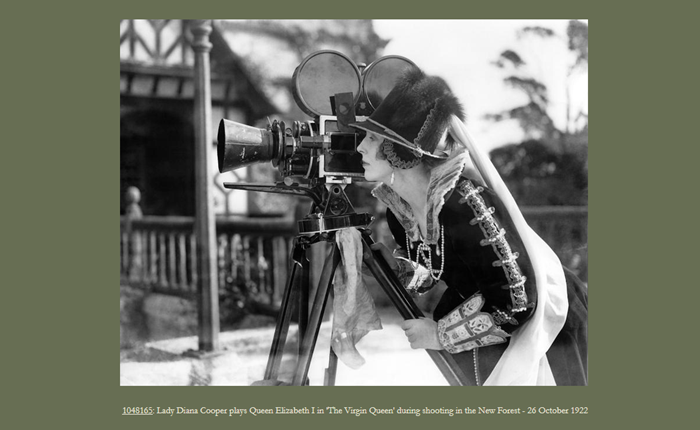


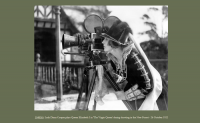
To mark the 2026 World Day for Audiovisual Heritage, prestigious British Archive TopFoto has organised an online event, “Topfoto: Past, Present and Future of Press Photography” online on Octber 27th. The event will explore how press photographs move from newsroom … Continue reading
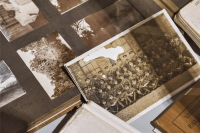
In the context of small support project CHERISH, Photoconsortium along with CEPIC, developed their first online survey to collect a wide feedback on existing digital challenges in EU for the image professionals. The survey takes approximately 15 minutes to complete, … Continue reading
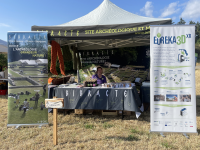
What if the visible remains of a place are only a tiny part of its story? With this blogpost, written by EUreka3D-XR’s partner Bibracte EPCC, you can discover how augmented reality, combined with complementary digital resources, reveals the many hidden … Continue reading
On 30th September and 1st October in Rome, the kick off meeting of project DiXiT was held at the premises of Sapienza University in Rome. DiXiT is an international network of high-profile institutions from the public and the private sector… Continue reading
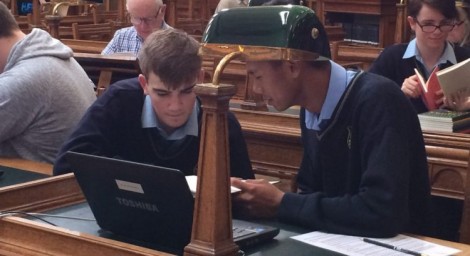
The University of Grenoble-Alpes together with the Maison de Sciences de l’Homme-Alpes with the sponsorship of ITN DIXIT* organises a summer school in Digital Editing and Digital Humanities. Details will be published shortly, but the summer school is aimed at … Continue reading
Challenges and Practices of Copyright and Licensing of Digital Cultural Heritage are the main topics of this event organised by the Co:OP project, funded by the Creative Europe programme of the European Union aims to strengthen and promote the co-operation between institutions preserving our common cultural heritage and the general public. Continue reading
Digilab and DiXiT network (http://dixit.uni-koeln.de/) organize a one day workshop on the educational application and social impact of digital scholarly editions. The workshop will take place on Tuesday, January 24, 2017, in conjunction with the AIUCD 2017 Conference and the 3rd EADH Day (aiucd2017.aiucd.it) at … Continue reading
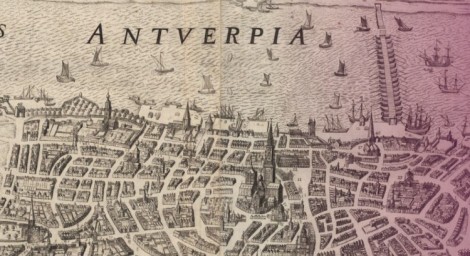
This thirteenth annual conference of the European Society for Textual Scholarship (ESTS), is organized in conjunction with the Digital Scholarly Editing Initial Training Network (DiXiT) and hosted by the Centre for Manuscript Genetics at the University of Antwerp, Belgium. 5-7 … Continue reading
The event is part of the DiXiT network and is hosted by the Huygens Institute for the History of the Netherlands. It brings together a group of international experts from the fields of textual scholarship and computer science. The … Continue reading
Summer School “Digital technologies applied to the study of poetry” Dates: 27 June to 1st July 2016 Venue: Sala Sáenz Torrecilla, Facultad de Económicas, UNED, Madrid – or your own computer (the course is available online) The summer school … Continue reading
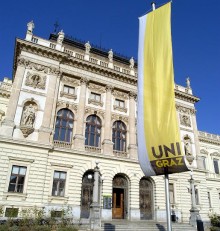
The symposium will discuss the relationship between digital scholarly editing and interfaces by bringing together experts of DSEs and Interface Design, editors and users of editions, web designers and developers. Continue reading
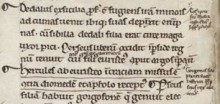
The Digital Scholarly Editions Initial Training Network (DiXiT), with the Institute of English Studies (London), the University of Cambridge, the Warburg Institute, and King’s College London are pleased to announce the sixth year of the course on Medieval and Modern Manuscript. The course is free of charge but is open only to doctoral students (PhD or equivalent). Applications close on Monday 22 February 2016… Continue reading

The course is being held in Madrid, at LINHD (Laboratorio de Innovación en Humanidades Digitales), from 13 to 17 July 2015, with the sponsorship of DiXiT – Digital Scholarly Editions Initial Training Network. The various programme sessions aim to complete the participants’ training, in order for them to become familiar with text transformation via different languages (HTML, CSS, XSLT) and formats (ePub). The competences acquired will enable the students to know the whole digital editing process and to generate several kind editions (scientific, didactic). Continue reading
This workshop, run as part of the Digital Humanities at Oxford Summer School 2015 (20 -24 July 2015), will enable participants to experience crowdsourcing in microcosm all the way from project conception to launch to data analysis. It will be of particular interest to academics, librarians and museum professionals who see the potential for crowdsourcing to expedite data extraction from non-machine readable collections. The workshop will be run by Dr Victoria Van Hyning, Digital Humanities Project Lead at Zooniverse.org (University of Oxford), and Sarah de Haas, a technical specialist from Google with a background in humanities. Continue reading