
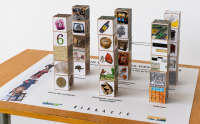
Developed by project partner Bibracte in the context of EUreka3D-XR, two Open Educational Resources (OER) on XR technologies and cultural heritage: “On the Shoulders of the Celts – How yesterday’s inventions have made today’s digital world possible“, a step-by-step guidance … Continue reading
Paper for the 19th Image and Research Conference in Girona, 19-20 November 2026. Abstract Historical photographic archives contain considerably more information than the comparatively small number of images traditionally selected for digitisation and publication. United Archives is therefore developing a … Continue reading
Starting today, it is possible to explore every single object that has been ingested on Europeana through EUreka3D-XR project. Produced by project coordinator Photoconsortium, two new galleries are now available on Europeana: one where all the 3D digitised, reconstructed and … Continue reading
Area: digital heritage

Storage is a central component in any preservation solution, and requires special functionalities in order to adequately address the need of a preservation system. This webinar aims to provide recommendations towards adopting storage solutions that can better serve digital preservation. Continue reading
The factsheet presenting the project and the call for tender is now available also in Dutch thanks to the work of the Netherlands Institute for Sound and Vision. The factsheet has been published both in the NISV project pages and in the DEN Project repository. Continue reading
DHOxSS is for researchers, project managers, research assistants, students, and anyone interested in Digital Humanities. DHOxSS delegates are introduced to a range of topics including the creation, management, analysis, modelling, visualization, or publication of digital data in the humanities. Continue reading
Digital photographs, film and sound recordings, books and museum objects are no longer hidden in archives, libraries and museums, or scattered on different websites, but more accessible and used in various ways by central services and Internet portals thanks to … Continue reading
Everywhere we look, the quantity of data is exponentially growing, fueled by the pervasive diffusion of digitalization in modern life. The fields of science, engineering, technology and even social sciences and humanities are undergoing a profound transformation to a data … Continue reading
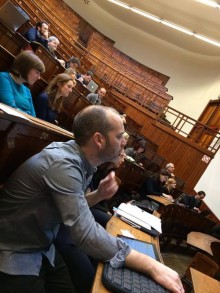
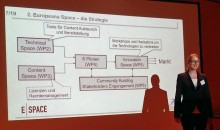
Beside the project members, participants in the meeting were the EU Officer Marcel Waletet and the deputy director of Europeana Foundation Harry Verwayen. The kick-off meeting was already the place to start the organization of the first public event of Europeana Space: the appointment is in Venice, in October 2014 with a great opening conference organized by the hosting partner Università Ca’ Foscari. Continue reading
The European Commission Information Society and Media DG, with the support of TERENA and the GÉANT project are organising a workshop to discuss federated access and more in general the vision for a global authentication and authorisation infrastructure at European level also in the context of the Horizon2020. Continue reading
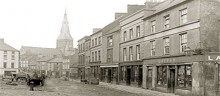
CULTURA Virtual Research Environment, three Cultural Heritage Collections, Personalisation, Entity Relationship Extraction, Entity Oriented Search, Text Normalization, Network Visualisations in the Drupal Module, Desktop Premapper, Web Premapper, FAST Annotation Service, Content Annotation Tool, Equalia, … Continue reading
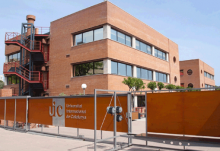
i2cat Foundation organised in collaboration with the Universitat Internacional de Catalunya (UIC) the first RICHES workshop to be held in Barcelona on the 13th of May Continue reading
This Workshop, hosted by the Labex ICCA (an interdisciplinary research centre on the arts, culture and digital markets and their practices), intends to provide a forum that allows the development and the dissemination of researches on a single object (cultural industries) but from different scientific fields (economics, communication sciences, sociology, law, education sciences…). It aims at favouring discussions and connections between various scientific fields and various cultural industries. Continue reading