

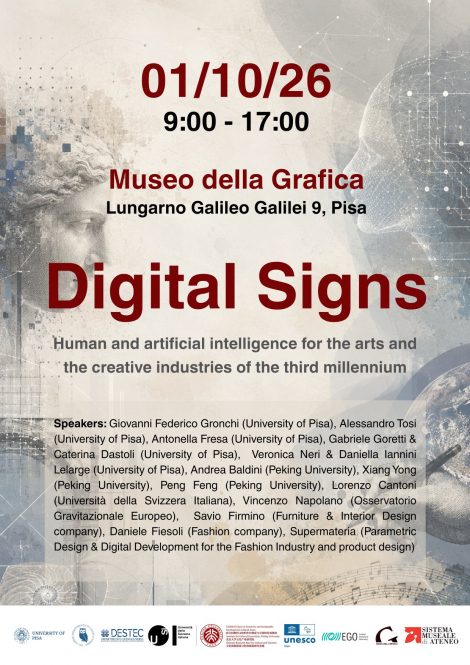
Digital Signs – Human and Artificial Intelligence for the arts and the creative industries of the third millennium

Share

Starting from the sign as a foundational element of the creative act—its becoming meaning, writing, and structure—scholars from different disciplines, ranging from art history to design, from philosophy to mathematics, and from the natural sciences to astronomy, will explore AI as a creative tool and an interpretative support. From graphic arts to the creative industries, from the reconstruction and enhancement of cultural heritage to the forms and sounds of the universe, significant and compelling international case studies will be presented and discussed. Digital signs, therefore, become a space for comparison and dialogue among different fields of knowledge, fostering new research and educational perspectives.

Museum of Graphic Arts (Pisa) is proud to host the Digital Signs international symposium, where experts in different fields and from all over the world will participate to provide insights and foster discussions through three roundtables on AI, creativity, the Arts, Cultural Heritage and more.

The event is open and no booking is required.

Learn more on the Museum of Graphic Arts’s webpage: https://museodellagrafica.sma.unipi.it/2026/09/digital-signs-human-and-artificial-intelligence-for-the-arts-and-the-creative-industries-of-the-third-millennium/


PROGRAMME of the DIGITAL SIGNS Symposium

Museum of Graphic Arts, Pisa, October 1st 2026

  • 9:00-9:30 Opening Remarks and Institutional Welcome
  • 9:30-12:00 Session I – Concepts and Perspectives
    Round Table: AI, Creativity, and New Perspectives for the Arts and Cultural Heritage

  • 12:00-14:00 Lunch break

  • 14:00-16:00 Session II – Practices and Applications
    Round Table: AI in the Creative Industries and Cultural Innovation

  • 16:00-16:15 Coffee Break

  • 16:15-16:50 Session III – Future Directions
    Round Table: Human and Artificial Intelligence for the Future of Creativity

  • 16:50-17:00 Closing Remarks


Leave a Reply


Related Articles

‘INNOVATE. PROTECT. EMPOWER. How cultural heritage can make Public AI a reality’ - European Heritage...
Join the European Heritage Hub to its upcoming Policy Talk, ‘INNOVATE. PROTECT. EMPOWER. How cultural heritage can make Public AI a reality’, taking place online on 29 September, from 16:00 to 18:00 CET. The Policy Talk will explore the vision of a distinctly European approach to AI - Public AI - and the role that the cultural heritage sector can play in shaping it. It will build on the recent paper ‘Making Public AI reality: How cultural heritage can lead the way’ developed by the commun...
Results and conclusions of "Report on the Survey 'Digitization and Artificial Intelligence for ...
Following a survey that had as an objective to investigate how AI is impacting digitization of archives and documentary heritage collections across different institutions, a study was published under the name of "Report on the Survey 'Digitization and Artificial Intelligence for Archives and Documentary Heritage Materials'". The survey measured the state of digitization within organizations and assesses the impact of artificial intelligence (AI) on digitization activities. The surve...
EVA Florence 2025
  EVA FLORENCE, the annual event in Florence of the EVA series. Electronic Imaging and the Visual Arts Conference, Training and Workshops. Only in-presence, Grand Hotel Minerva, Florence (Italy) Main topics: Artificial Intelligence for Cultural Heritage, Creative Enterprises, SME and Industries, Society, Public Administration Artificial Intelligence Perspectives and Evolution European Commission Projects and Plans regarding Innovation Technologies, Artificial Intelli...
EUscreen Symposium 2024: Responsible Use of AI in Audiovisual Archives
  Join the annual EUscreen Symposium on December 9th and 10th in Barcelona. The rapid advancement of Artificial Intelligence technologies has opened new horizons for the audiovisual sector, offering opportunities for creativity, and efficiency. However, as AI becomes increasingly integrated into audiovisual archives, it raises complex questions around its responsible use; ethics, copyright, and the strategic role it gained in the institutions. The EUscreen symposium “Res...