


PREAC training – Archaeology and young people: how do you show the invisible?

Share

From 1 to 3 December 2025, Bibracte, in partnership with the Musée départemental Arles antique, organised the national training course “Archaeology and Young Audiences: How to show the invisible?”, aimed at professionals working in arts and cultural education.

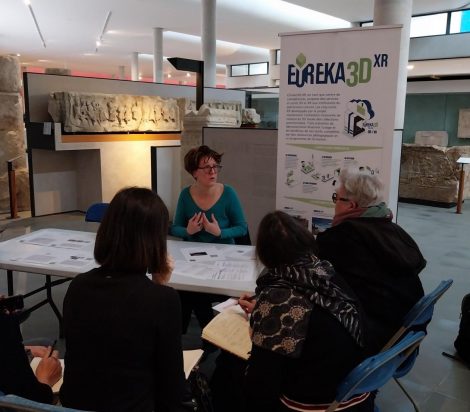
On the morning of 2 December, the Forum of Archaeology Professions gave participants the opportunity to engage in discussions with specialists about the invisible or less visible aspects of archaeology, as well as the methods and tools used to understand and communicate them to the public.

On this occasion, Agathe Le Riche-Maugis presented the five open-source tools developed within the EUreka3D-XR project at the stand entitled “Visual Mediation Technologies: Bringing the Real and the Virtual into Dialogue to Better Tell the Story of Archaeology”. Forty people took part in the event: 13 education professionals (regional pedagogical inspectors, regional advisers for arts and cultural education, and teachers responsible for museum partnerships) and 27 cultural heritage professionals (heads of mediation, mediators and archaeologists). Among them, around fifteen expressed a strong interest in the project and its future outcomes

Video capsules featuring the Forum speakers were also produced at the Musée d’Arles, with the aim of creating resources for future regional training initiatives connected to the same theme. Agathe Le Riche-Maugis’s video will be available on this blog soon.


eu emblemEUreka3D-XR project is co-financed by the Digital Europe Programme of the European Union.


Leave a Reply


Related Articles

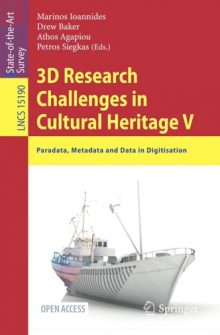
3D Research Challenges in Cultural Heritage V - Paradata, Metadata and Data in Digitisation
The Digital European Programme-funded project EUreka3D has ended at the close of 2024. The two-year project developed innovative technology, learning resources, and practices to support 3D cultural collections, also shared in the common European data space for cultural heritage. As an outcome of the project, the Springer open access book 3D Research Challenges in Cultural Heritage V - Paradata, Metadata and Data in Digitisation was published following the successful webinar in two parts o...
How EUreka3D enabled the creation and reuse of 3D heritage – a new publication on Europeana
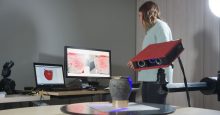
  The Digital European Programme-funded project EUreka3D has ended at the close of 2024. The two-year project marks a significant milestone in the field of 3D cultural heritage preservation and digitisation. It developed innovative technology and practices to push forward the boundaries of, and capacity for, 3D cultural heritage in the common European data space for cultural heritage. Explore its achievements and learn how the project’s work will continue through EUreka3D-XR i...
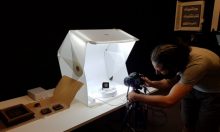
Challenges in 3D digitization: experiences and resources
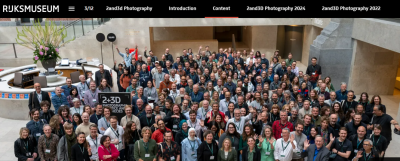
A joint presentation by David Iglésias Franch (Ajuntament de Girona, and Photoconsortium president) and Axelle Vanmaele (meemoo) will be delivered in the framework of EUreka3D-XR project at the prestigious 2and3D Photography – Practice & Prophecies conference at Rijksmuseum in Amsterdam, 21 May 2026. Title of the presentation is “Challenges in 3D digitization: experiences and resources” and starts with a story from the audiovisual archive of the Girona city council (CRDI). In 2022...
EUreka3D-XR presented at Europeana Aggregators' Forum 2026
The Europeana Aggregators' Forum is the gathering where twice a year the community of Europeana most trusted partners meets to review strategies and collaborations, and make plans for the future. All the aggregators work with cultural heritage institutions to gather authentic, trustworthy and robust cultural data and make it accessible through Europeana. Through the Europeana Aggregators Forum, aggregators work to exchange the knowledge and best practice that support the digital transformati...