


3D Research Challenges in Cultural Heritage V – Paradata, Metadata and Data in Digitisation

Share

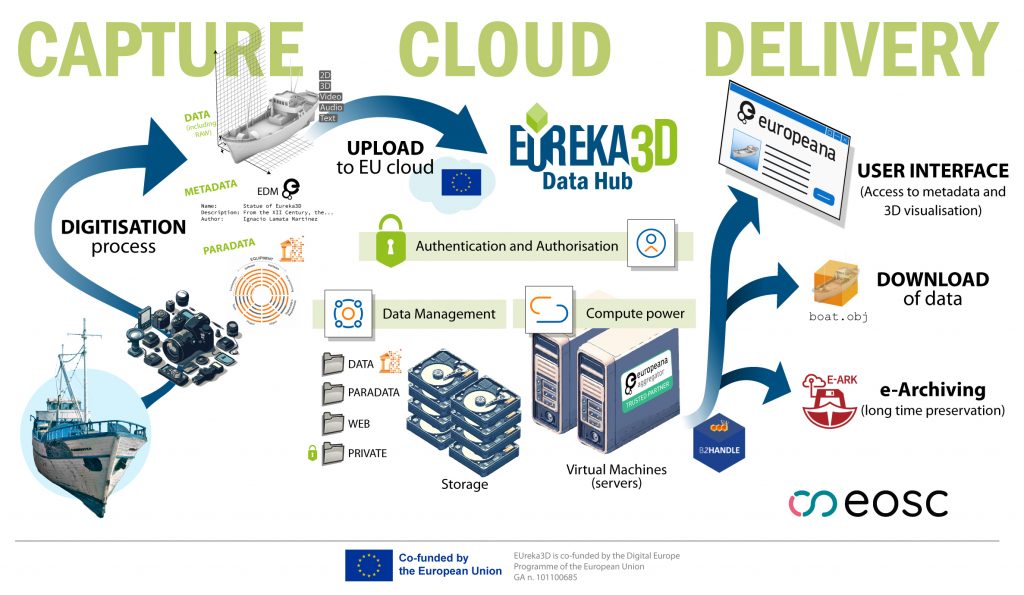
The Digital European Programme-funded project EUreka3D has ended at the close of 2024. The two-year project developed innovative technology, learning resources, and practices to support 3D cultural collections, also shared in the common European data space for cultural heritage.
As an outcome of the project, the Springer open access book 3D Research Challenges in Cultural Heritage V – Paradata, Metadata and Data in Digitisation was published following the successful webinar in two parts organized in April and May 2024.

Access the book here: https://link.springer.com/book/10.1007/978-3-031-78590-0

This open access book presents a collection of papers focussing on 3D digitisation in the domain of cultural heritage. The use of data acquisition technologies in digitising cultural heritage holds great potential for preserving and disseminating the history of mankind. However, to exploit these opportunities in full, comprehensive guidelines for documenting the process of digitisation are required. Only then can  the efficiency and credibility of digital representations be assured.
A major focus of the 16 papers included in this State-of-the-Art Survey is on all aspects of the documentation of the digitisation process, i.e., the paradata, which, alongside the metadata, is critical to the scientific rigour, replicability and sustainability of digital heritage resources. The volume provides a useful resource for computer scientists, surveyors, archaeologists, architects, museologists and engineers.


Leave a Reply


Related Articles

How EUreka3D enabled the creation and reuse of 3D heritage – a new publication on Europeana
  The Digital European Programme-funded project EUreka3D has ended at the close of 2024. The two-year project marks a significant milestone in the field of 3D cultural heritage preservation and digitisation. It developed innovative technology and practices to push forward the boundaries of, and capacity for, 3D cultural heritage in the common European data space for cultural heritage. Explore its achievements and learn how the project’s work will continue through EUreka3D-XR i...
NOW LIVE on Europeana: EUreka3D-XR wrap-up post
As EUreka3D-XR approaches its final stage, we can start to draw conclusions from a fruitful 18 months and are delighted to share the project’s work, achievements and resources: "EUreka3D-XR: exploring cultural heritage through 3D digitisation and XR experiences" is now live on the Common European Data Space for Cultural Heritage website. The blogpost explores: The three case scenarios EUreka3D-XR project's aim and scope, including the priority given to Data quality and authe...
EUreka3D-XR at IIIF Conference 2026
From June 1st to the 4th, IIIF Conference held its 2026 edition: the event is intended for a wide range of participants and interested parties, including digital image repository managers, content curators, software developers, scholars, and administrators at libraries, museums, cultural heritage institutions, software firms, and other organizations working with digital images and audio/visual materials. During the forth day of this year's edition of the event, Professor Ronald S. Haynes ...
EUreka3D-XR presented at Europeana Aggregators' Forum 2026
The Europeana Aggregators' Forum is the gathering where twice a year the community of Europeana most trusted partners meets to review strategies and collaborations, and make plans for the future. All the aggregators work with cultural heritage institutions to gather authentic, trustworthy and robust cultural data and make it accessible through Europeana. Through the Europeana Aggregators Forum, aggregators work to exchange the knowledge and best practice that support the digital transformati...