


How EUreka3D enabled the creation and reuse of 3D heritage – a new publication on Europeana

Share

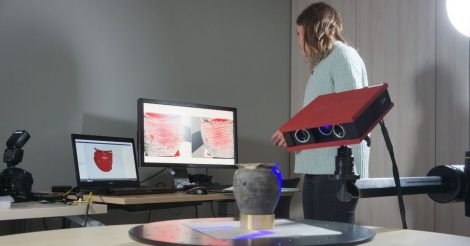
The digitisation process at Bibracte | 2024 | Bibracte | CC BY


The Digital European Programme-funded project EUreka3D has ended at the close of 2024. The two-year project marks a significant milestone in the field of 3D cultural heritage preservation and digitisation. It developed innovative technology and practices to push forward the boundaries of, and capacity for, 3D cultural heritage in the common European data space for cultural heritage.

Explore its achievements and learn how the project’s work will continue through EUreka3D-XR in the newly published editorial on Europeana: How EUreka3D enabled the creation and reuse of 3D heritage“.


Leave a Reply


Related Articles

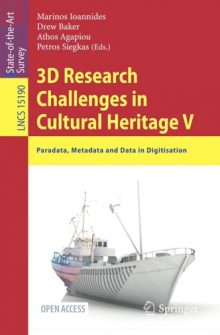
3D Research Challenges in Cultural Heritage V - Paradata, Metadata and Data in Digitisation
The Digital European Programme-funded project EUreka3D has ended at the close of 2024. The two-year project developed innovative technology, learning resources, and practices to support 3D cultural collections, also shared in the common European data space for cultural heritage. As an outcome of the project, the Springer open access book 3D Research Challenges in Cultural Heritage V - Paradata, Metadata and Data in Digitisation was published following the successful webinar in two parts o...
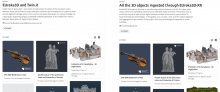
Explore all objects published on Europeana ingested through EUreka3D-XR
Starting today, it is possible to explore every single object that has been ingested on Europeana through EUreka3D-XR project. Produced by project coordinator Photoconsortium, two new galleries are now available on Europeana: one where all the 3D digitised, reconstructed and produced within EUreka3D-XR are grouped together, and a second one that focuses specifically on the work done in collaboration between EUreka3D and Twin it! (June 2023 – June 2024). Explore the galleries: All ...
3D, copyright and the public domain
A digitised 3D model is often seen as the end result of a digitisation project. But what happens next? Can you publish the model online? Can someone else use it in an XR application, educational game or virtual exhibition? And does creating a 3D model automatically create a new copyright? These were some of the central questions addressed by Ariadna Matas from Europeana Foundation during the second session of the Lifecycle of 3D Data in Cultural Heritage webinar series, organised by EUreka3D-...
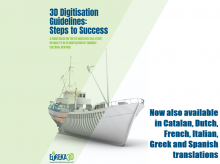
3D Digitisation Guidelines translated into multiple languages by EUreka3D-XR
3D Digitisation Guidelines: Steps to Success was designed and produced within the  to help anyone on their 3D digitisation journey. It is specifically aimed at Cultural Heritage professionals who are considering, or in the middle of, digitising their cultural heritage collections using three dimensional models. It outlines and simplifies the recommended standards highlighted in the EU VIGIE Study 2020/654 (Study on quality in 3D digitisation of tangible cultural heritage, published April 202...