


Paper showcasing EUreka3D to be published on FGCS journal

Share

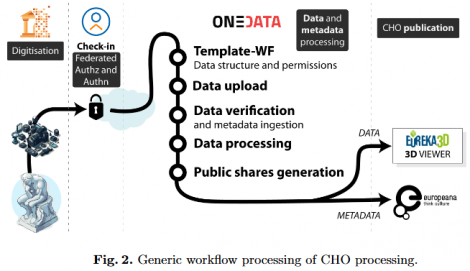
The Lambousa Fishing Boat case and the data managing within the scope of EUreka3D project was presented by Michał Orzechowski at the 15th International Conference on Parallel Processing & Applied Mathematics.

Following the presentation, Future Generation Computer Systems journal invited the authors of the presentation to write a paper. FGCS aims to lead the way in advances in distributed systems, collaborative environments, high performance and high performance computing, Big Data on such infrastructures as grids, clouds and the Internet of Things.

Title: Cultural Heritage 3D Object Management with Integrated Automation Workflows

Authors: Written by Michał Orzechowski, Łukasz Opioła, Ignacio Lamata Martínez, Marinos Ioannides, Panayiotis N. Panayiotou, Renata G. Słota, Łukasz Dutka and Jacek Kitowski

Abstract: The complexity of high-quality 3D digitised cultural heritage
objects creates challenges for existing data management systems as they
need to develop metadata management and processing capabilities to
provide semantic insight into the interconnectivity of data that consti-
tute cultural heritage objects. To address these challenges, we propose
a data and metadata management system, together with the federated
authentication and authorisation mechanism, and an integrated system
for designing and executing automated workflows that facilitate the pro-
cessing of both data and metadata. The solution is evaluated with a
3D digitised cultural object of Lambousa Fishing Boat and presents the
complete process from data upload to publication.

Download the paper at this link.


Leave a Reply


Related Articles

3D Digitisation Guidelines translated into multiple languages by EUreka3D-XR
3D Digitisation Guidelines: Steps to Success was designed and produced within the  to help anyone on their 3D digitisation journey. It is specifically aimed at Cultural Heritage professionals who are considering, or in the middle of, digitising their cultural heritage collections using three dimensional models. It outlines and simplifies the recommended standards highlighted in the EU VIGIE Study 2020/654 (Study on quality in 3D digitisation of tangible cultural heritage, published April 202...
Webinar on the state of 3D Digitisation in Cultural Heritage
  Organized by Heritage Malta and the UNESCO Chair on Digital Cultural Heritage at the Cyprus University of Technology, the Digitisation of Cultural Heritage: Methodologies, Technologies & Best Practices webinar is dedicated to presenting the results of a groundbreaking global survey carried out in the context of Heritalise project to exame the current state of the art in 3D digitisation of cultural heritage. The survey explored key questions, including: Who is digi...
EUreka3D training in Girona
As a side activity of the EUreka3D Final Conference in Girona, partner CRDI organized a public workshop expressely addressed to catalan cultural institutions and other local professionals. The scope of the workshop was to provide training on 3D digitization according to EUreka3D methodologies, and also to discuss strategies for the dissemination of 3D digitisation projects. In particular, the training included a presentation the 3D Digitisation Guidelines and the EUreka3D Final Booklet, by Da...
Mongolian Students trained with EUreka3D digitization guidelines
As part of the ERASMUS+ ARTEST programme, EUreka3D partner CUT hosted four early career researchers from the Mongolian University Science and Technology and the Mongolian National University of Arts and Culture. Over the 10 day training period the exchange students undertook training in the digitisation of CH objects using the EUreka3D guidelines for documentation as the basis for their work. The collaboration between ARTEST and EUreka3D was initiated early in 2024, also with a coordinatio...