


Optical views: a way to travel through Europe – a new blogpost on Europeana

Share

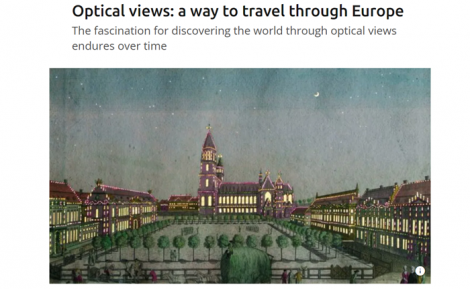
img. from Europeana website

As part of the EUreka3D project, a blogpost authored by Helena Nogué (CRDI – Ajuntament de Girona) was recently published on Europeana.

The blogpost showcases how optical views were used in 18th and early 19th century by people who were not able to travel in order to see the most famous cities and capitals of that time and to satisfy their hunger for knowledge.

Read the blogpost here.


eu emblemEUreka3D project is co-financed by the Digital Europe Programme of the European Union.


Leave a Reply


Related Articles

The History of 3D digitisation - a new blogpost on Europeana
img. from Europeana website As part of the EUreka3D project, a blogpost authored by John Balean on behalf of Photoconsortium was recently published on Europeana. In the blogpost, a brief history of 3D and 3D digitisation gets addressed, starting from a cartoon by Roland Emett from Punch Magazine in 1953. The narration goes through different hisotrical periods and locations, from Ancient Greece to the present day, and it's an occasion to reflect on the value of 3D throughout history - a...
3D, copyright and the public domain
A digitised 3D model is often seen as the end result of a digitisation project. But what happens next? Can you publish the model online? Can someone else use it in an XR application, educational game or virtual exhibition? And does creating a 3D model automatically create a new copyright? These were some of the central questions addressed by Ariadna Matas from Europeana Foundation during the second session of the Lifecycle of 3D Data in Cultural Heritage webinar series, organised by EUreka3D-...
3D Digitisation Guidelines translated into multiple languages by EUreka3D-XR
3D Digitisation Guidelines: Steps to Success was designed and produced within the  to help anyone on their 3D digitisation journey. It is specifically aimed at Cultural Heritage professionals who are considering, or in the middle of, digitising their cultural heritage collections using three dimensional models. It outlines and simplifies the recommended standards highlighted in the EU VIGIE Study 2020/654 (Study on quality in 3D digitisation of tangible cultural heritage, published April 202...
3D Research Challenges in Cultural Heritage V - Paradata, Metadata and Data in Digitisation
The Digital European Programme-funded project EUreka3D has ended at the close of 2024. The two-year project developed innovative technology, learning resources, and practices to support 3D cultural collections, also shared in the common European data space for cultural heritage. As an outcome of the project, the Springer open access book 3D Research Challenges in Cultural Heritage V - Paradata, Metadata and Data in Digitisation was published following the successful webinar in two parts o...