


Webinar series: The Lifecycle of 3D Data in Cultural Heritage

Share

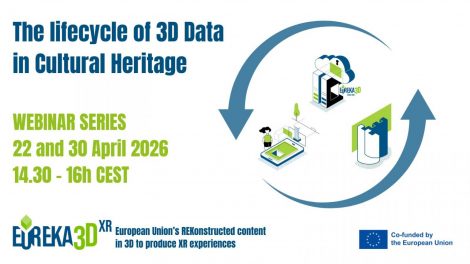
Aimed at cultural heritage professionals, EUreka3D-XR inaugurates a new webinar series, as the project gets closer to its conclusion in July: The Lifestyle of 3D Data in Cultural Heritage webinar serie, that brought together the key results of both EUreka3D and EUreka3D-XR projects to present them in a clear, practical, encompassing and accessible way.

This series offered a complete overview of how 3D data can be created, managed and reused sustainably, connecting technical, policy and practical perspectives, drawing on real tools, workflows and infrastructures developed within the projects, and aligning them with Europeana policies and the common European data space for cultural heritage.

The series was split in two focused sessions, where participants explored the full journey of 3D data in cultural guided by professionals of the sector with first hand experience in the field.

The recordings of the two sessions are now available on EUreka3D-XR’s YouTube channel.

Session 1 (April 22nd 2026)
Session 2 (April 30th 2026)

Programme

SESSION 1 – Wednesday 22 April 2026 14.30-16h CEST
Plan, collect, process and preserve

  • 14.30h Introduction, by Antonella Fresa (EUreka3D-XR project coordinator)
  • 14.40h Creating 3D data: plan, collect, process, by Marinos Ioannides (Digital Heritage Research Lab at Cyprus University of Technology)
  • 15.10h Preservation and management of 3D data, by Ignacio Lamata Martínez (EGI Foundation)
  • 15.40h Interactive session
  • 15.50h Wrap-up and accessible resources
  • 16h End of the session

DAY 2 – Thursday 30 April 2026 14.30-16h CEST
Sharing and reusing 3D data

  • 14.30h Introduction, by Antonella Fresa (EUreka3D-XR project coordinator)
  • 14.40h Publishing 3D data, by Valentina Bachi (Photoconsortium, EUreka3D-XR project manager)
  • 15h 3D, Copyright and the public domain, by Ariadna Matas (Europeana Foundation)
  • 15.20h Q&A
  • 15.30h Reuse of 3D in practice: XR scenarios (Axelle Vanmaele, meemoo)
  • 15.50h Wrap-up and accessible resources
  • 16h End of the session

eu emblemEUreka3D-XR project is co-financed by the Digital Europe Programme of the European Union.


Leave a Reply


Related Articles

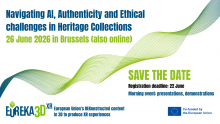
Navigating AI, Authenticity and Ethical Challenges in Heritage Collections
Nice success for the EUreka3D-XR hybrid capacity building event in Brussels on 26 June 2026, with ca. 60 participants online and 20 onsite: Navigating AI, Authenticity and Ethical Challenges in Heritage Collections This interdisciplinary conference explored the intersection of AI, authenticity, and ethics in heritage collections. Experts from museums, tech sectors, and academia shared case studies highlighting responsible innovation with the use of advanced technologies. 26 June 2026,...
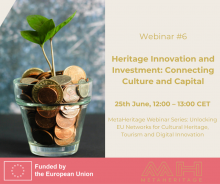
MetaHeritage Webinar #6: Heritage Innovation Meets Investment - Connecting Culture and Capital
Cultural heritage is increasingly recognized not only as a societal value but also as a driver of innovation, sustainable development, and economic opportunity. The upcoming MetaHeritage Webinar 6, titled “Heritage Innovation and Investment: Connecting Culture and Capital”, will explore exactly this intersection. The webinar brings together experts from the fields of cultural heritage, innovation, finance, and digital transformation to discuss how heritage can be sustainably funded, scale...
3D, copyright and the public domain
A digitised 3D model is often seen as the end result of a digitisation project. But what happens next? Can you publish the model online? Can someone else use it in an XR application, educational game or virtual exhibition? And does creating a 3D model automatically create a new copyright? These were some of the central questions addressed by Ariadna Matas from Europeana Foundation during the second session of the Lifecycle of 3D Data in Cultural Heritage webinar series, organised by EUreka3D-...
3D Digitisation Guidelines translated into multiple languages by EUreka3D-XR
3D Digitisation Guidelines: Steps to Success was designed and produced within the  to help anyone on their 3D digitisation journey. It is specifically aimed at Cultural Heritage professionals who are considering, or in the middle of, digitising their cultural heritage collections using three dimensional models. It outlines and simplifies the recommended standards highlighted in the EU VIGIE Study 2020/654 (Study on quality in 3D digitisation of tangible cultural heritage, published April 202...