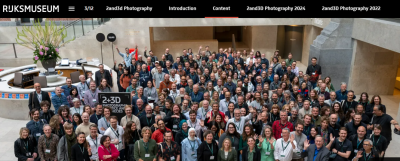



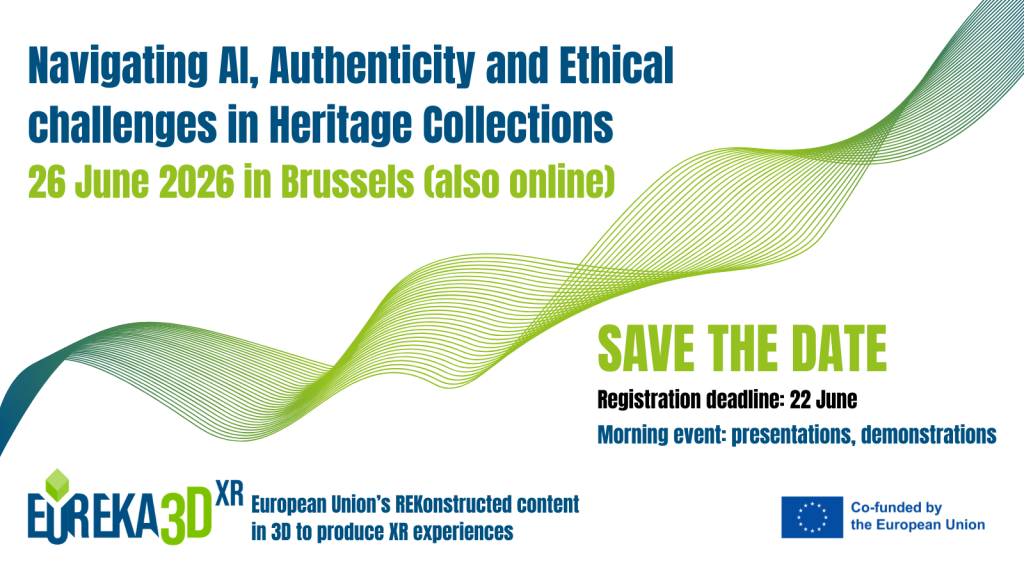
Nice success for the EUreka3D-XR hybrid capacity building event in Brussels on 26 June 2026, with ca. 60 participants online and 20 onsite:
Navigating AI, Authenticity and Ethical Challenges in Heritage Collections
This interdisciplinary conference explored the intersection of AI, authenticity, and ethics in heritage collections. Experts from museums, tech sectors, and academia shared case studies highlighting responsible innovation with the use of advanced technologies.
- 26 June 2026, starting h. 10
- Hosted at imec, Pleinlaan 9 1050 Brussels
- More information, presentations and recording: https://eureka3d.eu/navigating-ai-authenticity-and-ethical-challenges-in-heritage-collections/
>>>>READ AND DOWNLOAD THE IMPACT REPORT OF THE CONFERENCE<<<<
Programme:
- 10.00h Introduction to the event: the EUreka3D-XR project and what’s next for AI/3D/XR, by Antonella Fresa (EUreka3D-XR project coordinator)
- 10.10h The Power of Change: knowledge exchange and collaboration for innovative solutions in AI‑driven 3D & Image Analysis, by Ines Vodopivec (AI4LAM, National Library of Norway, Stanford)
- 10.20h Authenticy and AI in cultural collections, Keynote talk by Frederik Temmermans (imec/VUB)
- 10.45h Managing the intellectual property of digital collections in the AI era, by Philippe Rixhon (Valunode OÜ)
- 11.00h Case studies and experiences (15 minutes each)
- AI for metadata enrichment of heritage collections at scale, by Axelle Vanmaele (meemoo, Flemish institute for archives)
- Gaussian splatting, by Saeed Mahmoudpour (imec)
- AI in the service of CH, by Ismo Malinen (Museovirasto, Finnish Heritage Agency)
- AI-powered Knowledge Discovery in Digital Collections, by Nicolas Nadisic (KIK-IRPA and Ghent University)
- Crystal clear? Challenges of accuracy and transparency in AI-assisted metadata workflows, by Eva Andersen, Annamaria Van Ingelgem (Ghent University Library – Boekentoren)
- 12.20h Q&A and Conclusions of the hybrid conference
- 12.30h Onsite – Demonstrating technological innovation in image display at imec
- 13.00h Conclusions
 EUreka3D-XR project is co-financed by the Digital Europe Programme of the European Union.