

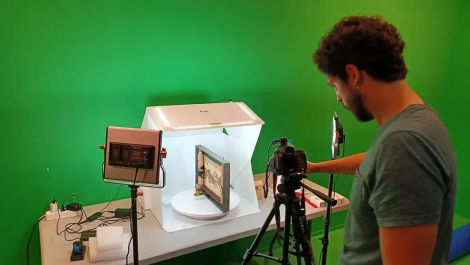
Image credit: Centre de Recerca i Difusió de la Imatge (CRDI), Girona (ES)
The EOSC Beyond project, coordinated and represented by the EGI Foundation, and the EUreka3D initiative, along with its continuation EUreka3D-XR, both coordinated and represented by PHOTOCONSORTIUM, signed a Memorandum of Understanding (MoU). This agreement sets the stage for a structured and enduring collaboration to amplify digital solutions for cultural heritage within the European Open Science Cloud (EOSC).
EOSC Beyond is a 36-month project funded by the European Union’s Horizon Europe research and innovation programme under grant agreement No. 101131875. The overall objective is to advance Open Science and innovation in research in the context of EOSC by providing new EOSC Core capabilities allowing scientific applications to find, compose and access multiple Open Science resources and offer them as integrated capabilities to researchers. EOSC Beyond also establishes a federated network of pilot EOSC Nodes operating at various levels to cater to specific scientific missions.
Enabling Innovation and Interoperability for Cultural Heritage
The MoU underscores the parties’ shared commitment to advancing the EOSC goals by leveraging each initiative’s strengths. The collaboration will enhance technical interoperability, foster data sharing, and enable knowledge exchange to benefit diverse communities, including cultural institutions, research organisations, and other stakeholders.
Through this partnership, the projects will:
Testing and Piloting:
- Implement the testing of EUreka3D and EUreka3D-XR datasets and services within the EOSC Beyond Innovation Sandbox environment as part of EOSC Beyond’s piloting actions.
Interoperability Initiatives:
- Facilitate the participation of EUreka3D and EUreka3D-XR in EOSC Beyond tasks aimed at achieving interoperability between EOSC and European Data Spaces, with a particular focus on identifying and adopting suitable metadata schemas.
Knowledge Sharing and Dissemination:
- Promote cross-dissemination and knowledge transfer to various communities, including cultural institutions, research bodies, and other stakeholders.
This collaboration reflects the strategic alignment of the projects with European Data Spaces. It reinforces their contributions to fostering innovation and ensuring that the benefits of Open Science are widely accessible. Moreover, the support from EOSC Beyond will boost the positioning of EUreka3D and EUreka3D-XR approaches and results as a competence centre in the 3D technologies experimentation.
“The collaboration between EOSC Beyond and EUreka3D will strengthen the EOSC/Data Spaces connection, fostering interoperability and the sharing of solutions for common problems. Furthermore, requirements and feedback from the scientist behind EUreka3D will allow EOSC Beyond to further tune its services to better serve European research.” Diego Scardaci, EOSC Beyond Project Director, EGI Foundation
“In the cultural heritage sector, we are witnessing a very lively scenario of digital transformation, that enables better and more modern workflows to empower research and citizens’ engagement with heritage collections, especially leveraging 3D technologies supported by various cloud services. The importance of interoperability between systems, and of a shared European vision for advancing cultural heritage and research communities, is key to fostering innovation. The collaboration established with EOSC Beyond supports the results of the EUreka3D project and empowers the upcoming EUreka3D-XR for the benefit of heritage and research professionals, as a concrete example of a competence centre for digitisation in cultural heritage, quality in 3D and experimentation of XR scenarios for reuse and enjoyment of cultural collections.” – Valentina Bachi – EUreka3D Project Manager, PHOTOCONSORTIUM
Looking Ahead
The MoU between EOSC Beyond and EUreka3D/EUreka3D-XR marks a significant step forward in their joint mission to strengthen the EOSC Federation and the wider ecosystem. By combining efforts and resources, the partnership aims to drive technical innovation, enhance interoperability, and support the alignment of services and datasets with European Data Spaces. For more updates and information about the two projects, please visit the websites of EOSC Beyond and EUreka3D.