


From Roman Castulo to the Alhambra

Share

© Factum Foundation

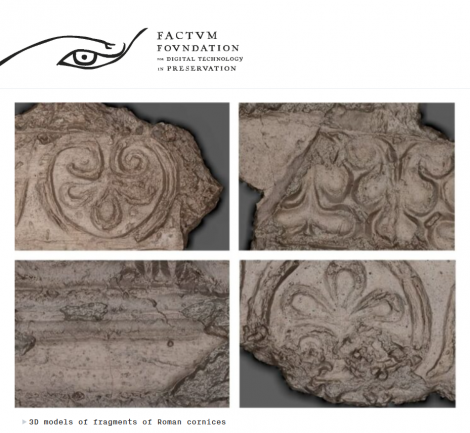
Factum Foundation for Digital Technology in Preservation, a not-for-profit organisation based in Madrid, collaborated on the PhD thesis carried out by Ana Carrasco Huertas at the University of Granada, co-supervised by Víctor Medina (University of Granada) and Carlos Bayod Lucini (Factum Foundation). The research was defended on 30 January 2026 and focuses on the study, digitisation, and virtual reconstruction of three groups of decorative architectural surfaces from different contexts and periods: fragments of Roman cornices made in lime mortar from the archaeological site of Castulo (1st–2nd centuries AD); decorative reliefs carved in bone discovered in the ancient city of Isturgi (1st–3rd centuries AD); and a 14th-century façade of plasterwork and wood in the Islamic tradition, located within the Alhambra Monumental Complex. In all three cases, these decorative surfaces have been heavily affected by the passage of time, which makes them difficult to read, understand, and interpret.

As part of the project, Ana completed a training and research placement at Factum Foundation in Madrid (May–July 2022), followed by work with the ARCHiOx project at the Bodleian Library, University of Oxford (June–September 2023). The aim of both stays was to learn and apply high-resolution 3D recording methods and the associated workflows used to support the virtual reconstruction of cultural heritage.

For the study and digitisation of the material, Factum’s Lucida 3D Scanner and Selene PSS were used. This made it possible to capture the micro-topography of the Roman reliefs (both lime-mortar elements and carved bone) and the plasterwork with great precision, enabling detailed analysis of the manufacturing marks and tools involved (such as moulds, profiling tools, lathes, and carving gouges). The work also produced highly accurate digital twins suitable for material and technical study, which will serve as the foundation for the subsequent virtual restitution.

© Factum Foundation; Read the original post.


Leave a Reply


Related Articles

EuroMed 2024: the 10th International Euro-Mediterranean Conference on Digital Cultural Heritage
Organized by Cyprus University of Technology, conference EuroMed 2024 offers the Cultural Heritage community the opportunity to come together and exchange our know-how, explore our research and discuss development in our field, current and future, from both regional and global perspectives. The conference, celebrating its 10th edition in 2024, provides a unique opportunity to present results, review outcomes, and draw new inspiration with our friends, colleagues and peers. EuroMed 2024 fo...
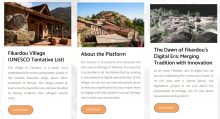
Village in Cyprus goes digital to promote its cultural heritage
The UNESCO Chair on Digital Cultural Heritage at Cyprus University of Technology, one of the key partners the EUreka3D project, has officially handed over an online platform dedicated to the holistic digitisation of Fikardou village to its community. A post about this initiative recently appeared on CORDIS, the European Commission's website dedicated to showcase the most important research results of EU funded projects. The platform will be used to record the community’s memory and tangib...
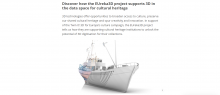
How the EUreka3D project supports 3D in the data space for cultural heritage – a new blog post on Eu...
  3D technologies offer opportunities to broaden access to culture, preserve our shared cultural heritage and spur creativity and innovation. In support of the Twin It! 3D for Europe’s culture campaign, the EUreka3D project tells us how they are supporting cultural heritage institutions to unlock the potential of 3D digitisation for their collections. Discover how with the blog post recently published on Europeana Pro The post offers a very interesting opportunity to explor...
How EGI is supporting digital cultural heritage
EGI brings together a platform of computing resources from centres across Europe. Many of these have experience in providing services for the DCH research community. EGI is now building on this heritage as a partner in the DCH-RP project and participation in the Euro-Mediterranean Conference in Cyprus.