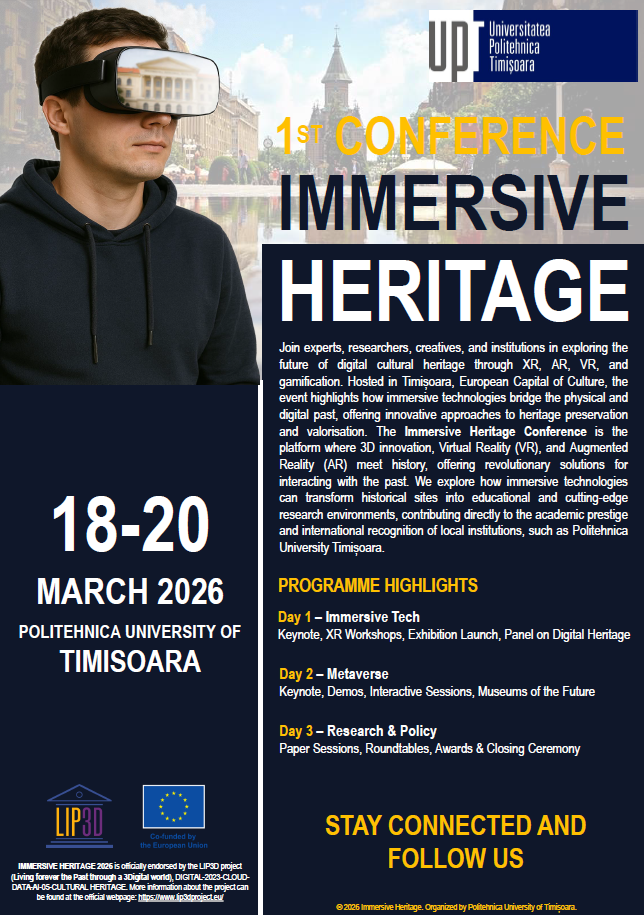


Paradata, Metadata, and Data in 3D Digital Documentation for Cultural Heritage: #DigitalTwins or #MemoryTwins

Share

Since its adoption in 2006 as part of the London Charter for the Use of 3D Visualisation in the Research and Communication of Cultural Heritage, the concept of Paradata has played an essential role in ensuring transparency in the creation of scholarly 3D Cultural Heritage assets. With further recognition by the ICOMOS Seville Charter (2017) and the European Commission’s EU VIGIE2020/654 Study on quality parameters for 3D digitisation of tangible cultural heritage, Paradata has emerged as a key aspect of 3D digital documentation.

Paradata, alongside Metadata and Geometrical Data, forms a “trinity” of elements essential for ensuring high-quality, reusable 3D digital resources. However, despite its growing importance, the Digital Cultural Heritage (DCH) community continues to grapple with fully defining and differentiating Paradata and Metadata, as well as understanding their role in supporting scholarly research, sustainability, and compliance with the European Commission’s recommendations for 3D-digitised cultural heritage.

This workshop brings together professionals from across the spectrum of Digital Cultural Heritage to share their experiences, aiming to establish a common understanding of Paradata and lay the groundwork for a community-built set of standards and best practices for its application in 3D documentation.

Download the full agenda here.


Leave a Reply


Related Articles

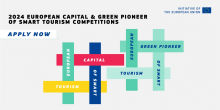
European Commission launches the European Capital and Green Pioneer of Smart Tourism 2024 competitio...
On behalf of the European Commission, DG GROW, we are pleased to inform you about the launch of two competitions open to cities in the EU Member States, and non-EU countries participating in the current Single Market Programme: the European Capital and European Green Pioneer of Smart Tourism 2024 competitions. 1. European Capital of Smart Tourism The European Capital of Smart Tourism is an established EU initiative which recognises outstanding achievements by European cities as tourism...
Re-shaping Tourism - Online Joint Webinar, 24/2/2026 - recording available
Re-shaping Tourism was held in the frame of the networking activities of SECreTOUR, together with the VERNE and the Cross-Re-Tour projects that participate in the SECreTOUR network of common interest.   The joint webinar co-organised by VERNE project, in collaboration with SECreTOUR, Cross Re Tour, Green2Grow and Regenera4MED was successfully held online on 24/2/2026. The full agenda and the links to the websites of the participating projects is accessible on the events pag...
SECreTOUR participation in the 5th project meeting of R.Map
  R.Map project participates in the SECreTOUR Network of Common Interest. R-MAP is the acronym of the project titled "Mapping, understanding, assessing and predicting the effects of remote working arrangements in urban and rural areas". Its mission is to study the urban-rural gap and to address how it is influenced by remote work. In the ambit of the 5th project meeting of R.Map held in Milan on 10/3/2026, hosted by its partner Bocconi University, SECreTOUR was in...
Cross-Re-Tour Open Innovation Programme
The Cross-Re-Tour project participates in the SECreTOUR Network of Common Interest. Cross-Re-Tour fosters open innovation in the tourism sector, giving small and medium-sized enterprises access to knowledge about digital, green, and circular economy tools and solutions to improve their operational performance. These tools, typically used in other industries or by large tourism corporations are tested, implemented, and scaled through the project’s Open Innovation Programme. Through an Open ...