

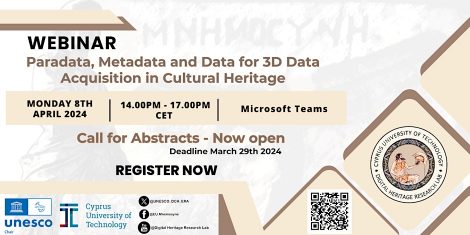
This webinar in two parts brought together professionals from the spectrum of Digital Cultural Heritage practice to share their experiences of using and working with paradata seeking to lay down a common understanding of paradata as a first step towards a community-built set of standards and expectations for its application to 3D documentation and the creation of knowledge.
- Part 1 was held on 8/4/2024 => RECORDING HERE and see also below
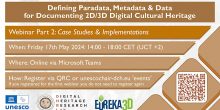
- Part 2 is held on 17/5/2024 => MORE INFORMATION HERE
Organized by UNESCO Chair on Digital Cultural Heritage at Cyprus University of Technology in collaboration with EUreka3D, this webinar discusses the most advanced requirements and cases of the use of Paradata and Metadata in the digital documentation of the Past in 3D, for enriching 3D assets, creating knowledge and promoting reusability.
The webinar is addressed to the Digital Cultural Heritage community to establish a definitive description and differentiation of what paradata and metadata are, and the benefits they are bringing to the stakeholders, owners, multidisciplinary community and digital scholarship, as well as to the European Commission.
Agenda – Please note times are in CET
- 13:30-14:00 Join the session using your MS Teams Link
- 14:00-14:10 Harry Verwayen, Europeana Foundation. NL – Opening remarks
- 14:10-14:20 Marinos Ioannides, et al UNESCO Chair on DCH at Cyprus University of Technology. CY – Paradata, Metadata & Data for a digital #MemoryTwin
- 14:20-14:35 Isto Huvila Invited KEYNOTE Uppsala University. SE – Datafication of archaeological archiving and the preservation of what?
- 14:35-14:50 Luisa Ammirati, et al UNOSAT/UNITAR. CH, UNESCO WHC, FR – Paradata and metadata in an immersive digital heritage experience
- 14:50-15:05 Erik Champion University of South Australia. AU – Usable, Useful, Reviewable and Reusable Metadata
- 15:05-15:20 Carla Schroer, et al Cultural Heritage Imaging (CHI). US – Building Reliable and Reusable Complex Digital Representations: The Digital Lab Notebook
- 15:20-15:35 Daniel Pletinckx Visual Dimension bvba. BE – 3D Heritage is Heritage, we should treat it as such
- 15.35-15:50 Tony Cassar, et al Heritage Malta. MT – Challenges of 3D Digitisation of Cultural Heritage
- 15:50-16:05 Shuyi Yin, et al Columbia University. US – Blockchain Technology for Enhanced Documentation and Management of Built Heritage in Historic Cities
- 16:20-16:35 Jean-Baptiste Barreau Archéologie des Amériques (ArchAm), CNRS. FR – Three-Dimensional Reconstruction of an Egyptian Saqiya: A Computational Approach to Preserving Cultural Heritage and Water Management Systems
- 16:35-16:50 Antoine Isaac, et al Europeana Foundation. NL – Making the Europeana Data Model a better fit for documentation of 3D objects
- 16:50-17:05 Raffaella Brumana, et al Politecnico di Milano. IT – HBIM quality information model to manage surveying, stratigraphic units and transformations into paradata. The mausoleum of Cecilia Metella and the Castrum Caetani
- 17:05-17:30 Discussion Session & Closing Remarks
Due to overwhelming response at the Call for Papers, with 52 abstracts submitted and over 552 colleagues registered (from 77 countries, highlighted in the chart below), the Organizing Committee has decided to extend this event into a series. Our initial event will still take place on April 8th, 2024, followed by a second event on Friday, May 17th (one day prior to the dedicated ICOM International Museum Day on May 18th, 2024, which is devoted this year to Education and Research to foster Knowledge in Museums).
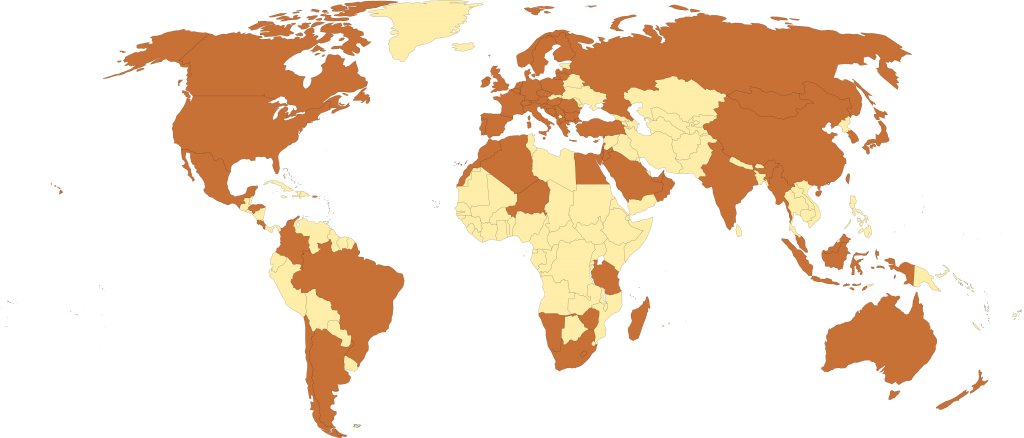
Paradata, Metadata and Data webinar – registrations, geographic provenance