


Demonstration of St. Neophytos Case Study Results

Share

Image courtesy of CUT – Cyprus University of Technology

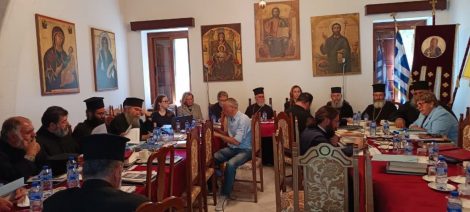
Following the public demonstration of the EUreka3D-XR project’s Virtual and Mixed Reality tools and digital cultural heritage asset reuse held at the Monastery of St. Neophytos, Talla, Cyprus, we were delighted to be invited back by the Archimandrite just 12 days later to demonstrate the interactive exhibit once again.

As part of the 21st Meeting of the Pilgrimage Tours Office of the Church of Cyprus involving the Holy Synod of the Church of Cyprus, representatives from the Deputy Ministry of Tourism, the Pilgrimage Tours Office of the Church of Cyprus and the Paphos Development Organisation, members of the Digital Cultural Heritage Research Centre MNEMOSYNE were invited to participate presenting the results of the Cyprus case study developed in collaboration with MIRALab, Switzerland as part of the EUreka3D-XR project, outlaying the potential benefits of capitalising on digital assets and tools for visitor engagement and valorisation of heritage. Attendees were also able to experience both installations in the Enkleistra itself and discuss technical possibilities for using innovative visitor experiences in their own contexts. Additionally, a small number of tourists visiting the monastery were able to use the two implementations and provide their thoughts directly to the delegates.

The monastery is currently investigating how the two applications can be integrated into the monastery’s museum on a permanent basis to enhance visitor experience and increase their touristic offering as part of a wider initiative to adopt new technologies within religious cultural tourism on the Paphos region.

Original post by CUT: https://digitalheritagelab.eu/second-demonstration-of-eureka3d-xr-st-neophytos-case-study-results-requested-by-archimandrite


Leave a Reply


Related Articles

Explore all objects published on Europeana ingested through EUreka3D-XR
Starting today, it is possible to explore every single object that has been ingested on Europeana through EUreka3D-XR project. Produced by project coordinator Photoconsortium, two new galleries are now available on Europeana: one where all the 3D digitised, reconstructed and produced within EUreka3D-XR are grouped together, and a second one that focuses specifically on the work done in collaboration between EUreka3D and Twin it! (June 2023 – June 2024). Explore the galleries: All ...
Welcome Back to EUrope - #CultureForEurope and #EuropeForCulture in real action
The first #3D #CulturalHeritage object #3DforCulture harvested by Europeana.eu in the post- #BREXIT era from the UK, is now a reality. https://unescochair-dch.net/Guildhall_Great_Hall We are proud to celebrate a landmark achievement for European #DigitalCultural heritage, #CulturalDiplomacy and international collaboration. The magnificent Great Hall of the City of London Guildhall, London City of London Corporation: City View has become the first #3D #CulturalHeritage asset from the...
3D, copyright and the public domain
A digitised 3D model is often seen as the end result of a digitisation project. But what happens next? Can you publish the model online? Can someone else use it in an XR application, educational game or virtual exhibition? And does creating a 3D model automatically create a new copyright? These were some of the central questions addressed by Ariadna Matas from Europeana Foundation during the second session of the Lifecycle of 3D Data in Cultural Heritage webinar series, organised by EUreka3D-...
3D Digitisation Guidelines translated into multiple languages by EUreka3D-XR
3D Digitisation Guidelines: Steps to Success was designed and produced within the  to help anyone on their 3D digitisation journey. It is specifically aimed at Cultural Heritage professionals who are considering, or in the middle of, digitising their cultural heritage collections using three dimensional models. It outlines and simplifies the recommended standards highlighted in the EU VIGIE Study 2020/654 (Study on quality in 3D digitisation of tangible cultural heritage, published April 202...