|
Digital meets Culture https://www.digitalmeetsculture.net/article/3d-copyright-and-the-public-domain/ Export date: Sun Sep 20 23:57:50 2026 / +0000 GMT |
3D, copyright and the public domain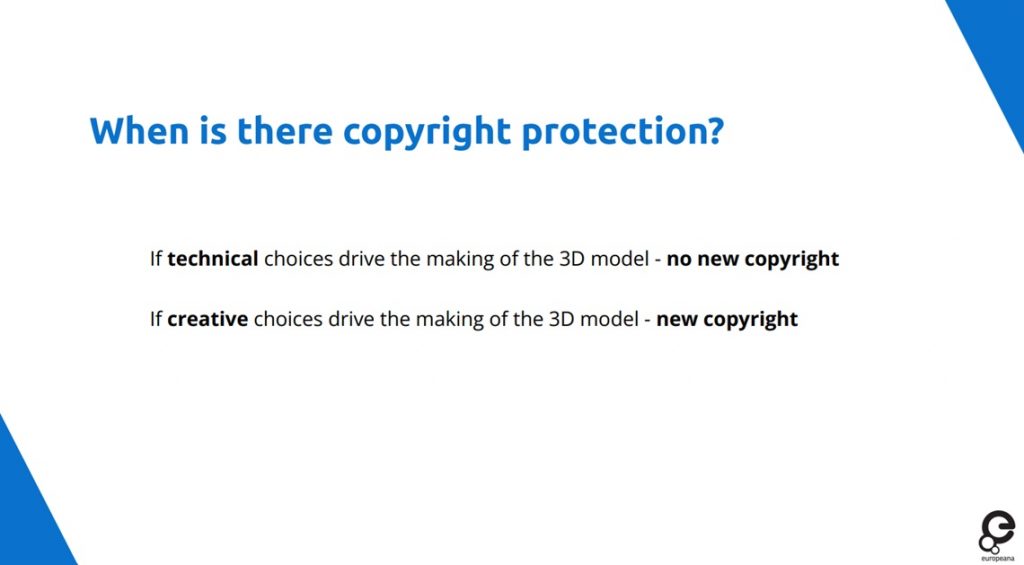 A digitised 3D model is often seen as the end result of a digitisation project. But what happens next? Can you publish the model online? Can someone else use it in an XR application, educational game or virtual exhibition? And does creating a 3D model automatically create a new copyright? These were some of the central questions addressed by Ariadna Matas from Europeana Foundation during the second session of the Lifecycle of 3D Data in Cultural Heritage webinar series, organised by EUreka3D-XR. If you work with 3D cultural heritage data or you would like to reuse existing 3D models, the recording is well worth watching, and a summary is provided below. → Watch the webinar recordings and download the presentations from the two sessions here: https://eureka3d.eu/lifecycle-3d-webinars/ 3D digitisationOne of the key messages of the presentation is that digitising an object in 3D does not automatically create new rights. Whether a 3D model is protected by copyright depends on the level of originality involved in its creation. If the purpose of the digitisation is to produce a faithful, technically accurate representation of an object or monument, there may be little room for the creative choices that copyright law generally requires. This distinction is particularly important for cultural heritage institutions that wish to make their collections openly reusable. Europeana's recent research into rights management for 3D models even suggests that many copyright claims currently attached to 3D models may not be legally justified. → 3D Models and Rights Management Report: https://pro.europeana.eu/post/3d-models-and-rights-management-report Rights managementAnother important takeaway is that copyright status and rights statements are not the same thing. Before digitising, publishing or reusing a 3D model, institutions should carefully determine:
Choosing the correct rights statement is essential for enabling lawful reuse, whether for research, education, tourism or innovative applications such as Extended Reality (XR). To support this process, Europeana has developed a Rights Labelling Flowchart, which Ariadna presented in her presentation and that helps institutions determine the most appropriate rights statement. → Download the chart here (PDF) Practical questions from the audienceOne of the strengths of the webinar was the lively discussion with the online participants. The questions reflected many of the real-world challenges faced by cultural heritage institutions today:
Rather than offering one-size-fits-all answers, Ariadna emphasised that copyright assessment should become part of the planning process of every digitisation project. Clear documentation, good rights management and transparent licensing not only reduce legal uncertainty but also maximise the value and reuse potential of digital heritage collections. Continue learningIf this webinar sparked your interest, you can dive deeper into the topic through the self-paced Europeana Academy course “How to select an accurate rights statement”, also developed by Ariadna Matas. The course explores the topic of rights statements in much greater depth, using practical examples specifically aimed at cultural heritage professionals. → You can find the course here: https://europeana.moocit.fr/courses/course-v1:europeana+ELF03+2023_Q2/about  This guide has been created within the framework of EUreka3D - an EU project co-funded by the European Union (grant no. 101100685). This guide has been created within the framework of EUreka3D - an EU project co-funded by the European Union (grant no. 101100685).
|
